

Seventeen years after Pagano, Panetta and Zingales's founding article on why companies go public (see Pagano & al., 1998), the motivations underlying the choice of going public are still quite scarcely explored. Yet in today's equity capital markets context, characterized among other things by a strong internationalization of capital flows, enhanced regulatory complexity and higher volatility (as proven by the recent Chinese equity market rout in August 2015 and countless other episodes), companies should consider the choice of going public even more carefully.
This recommendation applies especially to cross-border IPOs, defined by Price Waterhouse Coopers as “an IPO where 50% or more of the proceeds are raised on a non-domestic exchange”, which have been gaining traction in recent years. Just in 2014, the biggest year for IPOs since 2010, 851 listings worldwide accounted for USD 256.6b of proceeds. 11% of these IPOs were cross-border IPOs, up 2% year-on-year, with mainland China being the world's biggest issuer of cross-border IPOs (21% of total global cross-border IPOs in value and 16% by deal number in FY 2014).
This article aims at analyzing the reasons underlying a company's decision to go public on one single stock exchange abroad. It will focus on companies from mainland China which decided to go public for the first time on two major American stock exchanges, i.e. NYSE and NASDAQ, from January 1st 2010 to July 31st 2015 inclusive.
The motivations underlying cross-border IPOs vs. domestic IPOs: a comparative literature review
As a starting point we analyzed the preexisting literature on both financial and non-financial motivations for IPOs. We started with the reasons underpinning domestic IPOs, then compared them with the motivations underlying cross-border IPOs.
Regarding domestic IPOs, the primary listing reason cited by most scholars and finance practitioners is the possibility for a company to access a deeper and more liquid source of capital than before the IPO. Domestic IPOs are also undertaken due to the growth prospects enabled by the IPO decision (see Rydqvist and Högholm, 1995), along with the perspective of optimizing the firm's capital structure and/or to use the newly listed company's stock to merge with other companies. Implicitly, all of this means that domestic IPOs are often undertaken for the purpose of achieving a more accurate valuation, as Mello and Parsons (1998) have pointed out. IPOs are also a “liquidity event”, which for private-equity backed companies means that the preexisting owners will try to maximize the exit value of their investment.
Besides firms also choose to go public in order to improve their bargaining power with banks and lower their credit cost.
A fair share of academic research has also proven that listees often ponder the IPO decision in an opportunistic – albeit not always rational – way, by timing their IPO according to the market and to other firms' capital market strategy. Jay Ritter was the first to ever highlight this phenomenon for domestic IPOs in 1991, when he explained that stock issuance by corporates is positively correlated with the level of stock prices.
Finally certain non-financial factors can also influence the IPO decision, namely the quest for publicity and the motivation of human resources by aligning a part of their compensation to the firm's newly issued stock.
As concerns the motivations for cross-border IPOs, the literature is far less profuse. While cross-border IPOs are primarily motivated by liquidity and by the possibility to list alongside comparable peers, they are also triggered by an investor protection law arbitrage. The so-called “finance and law” literature has indeed demonstrated that cross-country differences in IPO levels are explained by differences in investor protection law.
Another motivation for cross-border IPOs, which is often mentioned by practitioners, is listing on an international exchange that comprises more specialized financial analysts and investors and/or more systematic stock coverage than on a domestic exchange.
A profitable “liquidity event”
Like domestic IPOs, the cross-border ones can also be a profitable “liquidity event” for the preexisting owners, who consider that listing the firm abroad can maximize the firm's value as opposed to a domestic listing. Furthermore, cross-border IPOs seize “windows of opportunity” to list abroad. Ndubizu (2006) found that cross-border issuers are particularly incited “to manage earnings, list in a window of opportunity, and maximize share prices and cash infusion by seeking higher levels of investor recognition at listing”.
Regarding the IPOs' impact on corporate financial structure, Doidge, Karolyi and Stulz (2013) clearly mention cross-country IPOs not only as an occasion for a company to achieve a more balanced capital structure, but also and foremost an opportunity to lower its cost of debt.
On the other hand, we found that resorting to cross-border IPOs as a means to obtain more liquid currency for future M&A transactions is not common.
A need for prestige and publicity
As regards non-financial reasons, cross-border IPOs are also triggered by a need for prestige and publicity. Some companies may choose to list in a particular location because they want to enhance or leverage their brand image in that location: such is the case for the French high-end cosmetics maison L'Occitane, listed in Hong Kong in April 2010. Listing on a world-renowned exchange is also a token of quality for investors and can help recruiting and retaining talents by indexing a part of their compensation on the company's newly issued stock.
Finally certain IPOs take place abroad to dodge the complexity or lengthiness of domestic legal procedures. As pointed out by a PWC Equity sans Frontières study, this applies especially to “Chinese companies looking to raise equity capital”, given that until lately “Chinese equity markets have been almost exclusively reserved to companies owned [entirely or in majority] by the Chinese government”.
When comparing the set of financial motivations for domestic IPOs as opposed to cross-border IPOs, firstly we notice the relative scarcity of academic literature concentrating solely on cross-border IPOs, as opposed to domestic IPOs and cross-listings. Secondly we find out that both categories of IPOs are motivated by similar financial goals, namely a quest for liquidity, access to capital and taking advantage of windows of opportunity. Both regular and overseas IPO are considered as a liquidity event, and both are triggered by common operational factors, i.e. the need for visibility and for a more attractive recruitment policy.
However, while both domestic and international IPOs are carried out to achieve more precise and/or more favorable valuation, cross-border IPOs are also motivated by the company's willingness to be covered by specialized financial analysts, to be in contact with more sophisticated and specialized investors and finally to be listed along comparable companies. There also exists little to no research on the relationship between a firm's growth path and its decision to IPO abroad, not to mention that post cross-border IPO capital structure and changes in bank relationship(s) are not accounted for. Cross-border IPOs also seem significantly influenced by investor protection and legal concerns: domestic issuers are willing to list abroad if they find more favorable laws and investor protection regimes than in their home country.
Based on the existing literature, cross-border IPOs also appear to be slightly more influenced by nonfinancial motivations, namely the need for international visibility and prestige; taking advantage of better investor protection and market infrastructure than in a domestic market; and attracting talent - perhaps at a more international and more qualitative level.
Hypothesis
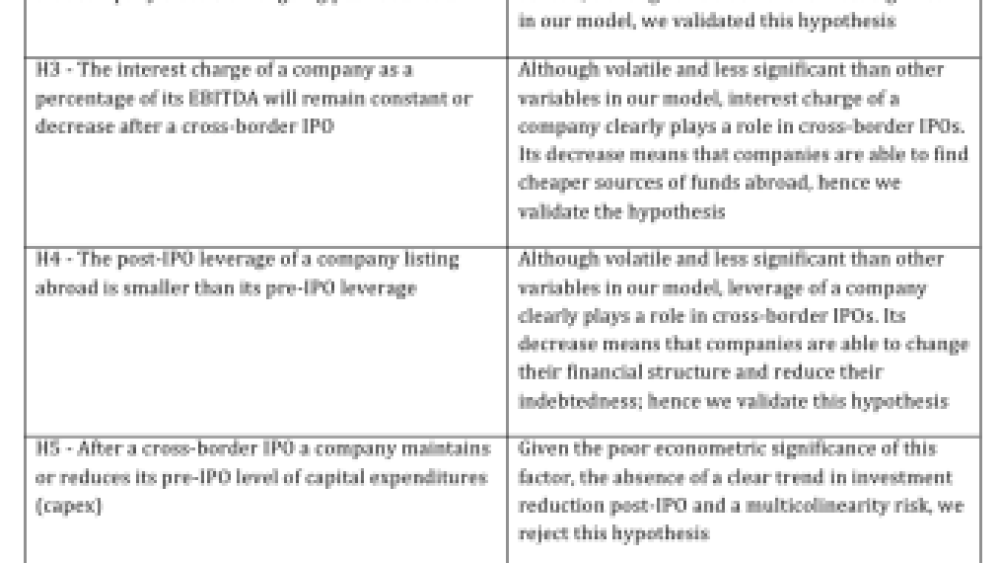
Based on the existing literature we endeavored to verify and complete the IPO motivations by formulating a set of 7 pre cross-border IPO hypothesis (6 on financial factors and 1 on non-financial factors). Then we will check if the post IPO consequences square with the pre IPO anticipations – which would imply that the motivations that led the firm to go public are rational and justified – and verify or invalidate the hypothesis at the end of this paper.
1. Size as a token of “firm maturity” and readiness to IPO
Although the existing literature on the correlation between company size and domestic IPOs is abundant, no such study exists for cross-border IPOs. We take notice of this void in literature and we assume that size – defined as the total consolidated revenue generated by a company – positively influences a company's decision to list abroad.
2. Profitability as a token of “firm maturity” and earnings management
Given that only companies that have been earning enough profits can undertake an IPO - whether cross-border or domestic - we assume that profitability is a key factor in determining a company's cross-border IPO decision and it is worth investigating. We also presume that if companies and their counsels are rational they will not undertake an IPO unless it allows the firm to keep growing and at least maintaining its margins despite the disclosure of insider information. Hence we hypothesize that a company's return on assets (ROA, defined as EBITDA divided by total assets) was positive before the IPO and that it increases post IPO.
3. Corporate international exposure and the probability to IPO abroad
For the first time ever in the existing cross-border IPO literature, to the best of our knowledge, we examine the correlation between the proportion of revenue generated abroad by a firm and its decision to undertake a cross-border IPO.
For the sake of this study, we suppose that the percentage of sales that a company achieves abroad is positively and proportionally correlated with that company's decision of going public - i.e. we predict that the stronger the international proportion of sales in a company, the stronger its probability to undertake a cross-border IPO.
4. Interest/EBITDA ratio to gauge interest charge and bargaining power with banks
We assume that, with the company's financial policy remaining stable and no major acquisitions or debt restructuring underway, the interest charge of the company as a percentage of its EBITDA will remain constant or decrease after the IPO, pointing to a reduction in interest charges. We will assume that such interest charge reduction is attributable both to the fact that the company has used IPO proceeds to repay its outstanding debt and to a diversification in the company's borrowing sources and structure, allowing such company to access more favorably-priced debt.
5. Debt-to-equity ratio
In line with existing literature on the negative correlation between an IPO decision and a company's financial structure and leverage – expressed as the quantity of debt compared to the equity –, we hypothesize that the post-IPO leverage of a company listing abroad is equal or smaller than its pre-IPO leverage.
6. Investments and financial policy
Similarly to academic literature findings for several European and global IPOs, stating that IPOs allow companies to re-equilibrate their financial structure and their investments after a period of significant investments, we believe that after a cross-border IPO a company maintains or reduces its pre-IPO level of capital expenditures (Capex).
7. Visibility and brand image
In the wake of the relevant academic literature and the common sense assumption that when a company goes public it will be more visible than when it was private, we hypothesize that a company will gain visibility to the general public after it undertakes a cross-border IPO. In doing so we assume that corporate visibility is mainly driven by both its general and specialized media coverage, since the media are often read by the financial community and by common citizens.
Methodology: A normative approach
The present work focuses on a group of mid- and small- capitalization Chinese firms that listed in the USA from January 1st 2010 to July 31st 2015 – the only large capitalization in the sample being Alibaba, which filed a USD 21b IPO. We chose to focus on US-bound Chinese IPOs since they have been the most significant cross-border IPO flows both in volume and in value in the past decade.
The company sample has been selected, then the related pre- and post- IPO data have been collected and analyzed through econometric and statistical tools, namely a series of multiple linear regressions on SPSS 22. Such data and matching results will be analyzed and interpreted later in order to individually validate (or invalidate) all of the initial hypothesis.
In order to study this phenomenon the present study adopts a normative approach and formulates a limited number of precise, ex ante hypothesis on both the financial and non-financial factors that trigger cross-border IPOs. The study then analyzes empirical, historical data in order to validate or invalidate each and every one of the previously formulated hypothesis, then interprets the data analysis results and draws the matching conclusions.
Data source and sample characteristics
Most of our starting data is recent (5 calendar years or less) secondary data coming both from financial market data providers and from the companies studied in this report, which was then assembled and cleaned by the author. Pre-IPO company data comes from both Thomson Reuters Eikon, corporate IPO prospectuses which were available on the EDGAR (Electronic Data Gathering, Analysis and Retrieval system)database of the Securities and Exchange Commission (SEC) and from Bloomberg. Post-IPO data comes from the company's IPO prospectus and the SEC's EDGAR tool. Industry data, IPO trends data and cross-border IPO data comes from Thomson Reuters Eikon, specialized equity capital market reports, the World Bank's Worldwide Governance Indicators database as well as specialized and general press.
In this paper quantitative data is completed by qualitative data, namely two interviews with cross-border IPO pundits and banking executives, whose name will not be disclosed but whom the author thanks heartily.
The sample analyzed entails 46 companies: all are incorporated in mainland China but 40 out of 46 are listed through a Cayman- or British Virgin Islands-incorporated holding company or Special Purpose Vehicle (SPV. 65% of our companies are listed on the NYSE and the remaining 35%, composed mainly of Software companies, on NASDAQ).
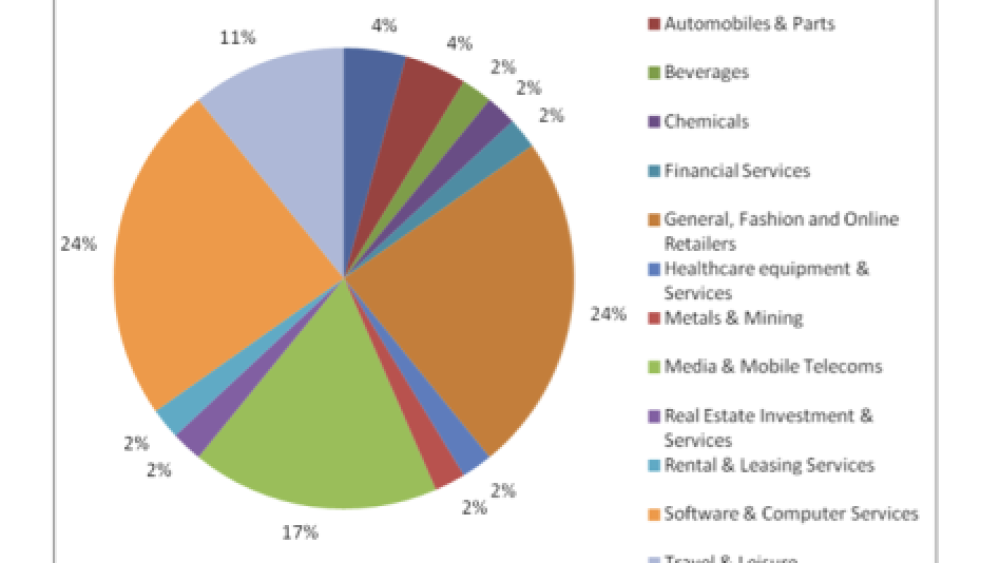
Most companies in our sample are General, Fashion and Online Retailers (see graph n. 2 p. 24: 24% of the sample i.e. 11 companies of which 1 Fashion Retailer and 1 e-commerce conglomerate), generally with some international exposure, and Software and Computer Services companies (also 24%). The Media & Mobile Telecommunications and the Travel and Leisure Goods sectors are also well represented (respectively 17% and 11%). Although several large Chinese cross-border IPOs this year were from financial services companies, this category of company appears almost insignificant in our sample but also among the presently listed Chinese ADRs, which is probably due to regulatory reasons as well as capital and banking license restriction measures (cf Graph. 1).
Results
When running a multiple linear regression on our overall cross-border IPO sample both pre- and post-IPO we assume that IPO proceeds (dependent variable) are influenced by 7 main factors (independent variables) which we formalize as follows:
P(IPOt=1)= β1SIZEt-1+β2ROAt-1+β3INTL SALESt-1+β4 INTERESTt-1+β5LEVERAGEt-1+β6CAPEXt-1+β7VISIBILITYt-1
First of all when looking at our pre-IPO descriptive statistics we can see that the average IPO proceeds of our sample are USD 617m and that the company size is USD 571 m - in other words, sample companies raise 1.08 the amount of their pre-IPO sales. However we must bear in mind that these numbers are biased by Alibaba; without its figures, both average IPO proceeds and company size could have been around 20% lower. The international sales coefficient also averages 4.35% of total company sales whereas the average interest charge ratio and leverage were respectively 25.75% and 20.73%, implying that interest charge is quite significant and certainly more significant than debt. With acceptable profitability around 10.8%, capex around 30 million per year and corporate visibility of around 34 news count per year, the pre-IPO sample seems quite coherent and standard.
Compared to these metrics, the post-IPO sample shows stronger size of 898.6 m, which appears to coincide with our hypothesis. As per our international sales hypothesis, international sales post IPO are on average higher than pre-IPO international sales, at 6%. Leverage and interest ratios are also significantly lower on average, 11% and 13.5% respectively, whereas visibility is on average four times as big as before the IPO. The two metrics that react paradoxically are average ROA, which is slightly lower (7.9%) than before the cross-border IPO, and capital expenditure that seems to double to USD61m after the IPO. Regarding the ROA variable this suggests that the average company in the sample has timed its IPO by going public when its earnings were the most favorable. Of course this needs verification on a longer period of time after the IPO, but we believe that it is a plausible hypothesis. Regarding the dramatic increase of Capex, the fact that some companies want to go public in order to carry out massive investments may be the most coherent explanation. However this would contradict our hypothesis that companies go public overseas to normalize their Capex after a heavy investment period, thus suggesting that these companies go public abroad to fund investments because they cannot fund them through internally-generated cash or external finance in their domestic country.
Before comparing pre- and post-IPO regression results first of all we check and obtain confirmation that no variable was excluded from our model; that our independent variables do not present any co linearity issue; and that the variables in the model are significant at p < 0.001.
We also successfully ascertained that both data sets are significant and relevant through the Fischer test by ensuring that our model has an actual, reliable predictive power, and by checking that there is no autocorrelation between the model's residuals through the Durbin-Watson test (respectively 2.406 for the pre-IPO dataset and 1.961 for the post-IPO dataset, which is very satisfactory).
Our final findings read as shown in Table 1.
Conclusion
Our research findings allow us to affirm that the motivations underlying cross-border IPO - notably Chinese cross-border IPOs in the United States - are primarily driven by visibility and by financial factors. Cross-border IPOs, like domestic IPOs, are motivated by company size, but they are also motivated by different factors such as the quest for visibility and the company's preexisting international exposure. Much like what Pagano et l. (1998) found out for domestic IPOs, cross-border IPOs are also motivated by a desire to deleverage the company and find cheaper financing – thus implying a better bargaining power with the banks and the financers –, at least in the short term.
For cross-border IPOs we also observe that, unlike what Pagano et al. (1998) pointed out, firms do not go public because they want to rebalance their financial structure after a period of intense investments. In fact they do quite the opposite: they explicitly say they are going public because they want to fund investments, probably because in China they cannot find adequate financing sources due to the lack of sophisticated investors (let us recall that Chinese stock exchanges are dominated by retail investors).
Finally a company's profitability appears not to be a major determinant of its decision to go public abroad. However lower post-IPO ROA compared to pre-IPO ROA points to, and confirms, a “window of opportunity” motivation for cross-border IPOs, similarly to what academia avers for domestic IPOs.
Our research opens up a number of questions, still unexplored or unexplorable as of today, such as finding a more precise modelization of cross-country legal and institutional differences and whether cross-border IPOs actually create financial value ex post.
When pondering our research results, discussing with capital market professionals and reading material on cross-border IPOs, one can consider a few potential, near-term evolutions in international capital markets and IPO trends. These include the rise of a “delisting” trend on behalf of these internationally-listed companies; more intense competition not only between global stock exchanges, but also among regional stock exchanges; decreasing developed countries cross-border IPO; and a shift from “developing-to-developed” equity capital flows to “developed-to-developing” equity capital flows.
All of the above mentioned elements suggest that, although international capital markets are booming and there has never been any better time to go public overseas, undertaking a cross-border IPO (or any IPO for that matter) still remains a serious decision that must be motivated by true financial and operational motives rather than by the impulsive decision to follow one's peers.