
Once upon a time, collateral management was considered a marginal activity, a nice-to-have capability regarded as a value-added activity, an extra. In just a few years, everything has changed. Collateral management is now a key priority for both financial and non-financial institutions and has shifted from a back-office discussion to debates at board level across the world. Today, however, many organisations are not sufficiently equipped with the technical systems necessary to carry out sophisticated collateral management; the industry faces enormous challenges but solutions are available.
Focus on risk
What lies behind this significant change in market behaviour? Certainly, politicians and regulators were quick to demand changes to banking procedures after the financial crisis broke out in 2008. Everyone’s focus turned towards risk management and a new wave of regulations were drafted to ensure financial institutions would be required to commit an even greater quantity of collateral to cover their exposures.
In consequence, the industry faces a huge shortfall of liquidity – in fact, the Quantitative Impact Study of the Basel Committee on Banking Supervision (December 2010) published an estimation from a comprehensive sample of banks worldwide that they would need an additional EUR 2.89 trillion of stable funding in order to fulfil the additional liquidity requirements of Basel III. It is clear to see the scale of the problem if this figure is extrapolated globally.
The Capital Requirements Directive (CRD) IV and the European Market Infrastructure Regulation (EMIR) in Europe, plus the Dodd-Frank Act in the US, will all increase the pressure especially with the demand that all OTC derivatives transactions are also fully collateralised. Unsurprisingly, this situation is beginning to cause concern. Banks need much more capital to collateralize their exposures at a time when the market is still beset by an underlying lack of trust: unsecured interbank lending has almost disappeared. Creative cash injections triggered by the central banks move straight back into the central bank accounts of the financial institutions irrespective of any commercial considerations.
High cost of inefficiency
A major problem for most institutions is that they do not have adequate systems in place to manage their liquidity and available collateral on a real-time and cross-market basis. Complex corporate architecture and international reach mean that the majority of institutions are unable to have a global view across all their positions and collateral pools from a single point. And even if some institutions have a single view, they lack the ability to move collateral from one location to another on a real-time basis and are unable to allow for intraday optimisation between different collateral locations.
The cost of this fragmentation is high. According to a study Clearstream commissioned from Accenture in 2011 (see also Accenture’s article), inefficient collateral management is costing the industry more than EUR 4 billion a year. The study of 16 global banks found that some 10 to 15% of available collateral is left unused internally within banks because of fragmentation and lack of adequate collateral management systems. And this estimate is based on the current situations; the cost of inefficiency can only increase when EMIR/Dodd-Frank come into force in 2013 and the markets feel the full impact.
The banks studied by Accenture together hold assets of around EUR 14 trillion and come from the investment and universal banking sectors. Between them they employ a variety of approaches to collateral management, have different business models and geographical distribution and yet all appeared to suffer from similar collateral management deficiencies.
Certainly, many institutions are turning a blind eye; the Accenture study demonstrated that the banks involved in the research are aware their collateral management is inadequate. All those featured acknowledge they suffer losses owing to an inability to consolidate their collateral pools and most confirm that internal fragmentation (collateral held within an institution) is much more extensive than external fragmentation, where collateral is held at different liquidity guardians around the world. Not having an overview of the collateral means many banks are unable to deliver the most appropriate – that is, the cheapest possible – collateral to each liquidity or funding point. This means they tend to chronically over-collateralise by placing higher quality or higher value collateral where it is not needed.
Staying secure with triparty repo
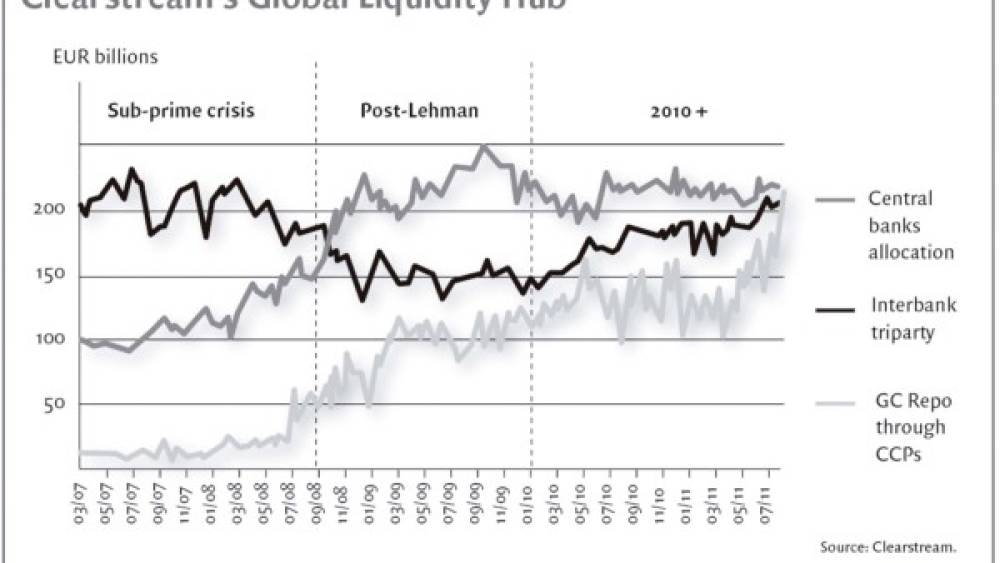
Clearstream took the decision some years ago to invest in developing its collateral management, securities lending and triparty services and to integrate them in a comprehensive and flexible Global Liquidity and Risk Management Hub. In the midst of the crisis, the Hub proved to be a lifeline to many market players, especially those seeking interbank lending.
In the wake of the sub-prime crisis, Clearstream saw a significant decline in triparty repo volumes but these stabilized following the fall of Lehman Brothers. Since then Clearstream has again seen a steady increase in customers using pure triparty repo (bilateral transactions) but there has also been a substantial surge of business in triparty repo with central counterparties such as Eurex Clearing and LCH.Clearnet Ltd. The business with Eurex Clearing only accounts for around a third of the EUR 650 billion outstanding in the Global Liquidity Hub.
Clearstream (or Cedel, as it was then) was the first to offer triparty repo services in Europe back in 1992 and now delivers these award-winning services around the world. It has the advantage of being a truly international and neutral supplier with a wide range of triparty options within the Global Liquidity Hub that enable customers to manage their portfolio out of a consolidated and complete environment ensuring highest reliability, transparency in reporting and cost-effectiveness.
Outsourced collateral management
The widespread industry need for good collateral management systems has made collateral management the key purchasing factor when financial institutions choose their securities services supplier. This explains the very positive market response from CCPs, CSDs, exchanges and central banks to Clearstream’s outsourced (white-labelled) collateral management services. Liquidity Hub GO (Global Outsourcing), a new dimension to the Global Liquidity Hub, was rolled out with Brazilian CSD CETIP in July 2011. It is an efficient (time-to-market) and cost-effective solution that took just a year from inception to delivery. Cetip’s IT systems connect directly with Clearstream’s collateral management engine which takes care of all the calculations (collateral allocation, collateral optimization and collateral substitutions) while Cetip and its customer base gains the benefits of collateral management. The fact that all the underlying assets remain in Brazil – as necessary under Brazilian law – is a pioneering model that has raised significant interest from further infrastructure providers across the globe. What makes this unique service eligible for global partners is the fact that it operates on a 24/7/360 basis which makes it a real cross-time-zone solution.
Right now, Clearstream is preparing for Phase II of the Liquidity Hub GO initiative which will enable domestic financial institutions (e.g. Brazilian banks) to not only access domestic (Brazilian) collateral held at the domestic CSD (Cetip) to cover market exposures, but will also allow access to international collateral (for example, eurobonds) held at Clearstream on an optimised basis, that is the cheapest to collateral from both collateral pools.
Clearstream is now in talks with a number of infrastructures worldwide, including the Australian Securities Exchange, with a view to partnering on future developments of Liquidity Hub GO. For many infrastructure providers and financial institutions, the race is now on to gain collateral management solutions before the industry is confronted with the full impact of the coming regulations.