


When it comes to company valuation, multiples are employed extensively, most probably for the simplicity of the concept. Calculating the ratio between the current (market) value of the company, and a specific yearly indicator (e.g. the Net earnings, the Ebit or the Sales), or extracting this ratio from a database, can lead to a quick and almost effortless company valuation. However, behind the apparent simplicity, practitioners have to make many methodological choices. For some professionals, multiple valuation is even viewed as a form of “art”, where they tend to trust more their experience and intuition. This is why academics have recently tried to close the gap between theory and practice, in order to provide users with generalized techniques and insights to enhance the results and avoid common pitfalls.
In this article, we build on the current knowledge about multiples to focus on the airline industry and test alternative measures in company valuation. Indeed, airlines are quite an unusual case in the global economy. Despite the fact that air carriers appeared in the 1920s, the environment was extremely regulated until the 1980s in the United States and the 1990s in Europe, which means that true competition did not really exist. But liberalization changed the competitive landscape substantially and facilitated the entrance of low-cost airlines that eroded the leadership of full-service carriers based on hub-and-spoke models. However, in more recent times, the relevance of both business models has been questioned as a result of the challenges that airlines are facing. Therefore, our aim is to assess the performance of multiple valuation in today’s airline sector, with a particular focus on low-cost and network carriers.
In the airline industry, the rise of two main business models
For the major part of the 1960s and 1970s, airlines experienced a constant rise in passengers, mostly fuelled by technology, namely long-haul widebody aircraft and pressurized cabins. At this time, governments regulated air traffic and generally controlled one airline, the so-called flag carrier. In this context, international traffic was driven by bilateral agreements in which both parties imposed restrictions to the airports, the frequencies and even the number of seats per plane. Starting 1978, the United States liberalized their domestic aviation market, following claims that the regulated environment was causing many inefficiencies. The European Union followed on during the 1990s, although the process was more complex given the large number of flag carriers and national interests. Eventually, deregulation had a profound impact in the evolution of the airline industry. Indeed, by being able to determine their networks, airlines would choose to develop hubs in order to maximize the density economies. Deregulation was also instrumental in the success of low-cost airlines in both transatlantic markets. In the US, Southwest Airlines initiated the low-cost model in the 1970s and their enormous success allowed them to expand gradually around their core markets. Likewise, Ryanair’s precedent in the UK-Ireland routes demonstrated that the low-cost model could also thrive in Europe and numerous low-cost entrants including EasyJet, Debonair and Virgin Express were launched in the 1990s. In fact, low-cost carriers intended to benefit from the explosive growth in passenger traffic that low prices generated in high-fare routes dominated by the flag carriers.
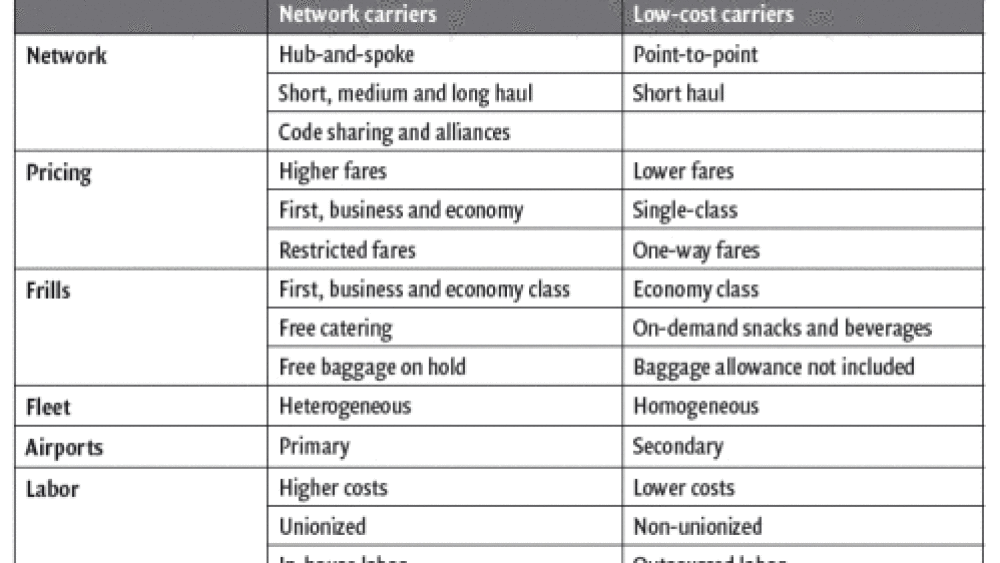
As of today, there are several business models in the airline sector: network, low-cost, charter, regional and business executive carriers (Graf, 2005). In particular, network carriers (NCs) and low-cost carriers (LCCs) have become the predominant airlines all around the globe in terms of both revenues and passengers. Table 1 shows the main difference between the two.
Finding the proper multiples for valuation
Multiple valuation is used extensively in the financial sector by investors, analysts and even journalists. For example, Pinto et al. (2015) gathered 1980 responses from CFA Institute members and found out that 93% of them used multiples. As regards the type of multiples, the best results are obtained with forward earning measures based on forecasts, as exemplified by Liu et al. (2002) or Schreiner & Spremann (2007), both for the US and Europe. The historical earnings approach is found to be less effective, followed by cash flow and book values, while sales multiples are found to be the least effective. Building on those results, we decided to test both approaches of the common practice, for which the multiples can be either trailing or forward. Trailing multiples are ratios between the current value and the last published indicator (often called historical multiples). In contrast, forward multiples are ratios between the current value and the forecasted indicator for the next period. Trailing and forward multiples are respectively identified with LTM (Last Twelve Months) and NTM (Next Twelve Months).
In general, multiples are categorized depending on the value in the numerator: enterprise value, as opposed to equity (market) value. Enterprise value measures the value of the entire firm i.e. the market value of the assets, whereas equity (or market) value measures the value of the shareholders’ stake in the company (they are also named “price multiples”). For our study, we chose value multiples from both families, as presented below with our comments regarding the specificity of the airlines sector.
Enterprise value (EV) multiples
Although straightforward (because they focus on the value of the assets i.e. the business units that deliver the operating profit), the multiples on enterprise value (EV) can be tricky to assess. Indeed, EV has to be reconstructed as a sum of the market value of the equity and a book or market value of the liabilities, depending on the availability of information. That being established, the corresponding indicators are easy to access, and they have a direct link with the operations of the company.
EV/Revenue: This multiple is defined as the ratio between enterprise value and revenues. In particular, EV/Revenue is useful because revenue is less affected by accounting standards than other value drivers. Moreover, this multiple is always positive so even unprofitable firms can be evaluated in this regard. However, unstable sales or significant differences in revenue recognition policies can limit the effectiveness of the valuation. Besides, focusing on revenue ignores the crucial role of costs in the firm, which is a key driver in the airlines industry.
EV/Ebitda: This multiple is defined as the ratio between enterprise value and earnings before interest, tax, depreciation and amortization (Ebitda). In this case, Ebitda does include costs, so the multiple is more comprehensive than the EV/Revenue. Additionally, Ebitda can be used as a proxy for cash flow, since it allows for comparisons regardless of the depreciation policies. However, Ebitda might not be informative when companies opt for leasing instead of purchasing their planes, since the related expenses would be either under operating costs (included in Ebitda) or depreciation (excluded from Ebitda).
EV/Ebit: This multiple is defined as the ratio between enterprise value and earnings before interest and taxes. Despite the fact that depreciation policies impact this measure, Ebit actually contains valuable information, as compared to the previous Ebitda multiple.
Price multiples
In contrast, price multiples tend to be used for the valuation of shares. Estimating price per share is simpler than enterprise values (EV) due to the fact that the market capitalization can be directly observed from comparable companies. However, the corresponding indicators are generally influenced by accounting policies, capital structure, diluted shares and extraordinary items, which means that price multiples have to be adjusted to account for these issues.
P/E: This multiple is defined as the ratio between the price per share and the earnings per share, or alternatively between market capitalization and net earnings. P/E is extensively used because of its combination of simplicity and informativeness. However, it is affected by numerous factors such as non-operating and extraordinary items, depreciation and amortization policies, capital structure (including excess cash) and earnings volatility.
P/B: This multiple is defined as the ratio between the price per share and the book value per share, or alternatively between market capitalization and book value of equity. P/B is particularly useful in industries that rely on tangible assets to operate or focus on return on equity such as financial institutions. However, diverse accounting policies (e.g. historical cost, depreciation, revaluation) can impact the value of the assets. From another perspective, we can also comment on the fact that the P/B is calculated with the current or forward book value of equity at a given point in time. Therefore, the concepts of LTM and NTM are not representative in this measure.
Building the proper sample
The current literature suggests several methods that range from selecting companies in the same industry, or choosing firms that are close to the target company in terms of return on equity, or size, or geography. For example, when it comes to industry or sector membership, many practitioners use the entire sector (using the S&P 500 classification or the SIC codes) to calculate their multiples, because it is a simple approach, but it has been shown that better results can be obtained by selecting five to ten really comparable companies (Cooper & Cordeiro, 2008). This leads us to question the items for comparability, in order to refine our sampling methods. Building on existing literature, we chose to use five different methods to select different samples, including business model, geography, return on equity and total assets as the main variables.
- 1. Industry (IND): All the firms in our sample in the same year except for the target firm.
- 2. Business model (BM): All the firms in our sample in the same year with the same business model except for the target firm.
- 3. Geography (GEO): All the firms in our sample in the same year in the same geographical area except for the target firm.
- 4. Return on equity (ROE): The 10 firms in our sample that are the closest to the target firm in terms of return on equity (ROE) in the same year.
- 5. Total assets (TA): The 10 firms in our sample closer to the target firm in terms of total assets in the same year.
The airlines in our dataset have been identified using the Thomson Reuters Business Classification (TRBC), which led us to select 110 listed companies. Then, we checked the country of headquarters for each airline from Thomson Reuters Eikon, in order to establish geographical zones. We have clustered the airlines in five categories: Asia-Pacific, Europe, Latin America, Middle East and Africa, and North America. Finally, we have assigned a business model to each airline, according to their websites, general perceptions and industry reports. In this context, we only distinguished between low-cost and network carriers. This means that hybrid carriers were included under LCCs whereas groups such as IAG were labeled as NCs given the weight of the network airlines within the holding. As a result, we had to eliminate 18 companies whose business is not comparable to these business models, e.g. aircraft ownership companies and helicopter operators. In the end, our sample contains 92 airlines, where 33 are identified as low-cost carriers while the other 59 are network carriers.
For each of those companies, we retrieved the following variables for 10 years (2008 to 2018), using Datastream, IBES and Worldscope: Total Assets, LTM ROE, Forward EV/Sales, Forward EV/Ebitda, Forward EV/Ebit, Forward P/E, Forward P/B, Enterprise Value, LTM Sales, LTM Ebitda, LTM Ebit, LTM P/E and P/B.
Finally, we calculated the current EV/Revenue, EV/Ebitda and EV/Ebit multiples using EV and the corresponding indicator when both numbers were available.
Average, median, harmonic mean?
Choosing the proper multiples and selecting comparable companies are the most important issues when it comes to valuation by multiples. However, there is also a methodological issue on the calculation of the averages. In general, the arithmetic mean (average) and the median are the ones which are used. The arithmetic mean is the common way to calculate an average value in a sample, but it can be influenced by the existence of extreme values in the sample. On the contrary, the median is unaffected, being the value of the company at the center of the sample. But there is a controversy on the use of more advanced indicators, such as the harmonic mean. This average, though more complex to calculate, can help solve problems of asymmetry in the sample distribution, and therefore it could lead to better (i.e. more accurate) results. As far as we know, there is conflicting evidence on the superiority of one indicator to the others, so we chose to include the three in our measures.
Our methodology, results and comments
For each company in our sample, we performed the following procedure:
- select one of the 5 methods of selection for the sample of comparable companies;
- in each of the 5 selected samples, apply the 5 valuation multiples previously presented;
- for each multiple, distinguish between the trailing (TRL), i.e. historic multiple, and the forward (FWD), i.e. forecasted estimation;
- for each multiple, calculate the mean valuation of the company in this sample, the median valuation of the company in the sample, and the harmonic mean of the valuation of the company in the sample;
- compare each average valuation (mean or median) with the current market valuation of the company;
- calculate the average error (mean or median valuation – real value) for each of the methods.
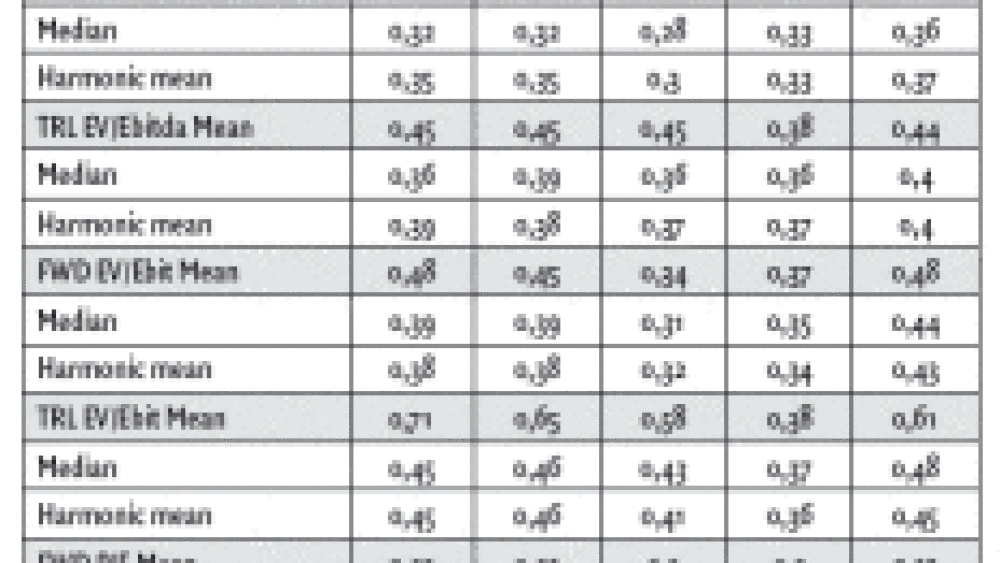
As can be seen in the table, the forward multiples (FWD) always have a lower error than the historic (trailing, TRL) multiples. In other words, using forecasted multiples helps reduce the uncertainty in valuation, as compared to historical indicators. This is in line with the previous findings in studies on the valuation by multiples, whatever the observed sector. In terms of multiples, forward P/E and forward EV/Ebitda multiples seem to have the lowest error rate. This result is somewhat puzzling, since both multiples belong to alternative families of valuation (enterprise vs. equity values) which have different limitations, as seen before. This would require additional investigations to propose a sound explanation for such a good performance of those two multiples.
As regards the modalities of sample selection, the 5 different columns do not show much differences, apart from the geographical location of the airlines: it seems that the splitting the samples by geography of the airlines might lead to better results (i.e. lower valuation errors) than, for example, considering the business model or the size of the assets.
Finally, in terms of medians or means, results are somewhat contrasted: whereas the harmonic mean helps reduce the error for EV/Ebit, P/E and P/B multiples (which conforms to previous results in research), this is not always the case for EV/ Revenue or EV/Ebitda. Once again, this would probably call for a finer combination, for example by focusing only on forward multiples, and changing the ways to select the sample of comparables. This effect will be investigated in more detail in the last part of this article.
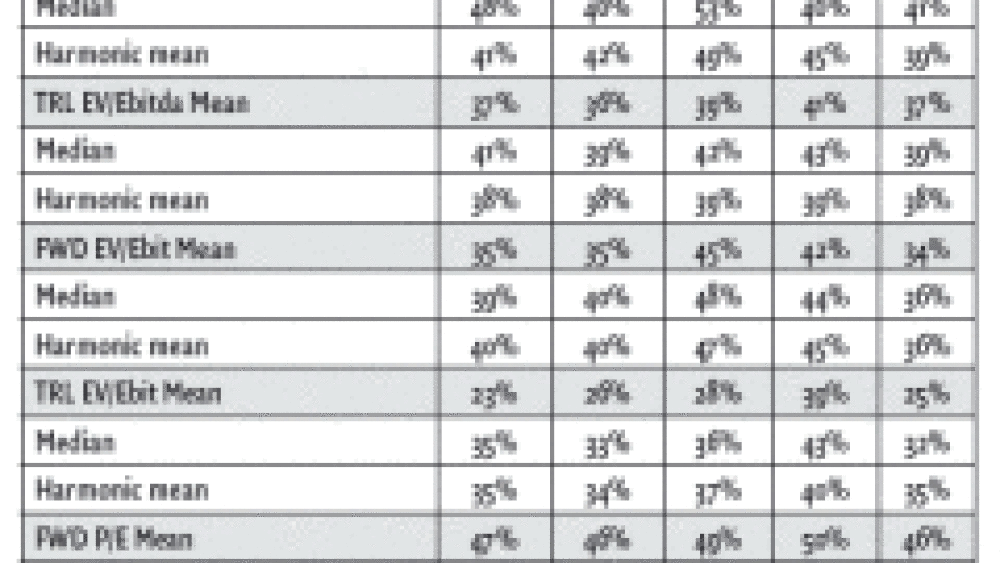
As this table of results might be difficult to read, we transformed those results in terms of probability. This is the purpose of table 3, which presents the relative occurrence of absolute errors under 30% (our arbitrary choice) for each combination. In this table, a value of 23% means that 23% of the valuations (using a multiple in a specific sample) lie under an absolute error of 30%, as compared to the current valuation.
Results are in the same line as the previous table. It appears again that all the forward multiples permit to have more accurate valuations. For example, for EV/ Ebitda valuations, we can see that 47% of the mean forward valuations lie below the 30% error threshold we have set, whereas with the trailing (i.e. historical) EV/ Ebitda valuation, there are only 37% of the mean valuations that are below a 30% error limit. This is true for all the multiples, all the measures (mean or median) and all the methods to select a sample. Building on our previous comments on P/E, we can even see that in the case of forward P/E, more than half of the valuations fall within our +/- 30% error rate, compared to the real company valuations.
Combination of different sample selections
As previously exposed, we wanted to mix the different approaches, in order to check whether combined methodologies could lead to better valuations and lower errors in estimation. Stemming from the main results of the study, we chose to focus mostly on forward multiples, and to combine the sampling methodologies. This means that we now add 4 more columns to the results: on top of the first 5 sampling methodologies (based on industry, business model, geography, return on equity and total assets), we add 4 more combinations, as described below:
- 6. Business model + Geography (BM+GEO): All the firms in our sample in the same year with the same business model and in the same geographical area except for the target firm, with a minimum of five comparables.
- 7. Business model + Return on equity (BM+ROE): The 10 firms in the same year with the same business model that are the closest to the target in terms of return on equity.
- 8. Business model + Total assets (BM+TA): The 10 firms in the same year with the same business model that are the closest to the target in terms of total assets.
- 9. Return on equity + Total assets (ROE+TA): The firms that are in the intersection of the closest firms in terms of total assets and the closest firms in terms of return on equity, in the same year, and with a minimum of 5 comparables and a maximum of 10.
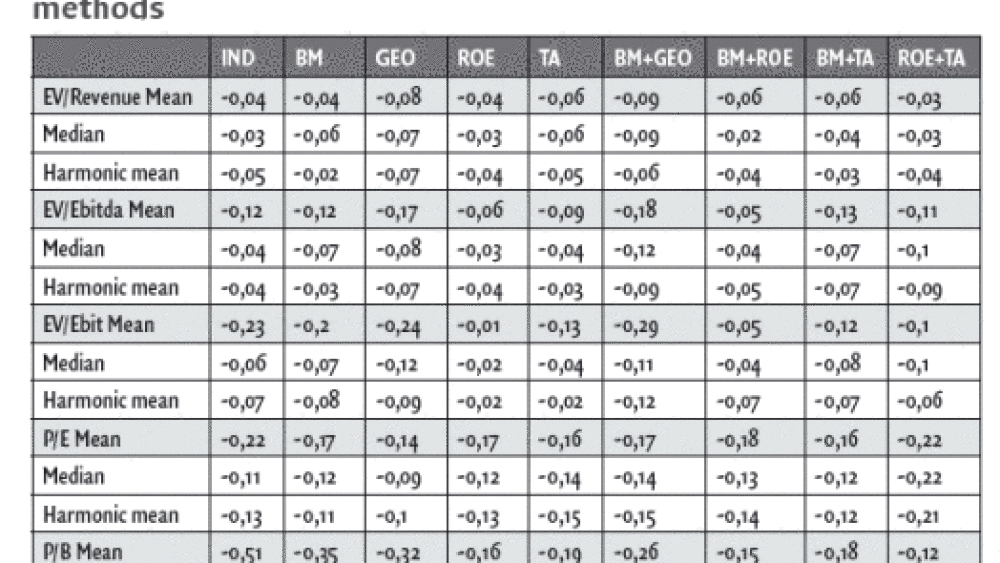
As can be seen from table 4, a sample of comparable companies that combines both the business model of the target and its geographical location (i.e. BM+GEO) obtains the highest reduction of error, as compared to historical multiples. This is valid for all the multiples (entreprise value or equity value) and for all the medians or means. All the previous tables show that the main driver of a good sample selection is the geographical location – see the results in the GEO column – but we get even better results now by adding the business model of the target.
It can be somewhat strange that the business model alone should not improve so much the evaluations. This would mean that whatever their strategy, be it network carrier or low cost, companies do not exhibit differences in the way they are valued by investors. We could attribute this result to the relative hybridization of those companies in the past years: when network carriers tend to launch low cost services, low cost companies try to offer more quality services. Today’s competition could blur out categories that used to be more clearly marked previously.