

Solvency II was finally implemented on 1st January 2016 after numerous amendments and delays. The Solvency II project has been in development for more than fifteen years with the aim of modernising the prudential regulation of insurers and reinsurers across the European Economic Area (EEA). The goal was to create a harmonised EU wide insurance regulatory regime which included more robust capital requirements, improved valuation techniques, stronger risk management and governance standards for the European insurance sector. In moving away from a simplistic Solvency I approach set up in the 70s, Solvency II carried a significantly wider remit as it sought to focus on all risks faced by an insurer. For the purpose of this article, the requirements of Solvency II are defined by the Solvency II Directive (2009/138/EC) and the Solvency II Delegated Act (EU/2015/35).
On the paper, Solvency II looks great as it intends to assess the insurers’ solvency by sticking to an economic approach. On the one hand, all the risks, mainly underwriting, pricing, investment, credit and operational, are assessed and compared with the companies’ solvency capital. This economic approach aims at ensuring that the company’s solvency reflects how the insurer is performing in its environment. In contrast, Solvency I had a prudent approach; its goal aimed at ensuring that over the cycles the insurers had enough solvency capital. Solvency I demonstrated the strong resilience of European insurance companies as reflected by their strong financial strength during the 2008-2010 financial crisis. With the exception of Aegon and Ethias, European insurers enjoyed a strong risk profile over the last years and did not have to get financial supports from their states as banks did.
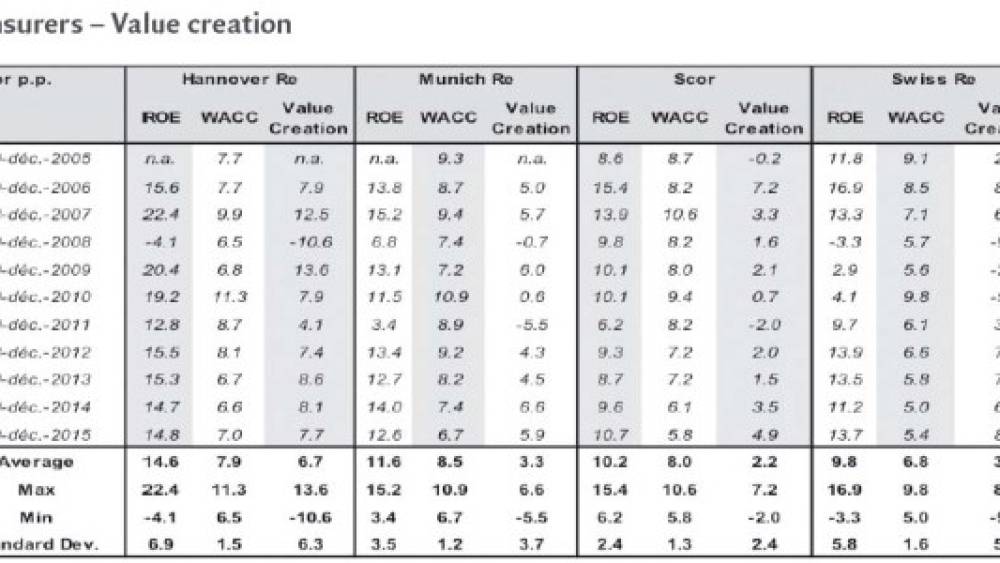
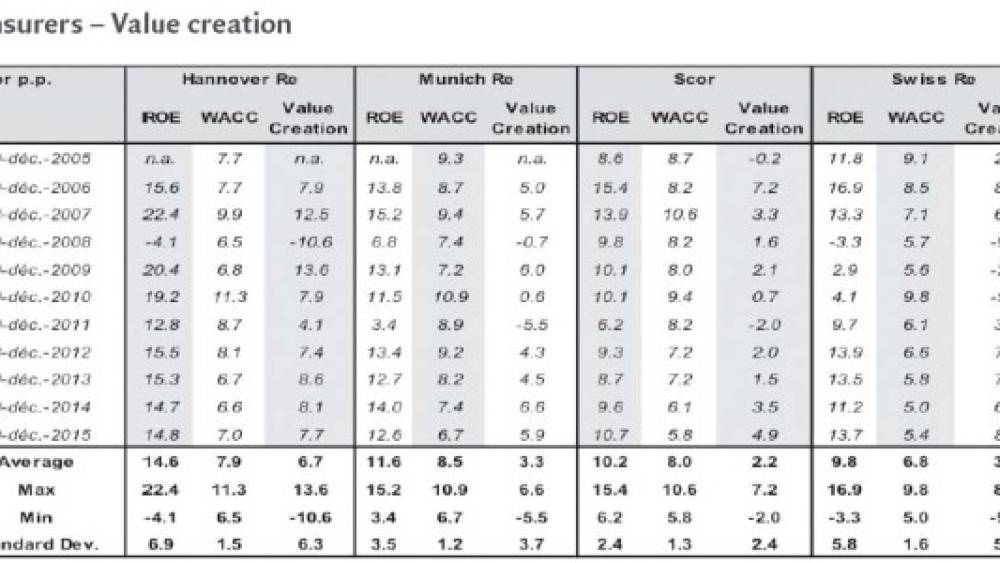
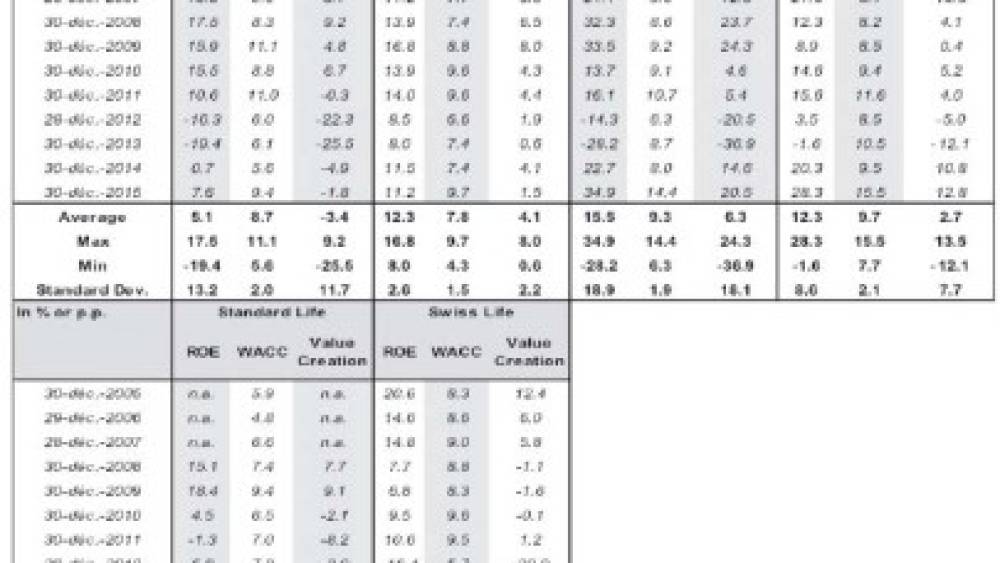
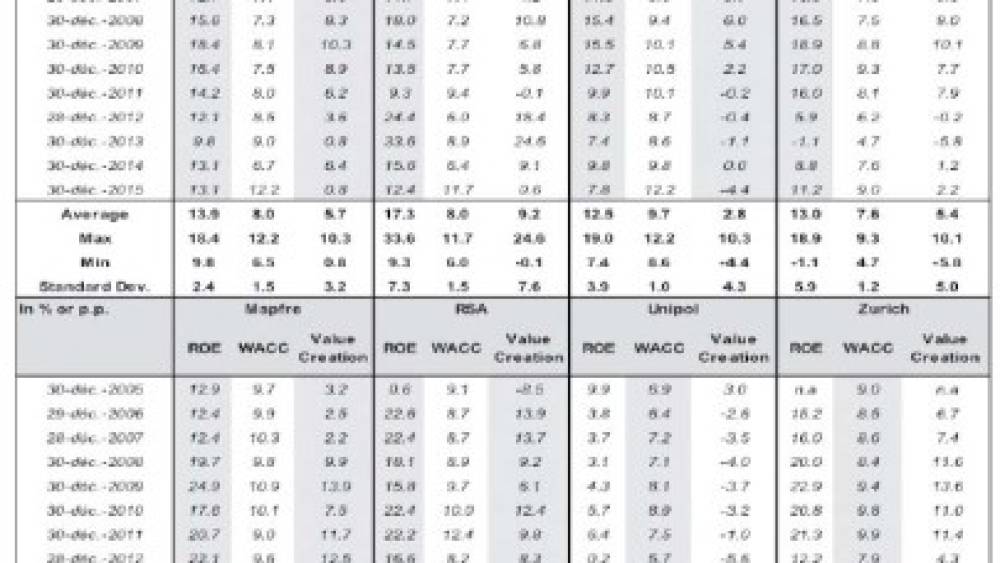
Prospectively, we believe that European insurers will look more attractive to equity holders. In other words, we expect a gradual increase in the insurers’ overall profitability level as measured through their ROE. Our rationale is based on two points. Firstly, the economic approach of Solvency II implies the inclusion of non-recognised IFRS elements of capital in the companies’ solvency capital tiers. A very good example is the full credit of the companies’ Value In Force (“VIF”) as regulatory capital. VIF essentially represents the net present value of future cash-flows of an in-force Life book of policies; hence it is susceptible to underlying assumptions and macroeconomic conditions. Under Solvency I, VIF was only credited at 50 % in most European jurisdictions reflecting the regulator’s prudence. Secondly, in the challenging trading environment characterised by the low interest rate environment, softening P&C Primary market and continuing excess of supply in the P&C Reinsurance market, we anticipate additional pressure from equity holders of European insurers to maintain an adequate profitability level. Under such difficult conditions, we believe that insurers will likely “manage” their overall profitability level through the optimisation of their solvency and economic capital. For example, the insurers’ excess of capital will likely be released over time through higher dividend pay-out ratios and/or share-buy-back programs.
Therefore, we expect an increase in the insurers’ overall profitability level as measured through their ROE. The sector will likely become more attractive to equity investors; but the downside risk has increased materially for some players because of the inherent volatility of their capital structure under Solvency II and the reliance of soft elements of capital such as net deferred tax assets.
The shift from a prudent to economic solvency approach is difficult to assess. On one-hand we can see the benefits for equity holders; nevertheless, it seems quite clear that policyholders of some insurers could be at risk due to the quality of their capital. In particular, UK based insurers who rely extensively on their VIF could become riskier prospectively. Recently, the UK regulator, PRA, did not grant a full credit of Pru’s VIF that stems from its Asian business. Local regulators will have to monitor and limit the use of soft elements of capital if they want to protect the policyholders.
The capital Tiers under Solvency II give credit to soft elements of capital. Compared with Basel 3, the capital structure of European insurers look weaker than European banks
We have seen how European insurers took the opportunity to optimise their capital structures via the grandfathering rules thus making our review of bonds to be called in 2016 complicated while identifying subtle changes in the accounting treatment of hybrid debt. We expect additional capital optimisation from European insurers by leveraging the credit of their VIF and net deferred tax assets in their Tier 1 and Tier 3 capital layers respectively.
Solvency II gives 100 % credit to Value In Force and recognises Letters of Credit and net deferred tax asset as solvency capital
Solvency II clearly defines the capital structure of European insurers into three layers; Tier 1, Tier 2 and Tier 3. Tier 1 capital is considered the bedrock layer of capital and must represent at least 50 % of the insurer's SCR and 80 % of the MCR. A key component of Tier 1 capital especially among Life insurers or Composite insurers with significant Life business is Value-in-Force. Under Solvency II, VIF will be credited at 100 % as opposed to 50 % under Solvency I, thus weakening the quality of capital prospectively considering the inherent volatility of the VIF.
In certain jurisdictions especially where Life policies present a guaranteed rate, VIF can be particularly volatile. A good example is Allianz's VIF, which declined from €12.5 bn in 2007 to €2.6 bn in 2008 following a sharp fall in the value of assets. At the end of 2014, Allianz's German Life portfolio carried an average guaranteed rate of 2.8 %. In contrast, other insurers like CNP enjoy a strong quality of VIF due to the absence of guaranteed rates in their liabilities.
Tier 3 is expected to be principally made of net deferred tax assets while Tier 2 capital may include letters of credit and reinsurance covers. Although Tier 3 capital is not seen to be material, we are concerned about the quality of this layer; in particular, for a company expecting a credit from an "unstable" European tax jurisdiction in the weak economic environment. The sum of Tier 2 and Tier 3 capital is capped to 50 % of the company's SCR and Tier 3 is limited to 15 % of the SCR.
Tier 1 Solvency II bonds are very similar to AT1…
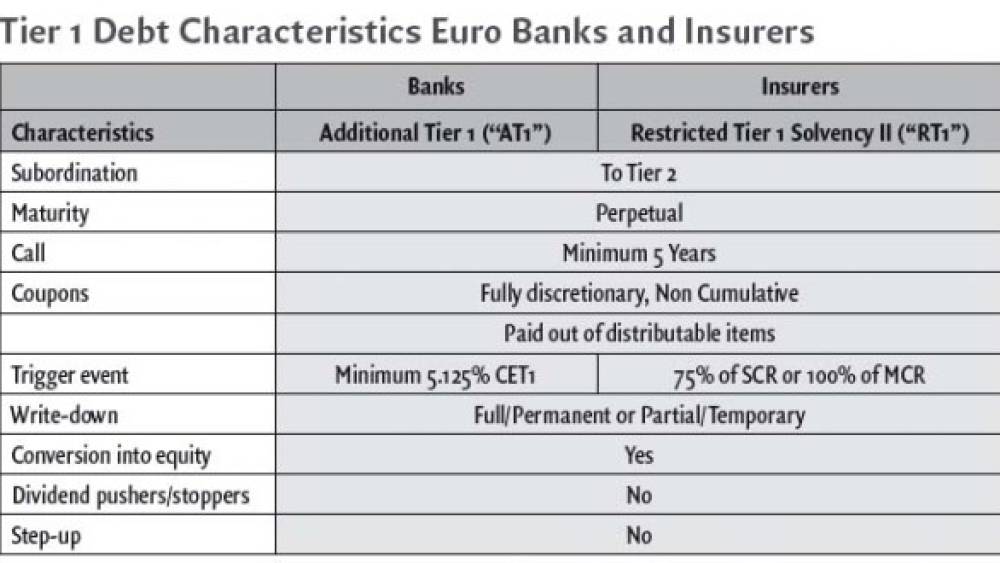
From a structuring perspective, there are not that many differences between a Tier 1 Solvency II compliant bond or Restricted Tier 1 (RT1) and its equivalent for banks, AT1. Both are subordinated to Tier 2 bondholders, perpetual and have a minimum first call of 5 years (NC5). Coupons are discretionary and non-cumulative, and there are no dividend pushers/stoppers or step-ups. Much like under Basel 3/CRD 4, Tier 1 bonds under Solvency II encompass a loss absorbency mechanism on a going-concern basis. In other words, in a resolution, the local regulator may impose a write-down of the Tier 1 Solvency II bonds or have them converted into equity. The event trigger defined under Solvency II is 75 % of the insurer's Solvency Capital Requirement (SCR) or 100 % of its Minimum Capital Requirement (MCR). Much like for banks, we expect the equity conversion for insurers to be set at a fixed conversion price when the bond is issued in order to limit the dilutive effect, possibly with a floor price.
Considering the complexity of the SCR's calculation, and the different assumptions used by each individual insurer in the quantification of its SCR, we believe investors will face difficulty in managing the distance to trigger of the Tier 1 bonds. Another important element in the expected volatility in the insurer's SCR resides in the weak quality of capital under Solvency II. In essence, the presence of a Tier 3 capital layer made of net deferred tax assets and the inclusion of 100 % of the company's Value In Force (VIF) in the insurer's Tier 1 capital (as opposed to 50 % only under Solvency I) will make the distance to trigger volatile. The volatility of the trigger could be a major concern going forward for investors; in the 2014 stress test conducted by EIOPA, under the most reasonable scenario (CA2 under EIOPA's terminology), 27 % of the participants had an SCR coverage ratio below 100 %.
Much like for EU banks, the trigger may change from one jurisdiction to the other. At this stage, we cannot confirm the intention of EIOPA and local regulators in implementing a variable trigger for European insurers.
…but there are significant differences between Tier 2 bonds under Solvency II and Basel 3
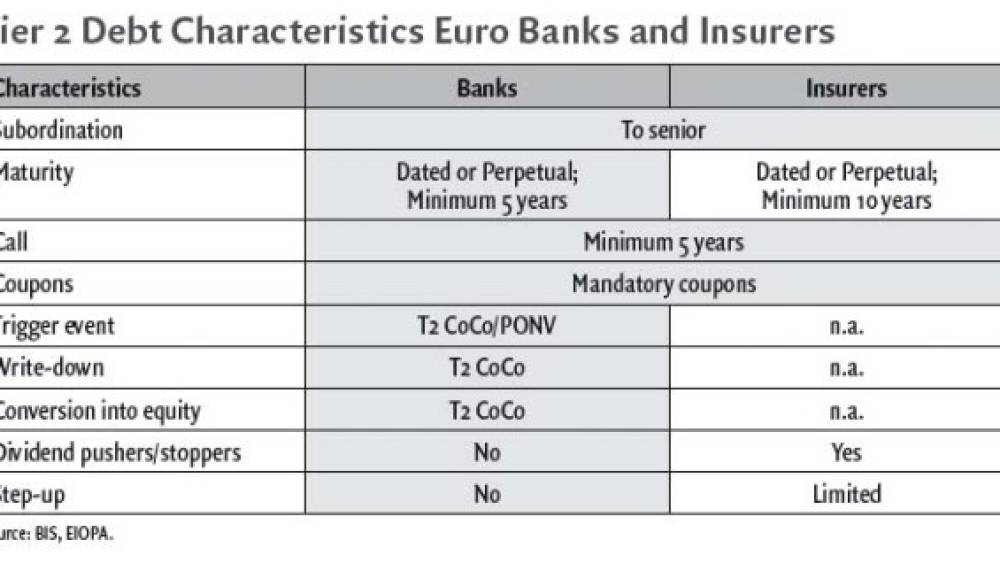
In contrast, Tier 2 Solvency II compliant bonds differ quite significantly from Tier 2 Basel 3 compliant bonds. In fact, the only similarities for Tier 2 bonds under their respective regimes are their subordination to senior bondholders, the flexibility to be dated or perpetual and cumulative nature of coupons. Solvency II permits dividend pushers/stoppers and limited step-up (capped to 100 bp or 50 % of their initial credit spread) for Tier 2 bonds; in contrast, Basel 3 excludes the use of such characteristics for Tier 2 bonds. Lastly, the minimum maturity for Tier 2 Solvency II bonds is 10 years as opposed to 5 years for Basel 3 Tier 2 bonds. Of interest, we also note that a few EU banks have issued Tier 2 Cocos (i.e. a Tier 2 bond that includes a trigger event, even though there is no regulatory requirement for this) which we understand that it is not the aim of Solvency II; we expect a Tier 2 Solvency II bond to be effectively a plain-vanilla 30NC10.
The point of non-viability does not seem to be included for insurers
While we understand that there exists a Point Of Non-Viability (PONV) for banks under Basel 3, which means a regulator may impose a write-down or conversion of bonds into equity even when the trigger is not breached (in the EU this is enshrined in the Bank Recovery and Resolution Directive), this concept has not been addressed for European insurers in detail. We are aware that certain issuers include wider regulatory clauses in the prospectus of bonds to capture the essence of PONV, but at this stage, we do not know whether it will be formalised under Solvency II and structured like the banks.
Banks enjoy a better quality of capital under Basel 3 than insurers under Solvency II
But the over-riding topic on comparing the characteristics of bonds between Solvency II and Basel 3 is the weaker quality of capital of European insurers when compared with banks. Our position is supported by three key elements. Firstly, and most importantly, Solvency II credits 100 % of the insurer's Value In Force as opposed to only 50 % under Solvency I. The approach under Solvency II is based on an economic view of the company, hence the need to fully credit its VIF. Nevertheless, although there is a certain level of harmonisation in the calculation of the VIF, Life insurers still have a significant amount of freedom in the assessment of their VIF. Additionally, each insurer will apply what it believes are the best estimates for its policy portfolio in terms of lapses and surrenders for example; these assumptions may change significantly from one insurer to the other and investors may not be able to compare the assumptions used. Additionally, the VIF can fluctuate significantly, in particular if the insurer provides relatively high guaranteed rates to its policyholders. Secondly, EIOPA introduced a Tier 3 layer of capital capped to 15 % of the company's SCR; the Tier 3 layer of capital is essentially made of net deferred tax assets. We view this layer of capital as weak considering the recoverability of tax is highly dependent on the health of the economy, of which, certain European countries can be seen to be at risk. It is no surprise that deferred tax assets are deducted from CET1 in the calculation of fully loaded ratios for banks under Basel 3. Lastly, Tier 2 capital may include letters of credit in meeting the SCR. We challenge the use of letters of credit as a capital instrument considering the interdependency between the financial stability of the insurer and the strength of the bank. With some European banks presenting existing and prospective weak credit ratings, we view letters of credit as a weak form of capital.
This current situation does not come as a major surprise to us given it is the culmination of the development of Solvency II. The first phase of Solvency II (2000 to 2005) focused on the quantification of risks and it was only once this exercise was completed that EIOPA realised that European insurers needed more capital. But, with European insurers seen to be less attractive to equity investors considering their relatively low profitability and complexity compared with other sectors, we believe EIOPA had to look for alternative solutions to reinforce the insurers' capital. The inclusion of 100 % of the company VIF and net deferred tax assets are such examples.
We expect European insurers to issue Tier 2 Solvency II bonds rather than Tier 1 bonds for cost reasons and because of their already relatively high level of Tier 1 capital
In view of the marginal cost associated with Tier 1 Solvency II compliant bonds (effectively the price of the loss absorbency mechanism), we do not expect vast issuance of these bonds. Our rationale is reinforced by the 2014 stress test performed by EIOPA which indicated that European insurers' Tier 1 capital represented 88 % of the company available own funds at year-end 2013 compared with Tier 2 and Tier 3 capital accounting for 10 % and 2 % respectively at the same date. We believe the abundance of Tier 1 capital for insurers stems from the inclusion of 100 % of the company's Value In Force, which represented 36 % of the composition of Tier 1 capital.
Going forward, we anticipate insurers with the weakest capital (qualitatively and quantitatively) will consider issuing Tier 1 Solvency II bonds.
Transitional rules under Solvency II seem to be quite loose compared with Basel 3
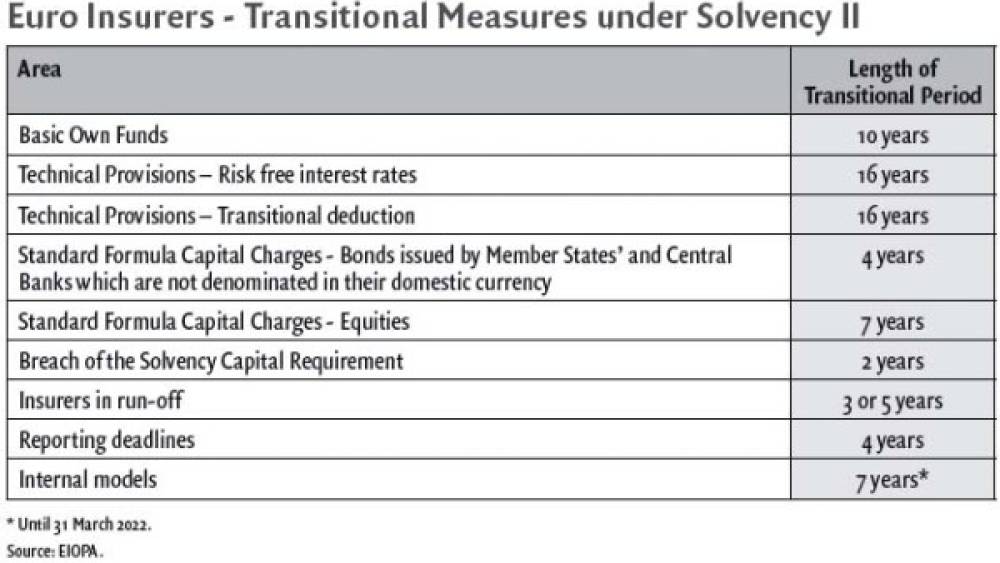
When compared against the European banks and the implementation of Basel III, we find the transitional measures under Solvency II to be extremely generous. European insurers can benefit from transitional measures which can stretch up to 16 years for their technical provisions. Being the first year of implementation for Solvency II, we can only hope the quality of disclosure by European insurers on their solvency positions will improve over time.
We come to the realisation of how "watered down" the adoption of Solvency II is when compared to the same process under Basel III. For example, European banks have to fully comply with Basel III by 2019 and only have a six year window to phase-in all the new provisions (2014-2019) whereas European insurers have the benefit of transitional measures which stretch up to 1st January 2032 for their technical provisions, i.e. a 16 year window. The running commentary is that Solvency II will probably be superseded by Solvency III by the time European insurers are actually fully compliant with Solvency II.
So far in 2016, the disclosures by European insurers on the use of transitional measures have been quite varied and in some cases, poor. While certain insurers like Delta Lloyd, CNP or Ageas are very explicit on the use of transitional measures, others like Pru plc refuse to provide any information especially on the impact of their Solvency II ratio without transitional measures.
The available transitional measures under Solvency II are enshrined in the Directive 2009/138/EC and in particular, Articles 308a to 308e. To be clear, the adoption of any transitional measure by any European (re)insurer requires the prior approval from the local regulator which has resulted in contrasting approaches amongst the different countries as observed in the market. For example, the Dutch regulator only permits very limited use of transitional measures in contrast to the pragmatic view of the UK regulator.
Grandfathering of Tier 1 and Tier 2 Subordinated Debt in Own Funds
The first and most commonly applied transitional measure amongst European insurers is the grandfathering of subordinated debt either as Tier 1 or Tier 2 capital for a period of 10 years from 1st January 2016. To recap, this means grandfathered Tier 1 subordinated bonds will count towards the 20 % limit for Restricted Tier 1 capital and form part of the minimum 50 % requirement of the SCR for Tier 1 capital. Likewise, grandfathered Tier 2 subordinated bonds will contribute towards the 50 % limit on Tier 2 and Tier 3 capital in the SCR respectively. After the 10 year period, the grandfathered subordinated debt will cease to be eligible as either Tier 1 or Tier 2 capital.
We first highlighted this transitional measure in 2014 following a notable trend by several European insurers like Groupama and Axa who took advantage of the weak grandfathering rules by issuing an Upper Tier 2 subordinated bonds (perpetual with cumulative coupons) which would be grandfathered prospectively as Tier 1 capital under Solvency II. In fact, the €1bn issuance by Credit Agricole Assurance in January 2015 was the last eligible bond to be grandfathered under Solvency II as bonds issued since have to comply with requirements under Solvency II. We also believe this rather "loose" grandfathering rule around Tier 1 subordinated debt will complicate our assessment of bond calls going forward. So far in 2016, disclosures by European insurers have shown that the majority have chosen to apply the grandfathering of Upper Tier 2 bonds as Tier 1 capital. The only exception we have come across has been ASR Nederland who opted to not grandfather its Upper Tier 2 5 % €500 mn Perpetual NC2024 as Restricted Tier 1 capital under Solvency II.
Technical Provisions
In our view, the transitional measures around technical provisions is possibly the area with the greatest concessions under Solvency II. European insurers can either apply (i) the transitional arrangements for risk-free interest rates OR (ii) the transitional measure for technical provisions. The emphasis on the "OR" means that European insurers are only permitted to select either option and not both. It is worth noting that the decision to use either transitional measure will also go hand in hand with the application of other long term guarantee measures like the Volatility Adjustment and the Matching Adjustment.
Under the transitional arrangement for risk-free interest rates, European insurers are able to gradually introduce the impact of moving from their present discount rate for their technical provisions to a Solvency II discount rate. This will be done on a straight-line basis over a period of 16 years. In contrast, the alternative option permits European insurers to apply a transitional deduction to their technical provisions as valued under Solvency II. This deduction would be effectively the difference between the valuation of the technical provision under Solvency I and under Solvency II, linearly apportioned over a period of 16 years.
Capital charges under the Standard Formula
On the asset side of the balance sheet, Solvency II offers two transitional measures around the capital charges for investments under the Standard Formula: (i) a 4 year period to phase in capital charges for bonds issued by Member States' and Central Banks which are not denominated in their domestic currency and (ii) a 7 year period to phase in capital charges around their equity investments.
Going into more detail, the first transitional arrangement highlighted above is regarding concentration risk and spread risk capital charges for bonds issued by Member States' Central governments or Central banks which are not denominated in their domestic currency. Until 31st December 2017, such bonds will attract a nil capital charge before declining to 80 % and 50 % in 2018 and 2019 respectively. At the end of 4 years i.e. by 2020, the transitional benefit will be nil. In general, we anticipate the holdings of such bonds to be limited or immaterial for European insurers.
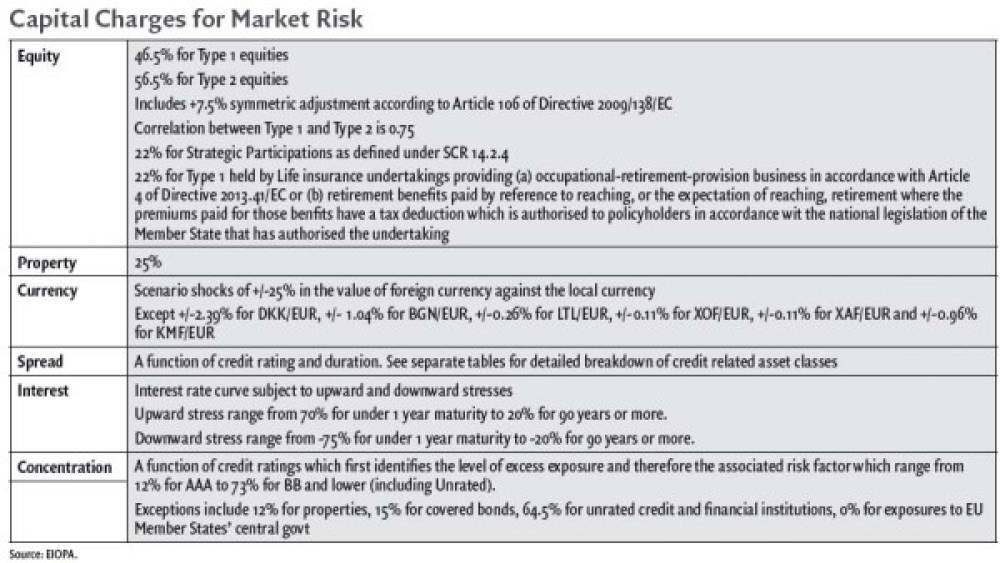
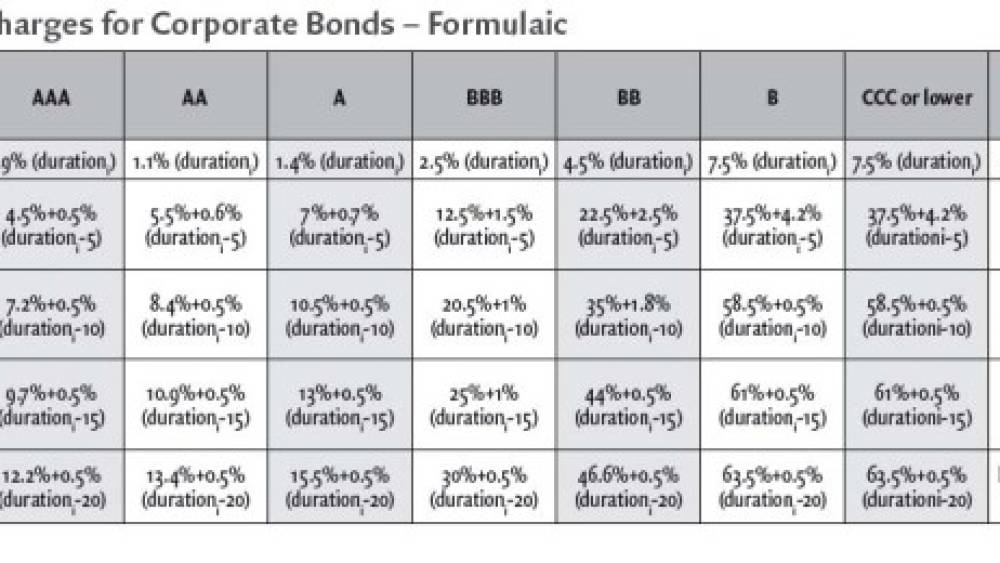
Instead, the more prominent transitional arrangement for capital charges under the Standard Formula would be the one applied to equity investments acquired before the 1st January 2016. Under this transitional measure, European insurers are essentially permitted to stagger the capital charges that would apply under the duration based approach to the current capital charges prescribed under the standard formula for Solvency II. In other words, a European insurer would be permitted to linearly increase its capital charge from 22 % to 46.5 % for Type 1 equities over a period of 7 years. In terms of disclosure, the only clear example of this transitional measure on equity is from Delta Lloyd. Its Solvency II ratio on the standard formula includes 5 pp arising from transitional measures for equity, of which 2 pp will run-off in the first quarter of 2016.
Breach of the Solvency Capital Requirement
In the event that a European insurer is in breach of its Solvency Capital Requirement (i.e. a Solvency II ratio of less than 100 %) in the first year of compliance of Solvency II, this transitional measure gives the company up to 31st December 2017 to take the necessary measures to achieve a ratio of at least 100 %; either by reducing its risk profile/SCR or by increasing its capital/eligible own funds. To apply this transitional measure, the insurer is required to report to the regulator every three months, at which point the regulator may decide to withdraw this extension in the event if it is dissatisfied with the progress of the insurer.
Internal Models
European insurers have 7 years until 31 March 2022 to apply for the use of an internal model in the calculation of their Solvency II positions.
Insurers in Run-off
Depending on the nature of the run-off process, European insurers in run-off as at 1st January 2016 are entitled to apply for transitional measures which will delay the full implementation of Solvency II. This means insurers in run-off will only need to fully comply with Solvency II from 1st January 2019 (in 3 years) if they have yet to fully cease all activities. Similarly, insurers in run-off who are subject to reorganisation measures are given up to 1st January 2021 (5 years) to cease all activity or they will need to adopt Solvency II in its entirety. In either scenario, the regulator may revoke the transitional measures if it is dissatisfied with the progress of running-off the business.
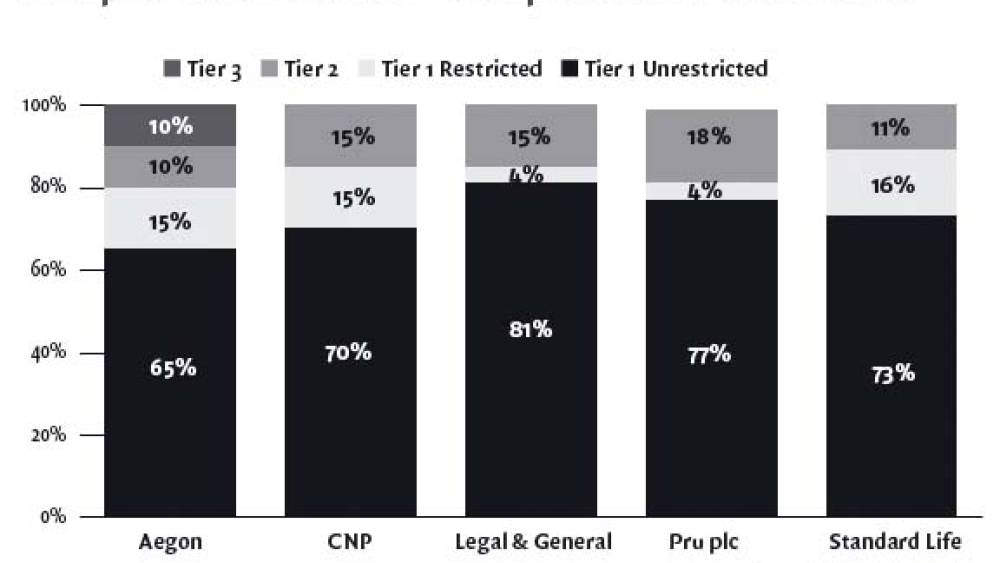
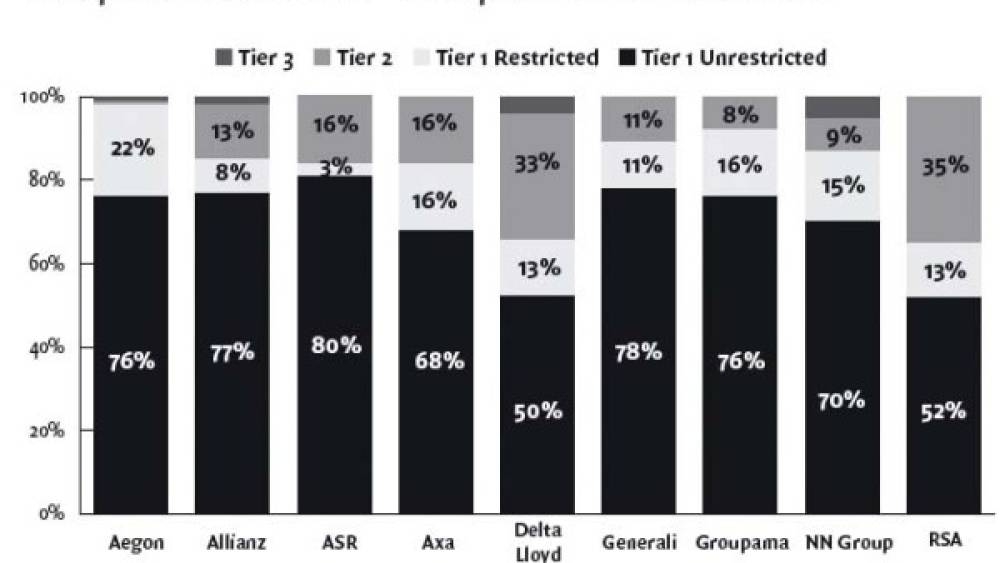
European insurers enjoy a strong quality of capital, in particular Unrestricted Tier 1 capital, thanks to their VIF. Pure P&C insurers are penalised under Solvency II.
So with “watered down” transitional rules, the use of obscure internal models and the inclusion of weak components of capital, how do we analyse the capital structures of European insurers under Solvency II? This is where the quality of capital will become the cornerstone of credit analysis for European insurers. In particular, investors will need to focus on the relative importance of Unrestricted Tier 1 capital (shareholders’ equity plus VIF) compared with Tier 1, 2 and 3 capital layers. Companies such as Delta Lloyd have already started Solvency II on the wrong foot and seem to be at risk considering the absolute low amount of their Unrestricted Tier 1 at year end 2015. Unsurprisingly, its shareholders recently approved the €650 mn rights issue proposed by the company’s management and back by the Dutch regulator to strengthen its Solvency II position. Even with such problematic players, European insurers under Solvency II appear to benefit from a relatively high proportion of Tier 1 capital and in some cases, too much Tier 1 capital which suggests that their capital structures are far from optimal under Solvency II. As a result, we could expect European insurers to replace their Tier 1 bonds with Tier 2 instruments (bonds and Letters of Credit) as a means to reduce their overall cost of capital.
Capital allocation under Solvency II will lead to higher ROE
Prospectively, we anticipate higher ROE levels as European re/insurers will optimise their capital structure under Solvency II. We believe this strategy will likely lead to the gradual release of their excess of capital through higher dividend pay-out ratios and/or share-buy-back programmes.
Historically, the profitability of European insurers has been penalised because of the relative conservative and prudent approach needed under Solvency I. Solvency II, which is a step towards reality, will enable European Re/insurers to optimise their capital base from both a solvency and economic perspective through the inclusion of additional elements of capital compared with Solvency I.
The sector will finally become more attractive to equity holders. But, at what cost?