
Classical theories have been tarnished by the succession of financial crisis the world has witnessed from the Black Tuesday to the subprime crisis. Nothing wrong with the logic behind these theories but the growing number of empirical evidences showing investors not really rational messes with one of the central hypothesis of modern finance. It helped give credit to behavioral finance theories over time, but if behavioral finance provides a new framework to understand recurring market anomalies via individuals’ psychology, it has not explained why entrepreneurs or family businesses owners remain shareholders of their firms. This case is often seen as marginal, firms are supposed to be widely held but as a matter of fact a majority of firms are owned by non-diversified investors.
The myth of rational markets and diffuse ownership
First, ownership of most private companies remains in the hands of their founders. Private companies represent over 99% of companies in US, and 86% of firms with five hundred or more employees. Some researchers showed that in 2010 private businesses accounted for nearly 49% of aggregated pre-tax profit in the US according to Biery (2013). Second, family businesses do not stop at privately held ones, actually behind the largest companies there are individuals and families, think of Exxon Mobil and the Rockefellers, Walmart and the Walton family, Microsoft and Bill Gates, Tata or L’Oréal. According to La Porta (1999), on average 30% of public groups are owned by a family but this varies greatly from a country to another, with approximately 50% of French large groups being family controlled for example. Faccio and Lang (2002) said that 45% of western European public firms are family controlled. Holderness (2007) (year of the study) provided evidences of the widespread presence of block ownership, 96% of public American firms have block-holders owning on average 33% of the common stocks, with family ownership accounting for 53% of all public firms in the US and 59% outside the US.
Family control as a form of governance has been widely studied and researchers highlight its specificities and practical implications. However, very little has been said about motivation of historical shareholders who bear the firm idiosyncratic risks, on top of sector risks and market risks, for the same return as for well-diversified shareholders. This goes against the generally accept capital asset pricing model established almost fifty years and it seems quiet unlikely that those who possess and run half of the world largest companies have not heard of the advantages of diversification. Hence the question: are non-diversified shareholders rational?
Family governance and its impact on value
Academics have identified two opposite arguments to explain the difference in performance of family firms versus non-family ones. On the one hand, family governance enables to lower agency costs and boost performance, on the other majority shareholders may use their powers to pursue private benefits instead of maximizing firm value. These two hypotheses have been tested several times in various settings, most researchers uncovered that family businesses tend to outperform their peers especially when the founder is involved in the company. These results vary from country to country, apparently depending on minority shareholders protection and corporate culture. Even if family businesses performing better than their peers seems a good reason to justify why their shareholders remain undiversified, it is not sufficient. Indeed shareholders are supposed to care about their return relative to the risks they bear. By selling their stocks and diversifying their portfolios non-diversified shareholders would lower their risks. So far most studies have based their performance measures on industry adjusted Tobin’s Q to determine a firm’s relative over performance to its peers. Therefore those studies do not shed light on the risks and return non-diversified shareholders are supporting.
Rationality, finance and equilibrium: to a modified utility function?
It is difficult to uncover the investment rational of large non-diversified shareholders as they do not seem to arbitrate between risk and return as classical finance theory supposed they should. The question of rationality in market agents has been investigated in behavioral finance research. Academics have studied how traders invest and the reasons behind their moves. Bondt (1998) in his literature review summed up that individual investors tend to fall into four types of traps when it comes to investing: one about the perception of stochastic process at play in asset pricing ignoring the CAPM; a second on the perception of value; third risk management based only on information; and fourth trading on impulsion or by imitation. Large historical shareholders with long term investment horizon do not fall into those traps as they are in fact not “traders” of their stocks. They stay invested in their companies even if the firm losses its fame or if its shares drop dramatically. And it seems unlikely that large wealthy shareholders, well advised, are not aware of the market portfolio theory. Large non-diversified shareholders do not seem to exhibit the same type of irrationality identified in behavioral finance theories. Nevertheless their will to renounce to the free lunch offered by diversification seem irrational according to modern finance theories. Another explanation for adopting this attitude would be that those shareholders are in fact risk lovers, contrary to the hypothesis of the CAPM that set investors as risk adverse. They would be happy to be exposed to an extra risk without expecting higher return in compensation. Some academics have looked into the real attitude of investors towards risk and nuanced the classical hypothesis of utility functions following a Bernoulli law. Those findings while not threatening the validity of the theories based on risk aversion highlight that in reality investors’ preferences are not homogenous and their utility functions are not similar for all levels of risk or across time. But the findings of Tversky & Kahnman (1974) are more disturbing as they observed that investors tend to take riskier gambles in order to avoid a loss than to realize a gain. Here contemplating rationality and wealth maximization behind this behavior appears questionable, but if we take into account the emotional cost of realizing a loss into the utility function, then this behavior may well follow a utility maximization program under risk adverse condition. This solution is appealing but quiet unorthodox in classic finance.
Modern finance is based on the risk – return framework leading to theories on market equilibriums. Once confronted with reality the simplified frameworks may not perfectly hold. This is not new, Sharpe himself said that it was not realistic to expect investors to assess “the desirability of a particular investment [..] on the basis of only two parameters of its distribution – its expected value and standard deviation” (1964, p. 427). One of the problems of the idea that maximizing utility correspond to maximizing wealth is that it is often perceived as an argument against agent rationality and equilibrium theories. Elster considers that “one of the most important cleavage in social sciences is the opposition between two lines of though conveniently associated with Adam Smith and Emile Durkheim, between homo-economicus and homo-sociologicus” (1989, p. 99). While Homo-economicus is supposed to be guided by rationality “pulled by the idea of future rewards”, homo-sociologicus, with a behavior dictated by social norms, is “pushed by quasi inertial forces”.
However defenders of the rationality approach have shown that in being flexible on what to include in the utility function it is possible to use it to understand the world as it is. The idea of injecting more elements in the utility function for equilibrium-based theories to better match reality has existed since a long time in finance. Black in 1986, while defending his idea about the central role of “noise” in financial markets, derived a number of equilibrium models that he thought of as “not rational equilibrium models, because of the role of noise and because of the unconventional things I allow an individual's utility to depend on, but equilibrium models nonetheless” (p. 530). These models are derived from the logic of the CAPM “to markets other than the stock market and to behavior that does not fit conventional notions of optimization” (p. 530). In this article, starting from the observations that investors trade on noise and that they care about receiving dividends, he offers to add trading and dividends into the utility function along total wealth. He offers so because both trading on noise and dividends payment affect negatively investors’ wealth. Therefore this does not fit “into a world where people do things only to maximize expected utility of wealth” (p. 534). The logic behind adding them in the utility function is that if investors care about trading and dividend it must be because this maximizes more in itself their total utilities than it decreases their wealth.
Ownership a valuable position?
If we apply this logic to our non-diversified shareholders it would mean that they might derive more extra utility from controlling their firms than from profiting of the safety of diversification. Postlewaite (1998) may offer a valuable explanation for this observation, he consider important to account for social arrangements in individual choices because they dictate desirable consumption. For example if people choose life partners in order to maximize their wealth once married, it is desirable to marry a richer person than oneself. Then agents will rationally consume as much as possible in order to appear in the eyes of rich people as a possible match. But if we imagine that the same rule applies plus a caste system then the over consumption will be limited to approaching the wealth level of the richest of one’s caste. Despite having been often mentioned by economists no model takes into account the relative rank in society, or the social status of individuals into their maximization behavior because of models incorporating them cannot be predictive. Perhaps equilibrium models as understood by Black, which are observable every day in real markets, take into account such social arrangements where the endless group dynamics would be another unobservable source of noise leading non-diversified shareholders unwilling to sell their shares.
Taking into account social arrangements in the non-diversified shareholders dilemma bring an element underlining the rationality behind their choice to retain ownership of their companies. The social status they have access to, by being the majority shareholders of their firms, may enable them to maximize non-monetary social benefits. Homo-economicus and Homo-sociologicus may peacefully cohabite within the homo-sapiens. And they may very well rationally renounce to increasing their wealth or reducing their risks in exchange of benefitting from being into the highly selective class of business owners compare to being in the relatively less selective class of wealthy individuals. If this is indeed the rational at play behind non-diversified shareholders’ choices, one can expect that their portfolios, meaning their company stocks, will tend to be suboptimal for diversified investors compare to portfolios on the Security Market line. This leads us to the following hypothesis:
Stocks of companies held by non-diversified shareholders have lower Sharpe ratios than the one of the Security Market Line.
Statistical Analysis
In order to statistically test this hypothesis, returns data of 58 stocks held by non-diversified shareholders were gathered from the 1st January 2000 to the 1st of February 2013 from top family firms established by Campden in 2011 (which creates a possible survival bias in this study). In order to establish a security market line equity indexes were used (S&P 500 composite for the North American market, the MSCI Europe for Europe and the MSCI World for the global market). The risk free rates used were the annualized total return of the US T-Bill 3 months on the secondary markets for the North America and globally and the Euribor 3 months for Europe. Finally calculations of returns, betas, etc, were performed on several time windows, a thirteen years-time windows from 2000 to 2013, two six years-time windows and four three-years-time windows.
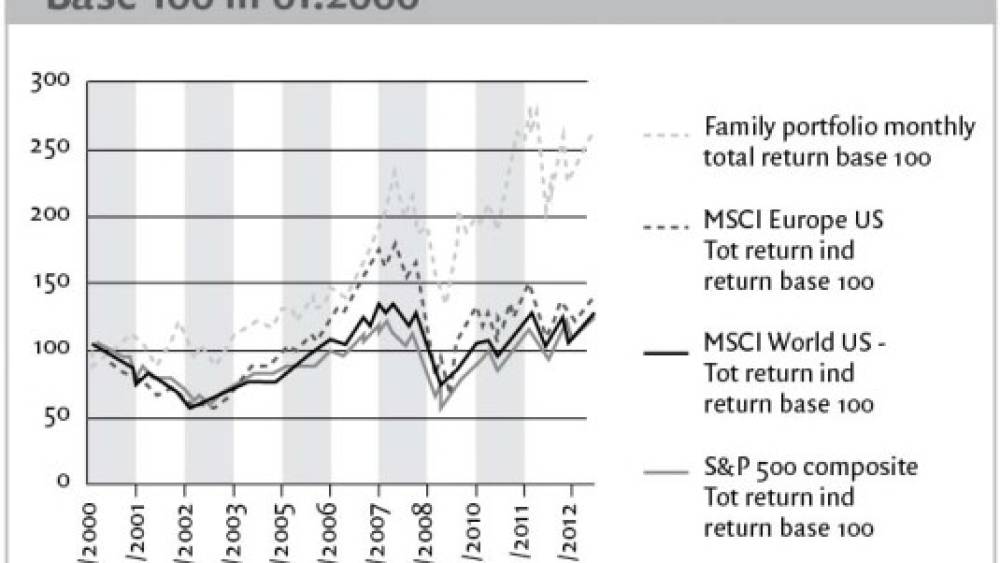
On average over the last thirteen years it has been less risky and more lucrative to invest into family firms rather than in the MSCI world index (see Graph 1). This observation holds for both the period 2000 to 2006 and from 2006 to 2012 for which the beta of family firms stayed on average at 0.9 and total return were respectively 3.4% and 4.7% against -0.1% and 4.2% and price return 1.5% and 2.4% against -0.6% and 1%.
It appears that on average family firms shareholders can benefit from an extra yield compare to an equity index investment but this depends on their horizons in terms of time and geographic. For instance during the period 2000-2006, differences between family firms’ Sharpe ratios and indexes’ ones are found positive and significant, with a 10% chance of error. Family firms on average offered 20% additional return for a unit of risk compare to returns offered by the MSCI World, this additional return is only equal to 8% compare to local equity indexes (see Graph 2). During the time window of 2006 to 2012 the average additional return offered by family firms compare to MSCI world is about 6% and 7% compare to the total returns of local indexes.
It should not be forgotten that behind those average measures the faith of the individual companies vary greatly. Over the last thirteen years 62% of the family firms in the sample outperform the MSCI world index based on price return, and 60% based on total return. The value of the Chi-square test, measuring the distribution of firms in outperforming and underperforming in 2000-2006 and 2006-2012, is of approximately 13 with a degree of freedom of 4 and significant at a 1% level. This means that the hypothesis that the observed repartition of outperformers and underperformers over the two time periods is the result of chance can be rejected with 1% risk of error. For all but one distribution the group of firms which outperformed in both periods is the biggest, with 40% of the sample, and the group of firms which underperformed in both periods is always the smallest with about 10% of the sample. And firms changing categories either from outperformers to underperformers or vice versa account for about 50% of the sample.
Conclusion
One may say based on this study, non-diversified shareholders invested in family firms get on average an extra remuneration for the extra risks they are bearing. This invalidates the hypothesis of this study which is: Stocks of companies held by non-diversified shareholders have lower Sharpe ratios than the Sharpe ratio of the Security Market Line.
Thus family firm shareholders may be following the axiom of wealth maximization and displaying “traditional” rationality.
However we also looked at a family firm portfolio, rebalanced according to the 58 firms’ capitalization every month since 2000 (see Graph 3). It yields superior returns against any of the other equity indexes: 0.6% on price return compare to 0.1% for the MSCI World and its standard deviation is equal to the one of the MSCI World. In the sample only seven firms managed to outperform the family portfolio, therefore the probability to yield superior returns with this portfolio appears far better than with an individual family stock. So if non-diversified shareholders are rational in believing in family ownership rather than broad diversification, a little diversification within family businesses would not hurt their returns. Non-diversified shareholders rational or irrational, the question remains. And what about asset management professionals who have been taught to balance well-diversified portfolios for years?
Diversification, a puzzling rational convention…