
Since the 2008 ‘financial crisis’, regulators in virtually every jurisdiction have significantly ‘upped the ante’ in terms of levels of disclosure, granularity, traceability and frequency of regulatory reporting requirements. This ‘quantum leap’ in standards has caused significant headaches for a number of firms, with issues like data quality, data adequacy and enrichment, functionality and lineage as key areas where capabilities have needed to be enhanced significantly. In many cases, these types of resources are very scarce in any single bank, much less when virtually all are competing at the same time to meet tight regulatory compliance and submission deadlines.
A framework for ‘regulatory reporting factory’ constructs
There are 5-6 (the number may vary by financial institution and sometimes country, depending on granularity and grouping of processes, etc.) key services areas involved when producing regulatory reports, which may briefly be characterised as follow:
Stakeholder interaction: regulators, internal financial and risk management, internal (to the regulated institution) audit and control, internal IT and others who provide basis minima and guidelines which the report content, format and traceability must satisfy
Governance and control: post-input per the above, internal and, as may be desired, external vendor processes and personnel to define policy standards, specific
Report development and production: post-input per the prior step, internal or (as may be desired) external vendor processes and personnel to identify, design, build and operate specific report output requirements (in terms of data content, calculation coding, format and presentation specifications, etc)
Data management: post-input per prior step, identify, extract,cleanse, standardise/normalise, enrich and provide the necessary ‘raw’ or semi-processed data from product, line of business,
Close: as a pre-requisite to all of the above (not derived therefrom, but a precursor to), perform the processes, audits, consolidations, eliminations and other financial procedures necessary to capture any and all relevant transactions and present them in G/L,
An example of how these various services areas may work in an ‘end to end’ use case of a request to produce a new regulatory report or modify the content to an existing regulatory report type follows (graphic 1 : red denotes activities which should be kept by a financial institution; black notes those which, due to more generic nature, responsibility and industry similarity might be considered for external vendor services.
A solution accelerator
This framework for services definition and classification, as well potential user/provider role definition can allow regulated financial services firms to:
- consistently analyse their own current capabilities;
- define and assess the possibility to source any or most of these from various external vendor options;
- set control points, hand-off requirements and related KPI’s and SLA’s for these controls and hand-offs
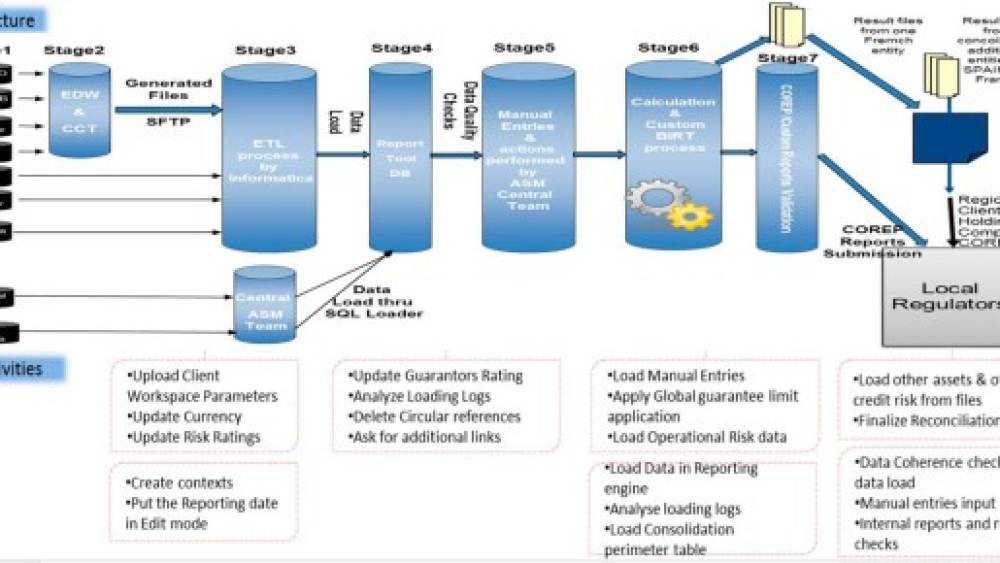
A simplified example of how these types of operations may be automated is indicated in the graphic 3 (the model indicated to produce future state CoREP reports has operated previously for Basel II purposes as well, with the major change being in the reporting and calculation technology platform used)
Reporting factories
Banks globally and particularly in the European Union are facing unprecedented levels of new and regular changing regulatory reporting requirements for capital adequacy, liquidity and other solvency-related purposes. They should therefore develop such reporting factories to help them achieve regulatory compliance at a reduced cost and on time.