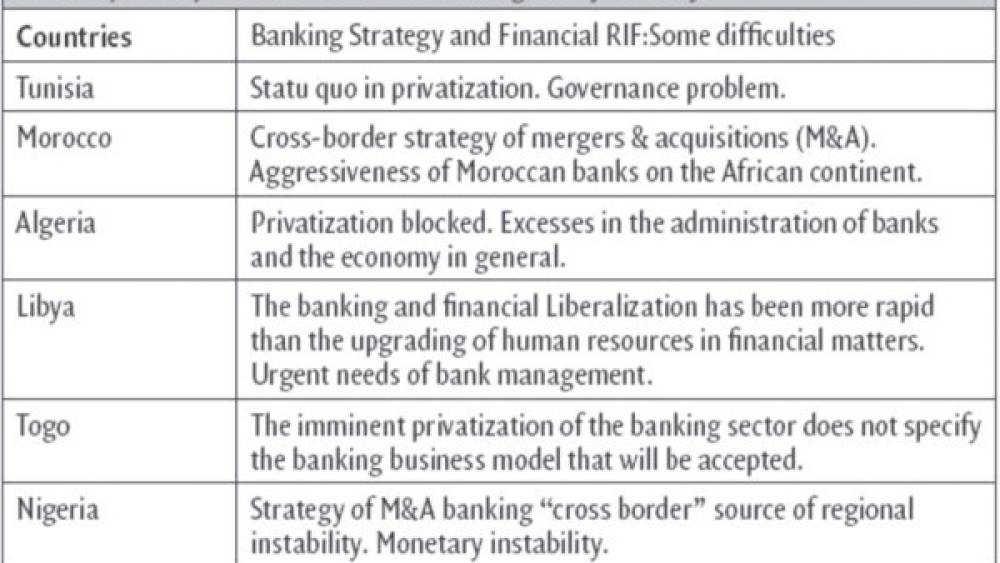

The focus here is on financial liberalization, which is the removal of restrictions or regulations in the financial system. Financial liberalization cannot be detached, in a developing economy, from the banking consolidation and privatization, the human resources challenges and the good governance.
The key of financial development
The Regulatory and Institutional Frameworks (RIF) of financial services and particularly banking dimension is the key of real financial development in Africa. Africa has committed more than a quarter of a century in a process of financial liberalization. The current crisis has confirmed the need to better control the market mechanism in order to not jeopardize economic growth and human development. The financial and banking regulation is vital to ensure sustainable economic development. It seeks systemic stability and a good functioning of financial system as an engine of real development. This final goal can be achieved if some basic micro-economic conditions are met. These conditions concern mainly:
– Consolidation and banking restructuring;
– Banking privatization;
– Upgrading of human resources;
– Good banking governance.
Financial and banking regulation should not be a simple piece of legislation. It must not remain at the stage of good intentions. It must first be an economic strategy based on a multidimensional gradualism (box 1).
All African countries are not at the same stage in terms of banking RIF (box 2). Specifically, in the work that follows, we will address three aspects:
– Introducing the evolution of banking and financial services in Africa: issues of financial Llberalization as a key basis for real development,
– Analysis of some national banking and financial experiences. We will discuss the “success stories” but also consider the difficulties faced by some countries in regulating the process of liberalization;
– Lessons from national experiences in regulating banking and finance. The idea is to give some tracks for local regulators to better develop the overall architecture of their domestic financial systems and better prepare them for the international opening with a global context where market volatility dominates.
Part 1. Liberalization and real development
During the 80’s and 90’s and with “subprime crisis”, the increase in financial instability shook up the idyllic vision of the financial liberalization. The difficulties concern the banking sectors. They spread out in some countries in form of systemic crises. The liberalization of the financial sector has really affected their banks
The financial liberalization aims at the passage from a regulated economy to a liberalized one
From this point of view, the thesis of financial liberalization considers that governmental restrictions on the banking system reduce the quantity and the quality of investments. Interventions of the State on the financial system would induce a negative effect on the growth rate. Financial liberalization encourages the liberalization of national banking sectors and foreign bank penetration aims to increase competition, transfers of know-how and financial operation transparency. That means also the development of stock markets.
Several studies confirm the existence of a first order positive relationship between financial liberalization and economic growth
1. 1 Characteristics of the African banking and financial system
African banks remain very small compared to global giants. Total assets of the top 200 African banks should reach about 1,000 billion dollars. The largest bank in Africa , Stanbic Bank (South African), is 24 times smaller than the first bank in the world. Moreover, the financial systems remain fragmented, heterogeneous but changing relatively fast.
The essential features remain the following:
– A geographical division in 5 main areas that have long remained separated because of the history and language: North Africa, South Africa, Nigeria, The rest of English-speaking Africa, francophone Africa;
– Low coverage: the traditional banking sector meets only a marginal fraction of needs with maximum 5% rate of bancarization in sub-Saharan Africa, despite some progress in recent years and the willingness of central banks to reach 10% in 2010. It must however take into account penetration of Microfinance Institutions (MFI), often more important;
– A great heterogeneity and rapid change today: There has been a deep clean during the last 20 years. Today there are few banks in difficulties and most meet the requirements of bank charges. These mutations result by an unprecedented effort to modernize especially in information technology, privatization and diversity in ownership - there are only very few state banks and those that remain are usually in search of private shareholders today.
The obstacles to development are more related to external causes: problems in energy supply, political instability, insecurity, bad governance, etc.
1.2 Things suitable for the North are not necessarily so for the South
The success of the financial liberalization depends on the local actors’ behaviors. These behaviors depend on informal local usages and practices. The main difficulties in the construction of an efficient financial system are the recognition of the time which is necessary for the local actors’ adherence to the new institutions. This time is longer than the time required for the installation of the institutional reforms. Indeed, actors do not adopt instantaneously financial product innovations and institutional change. They need time to evaluate changes through practice. Costs induced by this effort of evaluation are compared to existent benefits resulting from existent informal practices. This is the reason why the formal definition of new specific institutions from developed countries by developing countries is not an immediate and absolute guarantee of better performance and development. Weaknesses in the theoretical structure of financial liberalization have promoted the appearance and the amplification of financial crises in emerging countries.
Part 2. National experiences in the field of banking and financial liberalization
How the African banking industry is facing global financial liberalization today? Africa is affected by the crisis indirectly: lower exports, lower financial direct investments (FDI), lower support ... This is the idea defended by Dominique Strauss-Kahn in March 2008: “I do not believe in the theory of decoupling. Nobody is immune. I speak rather of lag time ... declining growth prospects in emerging countries ... the transmission of the financial crisis to the real sector starts to be significant”.The GDP of Africa, according to calculations of the World Bank is declining in 2009 (Box 3).
With the global financial liberalization, some banks appear more dynamic. Those of South Africa are regarded as leaders. Those from Nigeria are characterized by dynamism and remarkable progress. Those of the Maghreb have known exceptional modernization with Moroccan banks becoming more aggressive outside their national territory. Some African banks are already in the strategy of consolidating their market and follow the logic “predator-prey”. Such logic, if too aggressive, may pose risks.
2.1 The situation of financial services in africa
South Africa: 6% of African banks of the Continent, 45% of total African banking balance sheet, 32% of net African bank revenue. The rate of bancarization is above 50%. South Africa is a leading financial place leading in Africa, with 5 of the 6 largest banks on the continent and 18th global stock market capitalization ;
The banking system is highly concentrated. Some 75 institutions represent nearly 40% of the total banking system. The Standard Bank is the first bank. It is twice as big as ABSA the second bank with Islamic banking solutions - subsidiary of Barclays. The profitability of banks draws foreign banks. Since 2007 20% stake in Standard Bank is owned by the Chinese bank ICBC. Note also the partnership agreement between Nedbank and Ecobank.
North Africa: 27% of African banks of the Continent, 32% of total African banking balance sheet, 32% of net African bank revenue. Systems differ by country.
– Egypt has powerful banks : 21 rank in the top 50 North Africa and 23 in the top 200 of the Continent.
– In Morocco, the banking system is highly concentrated (see Annex 1) in three banks Crédit Populaire, BMCE, Attijariwafa (the later is the first with 27% market share and 64% of total assets). It counts 16 banks today against 20 in 2000 but heavily upgraded with new ambitions in Sub-Saharan Africa for two of them – BMCE and Attijariwafa - and a stronger presence in Europe. We note the recent creation of Medicapital, merchant bank of BMCE with headquarters in the City of London. BMCE announces plans to expand in Europe and Africa.
– In Tunisia there are many banks: 20 banks. The 2 most important are still public. They are fragile because of the importance of bad loans including a few large companies. However, there are interesting experiments in the field of specific funding for small business (Banque Tunisienne de Solidarité - BTSand BFP-PME), as well as venture capital that is often used reference on the Continent.
–In Algeria, the banking sector is dominated by the state. The privatization is difficult in Algeria and Libya. The 6 state banks in Algeria still carry 90% of the national banking. The incident of Khalifa Bank blocked the process of modernization and liberalization of banking in Algeria.
– Libyan banks are interested in facilities in sub-Saharan Africa. It is the case of the Libyan Arab Foreign Bank and the BSIC group. The latter wants to settle in thirty African countries of the Community of Sahel-Saharan States (CEN-SAD) by acquiring subsidiaries in Burkina, Niger, Mali, Togo, Mauritania and Chad. We note excellent performance as the doubling of total assets in one year.
The rates of banking services or “bancarization” are variously high: 37% in Morocco, 42% in Tunisia, less than 20% in Algeria and higher in the rest of Africa. The number of agencies or branches is higher in North Africa: 1 for 7300 people in Morocco, 1 for 10,000 in Tunisia, 1 for 26,000 in Algeria compared to 1 for 2400 in France and 1 for 99,000 in West African Economic and Monetary Union (UEMOA).
– Mauritania presents another special case. Its banking system has been completely restructured since 1990. There are now 11 banks that share 125,000 accounts. There are many applications for approval to the Central Bank of Mauritania from other North African countries like Tunisia and Morocco from Gulf countries and even Malaysia.
– Nigeria: 9% of African banks, 11% % of total African banking balance sheet, 13% of net African bank revenue. Big changes in the banking system occurred since 2004, such as considerable revaluation minima on equity (minimum in 2004 multiplied by 125). The result was a reduction of the number of banks from 89 to 25. This strengthens the financial structure and liquidity risks. However, strong dependence to oil sector and predominance of state on the credit market remain. 12 banks rank among the top world’s 1000, the 1st, United Bank for Africa (UBA) is 355th with 4,000 branches and 15th at the African level. This bank employs 150,000 employees with 560 branches. It has a market share of 17%. 8 Nigerian banks are in the top 50 of the continent. The banking system is still dominated by local ownership with a weak opening to foreign capital. The Guaranty Trust Bank was the first African bank listed on the London Stock Exchange. UBA has opened a subsidiary in London investment bank - UBA Capital - which will build a portfolio of investments in Africa. A new Nigerian bank offensive is considered to UEMOA and CEMAC (The Economic Community of Central African States).
– The rest of the English-Speaking Africa: 13% of total African Banks , 3% of total balance sheet and 5% of banking total revenue. British banks have a strong presence such as Barclays Bank which operates in 13 countries , followed by U.S. banks and South Africa banks but also domestic private capital.
Banking systems are very competitive: 45 banks in Kenya, including 22 in the “top 50” in Africa, 34 in Tanzania. The number of bank accounts holders (bancarisation) is greater than in French-speaking area: 11% in Tanzania, 19% in Kenya, 13% in Uganda.
– The rest of French-speaking Africa: 17% of African banks, 3% of total balance sheets and 6% of total banking revenue. Less than 5% of the population have a bank account. Banks remained under the influence of former colonial power for long time.
The number of banks became too important in West Africa: 20 in Côte d’Ivoire, 17 in Senegal, 13 in Mali, 12 in Burkina Faso and Benin (with a population of only 8.4 millions). In the UEMOA the emergence 20 years ago of regional banks as BOA (Bank of Africa) and Ecobank and recently Bank Atlantic leads to an overcapacity in banking services with 120 financial institutions and 47% more banks than 5 years ago. The number of French-owned banks has declined considerably with less than 30% of the market today, against 80% 25 years ago. The number of branches increases considerably in the last 2 years to reach about 1000 branches. In the CEMAC zone the number of banks remains the same than five years ago in UEMOA n: 12 in Cameroon (same number as the Benin but with twice the population). 6 in Gabon, 4 in Congo.
2. 2 Liberalization, restructurations and financial services improvement: the Maghrebian experience
The weight of the Arabic Maghreb banking system (Egypt, Libya, Tunisia, Algeria, Morocco and Mauritania) in Africa is important. There are 25 banks from North Africa in the top 50 banks in Africa, in terms of balance sheet in 2009, with an amount of 350 billions U.S. dollars, or 80% of the total
Since the 1990s, the central Maghreb countries, Algeria, Morocco and Tunisia, undertook extensive financial reforms to strengthen their banking systems through mergers between financial institutions. These consolidations meet requirements in terms of capital suggested by the international rules of Basel.
The process of nationalization after independence
– In Morocco, Bank Al-Maghrib (BAM) has been entrusted by the Dahir No. 1-59-233 of June 30, 1959, with the issue of the currency and the task of ensuring its stability and convertibility and ensure the proper functioning of the banking system (supplemented by Act of July 6, 1993, regarding the performance of the business of credit). In 1959 were created the Caisse des Dépôts et de Gestion (CDG), the Fonds d’Equipement Communal (FEC), the Caisse d’Epargne Nationale (CEN), the Banque Nationale pour le Développement Economique (BNDE) and the Banque Marocaine du Commerce Extérieur (BMCE). In Morocco, the nationalization of the sector was characterized by reducing the number of banks. It was reduced from 69 to 26 between 1954 and 1961 and from 26 to 16 between 1961 and 1966.
– Algeria, with the law n ° 62-144 of December 13, 1962 established the statutes of the Central Bank of Algeria and the national banking system. The first step has allowed the creation of two funds, the Caisse Algérienne de Développement (CAD) and the Caisse Nationale d’Epargne et de Prévoyance (PSC). From 1966, foreign private banks were nationalized : Banque Nationale d’Algérie (BNA, 1966), Crédit Populaire d’Algérie (CPA, 1966) and Banque Extérieure d’Algérie (BEA, 1967).
– Tunisia by the law n ° 58-90 of September 19, 1958 created the Central Bank of Tunisia (BCT). The BCT’s overall mission to preserve price stability. It created the Societe Tunisienne des Banques (STB, 1957), Societe Nationale d’Investissement (SNI, 1958) and the Banque Nationale Agricole (BNA, 1959). The application of Law No. 2001-65 of July 10, 2001 has ensured a more liberal environment for the exercise of banking business.
The banking services in the Maghreb
The number of bank accounts holders expresses the level of banking services and is measured by the percentage of households having at least one account at a bank. Tunisia has a relatively comprehensive and sophisticated banking system. The rate of bancarization is among the highest in Africa (60%). For comparison, in France the rate is near 99,9%. In Morocco the rate of bancarization is still modest, about 25%. While in Algeria’s rate is lower, less than 20%.
New horizons to explore
In the Maghreb, Moroccan institutions have been particularly aggressive. Attijariwafa Bank has partnered with its shareholder Banco Santander to buy 53.5% stake in Banque du Sud in October 2005. The investment bank BMCE Capital bought in 2000, 50% stake in Axis, a Tunisian company specialized in the business of financial advisory, asset management and financial intermediation. This gave birth to a new Tunisian-Moroccan Investment Bank “AXIS Capital”.
Maghreb Leasing Algeria, offshore leasing company, was established in Algiers by the group “Tunisie Leasing” in partnership with Amen Bank, the third private bank in Tunisia. The new entity wants to become a privileged partner of SMEs and corporates in financing their equipment and materials necessary for their activities.
Besides these Maghrebian financial mergers, the creation of a new institution is foreseen, “Banque Maghrébine d’Investissement et de Commerce Extérieur” (BMIC), which will operate across the whole Maghreb Union. The Maghrebian banking markets is a source of growth for the major French banking groups. Their strategies on the North Africa market can be summarized in two alternatives:
– Purchase a minority interest in a local bank without takeover (Calyon, Natexis Banque Populaire, Crédit Mutuel-CIC and Caisses d’Epargne);
– Purchase a majority or create an entity (BNP Paribas, Societe Generale).
However, it seems that the first alternative is a transitional phase to the second (box 4).
Given the needs of customers in financial services, foreign banks still have a potential to exploit in the Maghreb. In Tunisia and Morocco, not only the legal and regulatory architecture is rich and favorable, but these countries have a modern infrastructure for the distribution of banking products through various channels. Foreign banks wishing to invest in these countries and bring modern technology could probably find partnership opportunities with banks instead.
The program of privatization and modernization of the financial sector in Maghreb provides other sources of growth for foreign banks in financial engineering for major projects and advice and assistance in management of treasury and mergers acquisitions. But in Tunisia the restructuring is somewhat hampered by the bad loans of some banks and a lack of will to continue modernization (box 5). For Algeria, it still expects a realization of reforms especially in the modernization of payment methods and the launch of the privatization process (including the CPA would be followed by that of the BDL).
Reform of financial sectors in the 1990s
The reform of financial sectors started only in the 1990s, far later than in other countries such as East Asian and Latin American countries, where it was initiated as early as in the 1970s and 1980s. Over the last two decades Maghrebian countries like much of the developing countries have experienced a wave of liberalization of their financial sectors (box 6). Interest rates subsidies to priority sectors have been reduced or eliminated. The monetary authorities started to manage liquidity through a more active use of reserve requirements and a more market-based allocation of refinancing (Achy, 2003). Stock markets legislation has been updated. New banking law increased autonomy of the central bank and introduced prudential regulation in line with international standards. Finally, measures to increase competition by opening banks’ capital to foreign participation have been designed.
2. 3 Togo: the necessary privatization
Thirty years ago the Togolese banking system could rightly claim to be a true “financial Switzerland” of Africa. A sufficiently comprehensive financial structure was introduced. It allowed funding all economic sectors. Commercial banks were generally sound and enjoyed the challenges of neighboring Benin whose financial system was fully nationalized. Togo had succeeded in attracting many banks and financial institutions through the tax system of its free zone : Ecobank, Banque Atlantique, Financial Bank, Banque Ouest Africaine de Développement, de Cauris Investissement, Fonds GARI, EBID (Banque d’investissement et de développement de la CEDEAO).
The major challenges to modernize banking services
Unfortunately with repeated political and social events, the Togolese banking sector has transformed in recent years in a nebula of financial actors with a poor performance (box 7) : bad debts by 30%, bad banking practices, overstaffing, overcapacity, conflict of interests with public companies (eg Socoto) ...). These banks are currently the financial arm of the state. The result is a big management problem factor. It has alienated in recent years, the flagship of the Togolese banking industry (BTCI, UTB) from the benchmark. Besides the French core shareholders (Credit Lyonnais and BNP) have “given up” sometimes brutally, after twenty years of presence. Togolese banks have serious challenges in the next five to ten years: dealing with foreign banks motivated by a shareholder logic value, local resistance to change facing windfall profits, impact on employment, social management of the transition, effective communication ... and a lot of teaching at all levels of administration.
The restructuring of the banking industry of Togo is a project which is part of the “Big Projects” that a Nation can experience during its existence. This is a strategy of institutional reform for the “heart of the economy” i.e banks. The shockwaves of the financial crisis of 2007 confirms that the causality runs from banks to the real economy. Therefore the FSGO (Financial Sector and Governance Project) adopted with the World Bank in Togo in April 2009 was historic (box 8). It is therefore urgent to develop strategies for effective privatization. It is important to determine the best ownership structure for banks in Togo.
One thing is sure : the competition on African banking market will be very high for the next years. Some Moroccan banks, as Attijariwafa and BMCE are very dynamic. Similarly, some Nigerian banks including United Bank for Africa (UBA) and Diamond Bank already have their plan for potential acquisitions in Togo as for BTCI. We can add th e entry of African banking groups like Bank of Africa and BGFI Bank whose openings could be effective in 2010 and some Asian banking strategies as the Industrial and Commercial Bank of China (ICBC) for which Africa is a new market (Annex 2).
2. 4 Libya: improving financial services by upgrading human resources
Libya represents 6 million people. It is engaged in structural reforms in preparation for its accession to the WTO. The income per capita is 13,100 U.S. $ slightly higher than that of Argentina or Mexico. The growth rate in 2008 stood at 7.3%. The weight of oil is significant in the economy (75% of budget revenue). Libya is the second largest oil exporter in Africa behind Nigeria, but oil reserves are the largest in the continent (40% of African reserves). It also offers great potential for development of gas reserves not yet developed.
The country has begun negotiations with the European Commission to conclude a framework agreement EU-Libya. The partial privatization of the economy engaged with the participation of sovereign funds (fund economic and social development with 8 billion dollars and Libyan Investment Authority has 70 billion dollars) has contributed to the rise of the Tripoli Stock Exchange created in 2006.
An ongoing financial liberalization
There are 15,000 banking employees. The reform of the banking sector is only beginning.
In March 2005 a new law allowed the opening of branches of foreign banks for the first time, with minimum capital of $50 million. Foreign banks have expressed interest, and HSBC and Qatar National Bank opened branches. BACB (Burkina) has started discussions about the acquisition of a stake in the Bank of Commerce and Development.
In 2007 BNP Paribas has taken 19% stake in Sahara Bank with an option of 51% within 5 years. Arab Bank entered the capital of Wahda Bank. In 2008 a merger was acted between Joumhouriya Bank (6,000 employees) and Umma Bank. The First Gulf Bank recently opened a new commercial bank and Attijariwafa Bank has opened a representative office in the upcoming privatization. There is also a prospect of closer ties with Tunisia with the establishment of a consortium between the Tunisian BTL and the Lybien Naib Alubaf.
In 2008, a number of foreign commercial banks won approval to open their representative offices, including two UAE banks : Abu Dhabi’s First Gulf Bank (FBG.AD) partly owned by the Economic and Social Fund of Libya and National Bank of Abu Dhabi (NBAD), one bank from Qatar Masraf al rayan, interested in the strategic geographical location of Libya as well as Egyptian investment bank Beltone Financial, also in partnership with Economic and Social Fund of Libya.In addition, seven other foreign banks currently operate representative offices in Libya: Bank of Valleta (Malta), UBI (France), Bawag (Austria), BACB (UK), the Housing Bank for Trade and Finance (Jordan), Suez Canal Bank (Egypt) and ABC (Bahrain).
Order 19 (of May 2009) allows local banks to form strategic partnerships. Up to 49% ownership by a foreign entity is permitted.
Ongoing investment in Libya is driving expansion of banking assets: +36% year-on-year in April 2009. The banking sector is dominated by the Libyan Foreign Bank (LFB) and four state owned or controlled commercial banks (85% of assets).
A cautious reform
Banking Law of 2005 established the Central Bank of Libya’s (CBL) independence and role as regulator. At present, the CBL is cautiously reforming the banking sector. Libya’s financial services industry remains highly protected. Shares in some of the state banks have been offered to Libyan citizens, and private banks are permitted, but the banking sector has not been opened to foreign institutions; Islamic finance is largely absent from the market. The most significant reforms in the service sector over the past decade have occurred in banking and finance. Banking Law No.1 of 2005, along with the Anti Money Laundering Law No.2 of 2005, are aimed at creating a new legal framework for the banking system in Libya. The country’s five public banks were recapitalized and its four private banks licensed. The Bank of Commerce and Development is the most substantial of the four private banks and has led the way in the modernization of Libya’s banking sector by introducing modern services such as ATMs and credit cards. Twenty-one regional banks have been merged, banking supervision reinforced, interest rates and foreign exchange partially liberalized, and the exchange rate unified.
Up to international standards
The year 2007 saw the start of a strategy announced by the Central Bank in 2004, to develop and modernize the banking system to meet international standards.The CBL has been working with the IMF to create a structured capital market and the first sovereign bond issue is expected in 1-2 years, according to observers. There has been a gradual improvement of banking supervision with centralizing data and improving processes.
Historically, Libya has lacked a credit culture: banks sat on liquidity and the limited lending activity that existed was to the public sector, and was poorly controlled. In response, the CBL has been working on a central Credit Bureau for the last year. The database has been in operation from April 2009 and 25% of individuals and corporates have been assessed. The project is supported by a team of international specialists and a 38% increase in lending is expected in 2009.
The CBL has been seeking to upgrade technology supported by international experts. A project currently coming to fruition is the National Payment System. Previously, payments were slow and unreliable, sometimes even made through another country.
Overall, despite progress, the country’s banking system remains highly centralized. Libya has looked to a number of sources of foreign advice in pursuing reform. In October 2008, a cooperation agreement was signed between the Libyan Stock Exchange Market and London Stock Exchange, providing for training teams from the Libyan Stock Exchange in Tripoli and London to enable them to run stock market operations.Limited Liberalization of the insurance market began in 1999 with the creation of the United Insurance Company as a joint public/private venture, and approval has been given for two private sector insurance companies.
Lack of human resources modernization
In this movement to modernize the economy, the problem is the human factor. Investment in human capital represents a major challenge especially as the population is young. In this context, senior executives of different nationalities (Morocco, Tunisia and other Arab countries like Egypt and Jordan) are increasingly solicited by the Libyan banking system.
The Institute (IBFS) was created in 2006 under the authority of the Central Bank of Libya. Its board is chaired by the Vice Governor. The aim of the Institute is to focus on the importance of training, education and the upgrading human technical, professional and scientific levels. The Institute is responsible for the execution of courses, training programs but also seminars or meetings, in the field of financial and banking. It organizes the researches and studies that helps to develop the sector of banking and financial and issue reports and papers in the field of the science of banking and financial.
Important links are established with the Central Bank of Tunisia, Egypt, Jordan, Bahrain, Dubai. The Libyan banking regulation is largely inspired by Tunisian law and the two Central Banks of Tunisia and Libya enjoy excellent relations. The Institute is well positioned (link Central Bank) but lack of architecture programs allowing banks to offer a structured development of skills of their staff.
2.5 Nigerian banking system: fast liberalization but more systemic risk
Nigeria is sub-Saharan Africa’s second-biggest economy after South Africa’s and the world’s eighth-largest oil exporter, yet the continent’s most populous country (with 140 millions citizens) has yet to fulfil its economic potential. Nigeria became politically independent in October 1960. Agriculture was the dominant sector of the economy, contributing about 70 per cent of the Gross Domestic Product (GDP), employing, and accounting for about 90 per cent of foreign earnings and Federal Government revenue. Nigeria is an oil-rich country and yet its people live in poverty.
The banking take off
The financial liberalization in Nigeria that started in 1987. The liberalization initially pivoted powerful incentives for the expansion of both size and number of banking and non-banking institutions. The consequent phenomenal increase in the number of institutions providing financial services led to an unprecedented degree of competition in the banking industry.
Following consolidation in 2005, the Nigerian banking sector took off very quickly becoming the largest sub-Saharan African banking sector outside South Africa. Nigerian banks begun expanding, both in Africa and even into developed markets such as the UK. Nigerian banking sector is supported by fundamentals – oil wealth, solid growth forecasts and a large population (the biggest in Africa) with minimal access to financial services.
Monetary instability and precarious financial environment for banks
However, given the rapid deterioration of the global economy, notably the collapse in oil, there is risk that the sector could undergo a series of bankruptcies, bailouts and consolidations over the next two years. Apart from the competition with the range of financial activities, banks have also faced problems associated with a persistent slowdown in economic activities, severe political instability, virulent inflation, worsening economic financial conditions of their corporate borrowers and increasing incidence of fraud and embezzlement of funds.
Another major problem banks have had to content with is the inconsistency in monetary and regulatory policies. The surveillance and regulatory measures of the Central Bank of Nigeria have unfortunately been unable to keep the pace with the rapidity of the charges in the financial system.
All these factors have combined to create a challenging and precarious financial environment for banks. Consequence of the new financial environment the profitability of the traditional banking activities has been rapidly declining. Thus, in a bid to survive and maintain adequate profit level in this highly competitive environment, banks have tended to take excessive risks. But the increasing tendency for greater risk taking has resulted in insolvency and failure of a large number of the banks. The continuing deterioration in the financial health of the banks and increasing incidence of bank failure since liberalization have raised question about the nature of the Nigerian banking sector.
Consolidation and best banking practices: some solutions
Consolidation is a term used by the central bank of Nigeria(CBN) to describe the coming together of some banks within the country to become one bank and be able to meet CBN’s requirement for capitalization to a minimum of 25 billions USD.
Perhaps most importantly, Nigerian banks are facing a home-grown credit crunch due to excessive margin lending, whereby investors borrowed from banks to invest in Nigeria’s stock market.
The dangers this could pose to the wider banking system, in turn, could be exacerbated by large amounts of interbank lending (or the sudden lack of, that is). Nigerian banks allegedly borrow large sums on the interbank market to shore up their balance sheets when reporting, a practice which is possible since banks report at different times through the year. This problem was tacitly acknowledged by the central bank in 2008, when it instituted a requirement that all banks report their end-of-year figures in December, as simultaneous reporting would make it impossible for banks to bolster their balance sheets by borrowing from each other without detection by the authorities.
A high degree of opaque interbank lending means that the insolvency of a small number of banks that are important links in the system could pose widespread risks to the banking system as a whole. In such a scenario, an insolvent bank may default on its obligations to other banks which, in turn face liquidity or even solvency problems of their own.
Some of the problems are:
– Lack of transparency: for example, UBA was fined over 15 millions de dollars by the US banking regulations for ignoring anti-money-laundering regulations despite several warnings. “There’s no resemblance at all between operating in Britain or America and operating in Nigeria,” says Fola Fagbule, a research analyst with Afrinvest. “It’s light years apart, and it’s an issue [the banks] need to address”.
– Weak regulations.
– Shady bank practices – banks lending money to investors to buy shares from the banks which result in the rise in their stock prices.
Yet share prices have been dropping throughout 2008, suggesting a lack of confidence. Would-be investors have started to eye Nigeria’s banks, in particular their regulatory practices, more warily.
The top seven Nigerian banks, with a combined market value of almost $40 billion, are overvalued by as much as 56%, according to a report published in May by JPMorgan, an American financial-services company. Part of the problem is that banks have used their own money to push up their stock prices by engaging in risky lending to corporations and individuals who invest in the banks’ own shares.
Part 3. Lessons from national experiences: how successful the financial liberalization
3.1 Governance: Some objectives
The problem of the governance in developing countries has been pointed out for the first time in the World Bank report of 1993. In substance, governance aims to restore an efficient institutional framework. It means :
– Fight against the corruption and the ineffective bureaucracy;
– Security of depositors and the respect of the shareholders and creditor right;
– Accounting norms allowing a good management of firms;
– Rigorous application of contracts.
The quality of the governance deals at least with three aspects of the financial and economic activity in developing countries.
The efficiency of economic policies and industrial structures. Two countries presenting similar financial systems and committing a similar economic policy can exert a different effect and a different causality between financial development and economic growth. This is due to the difference of the quality of their governance linked to the efficiency of institutions that exert it. As a rule, the industrial dynamism is more important for countries subject to a highest level of financial development, a best judicial shareholder and creditor protection and an efficient mechanism of application of contracts.
The financial system performance. The quality of the governance explains differences in the financial systems efficiency. The banking sector stimulates more or less the growth according to the institutional framework. The quality of the governance as exogenous component acts on the performance of the banking system which would exert a significant and positive influence on the growth of the GDP, on the accumulation of the physical capital and on the growth of the productivity.
The probability of banking crisis appearance. The weakness of the institutional environment increases the probability of crises due to the financial liberalization. That is the case in countries where applications of rules of the law are weak, the corruption and the ineffective bureaucracy extended and low respect of contract mechanism application. Weaknesses of the institutional environment can then translate into the two amplification types of risks: the risk of credit and the risk of changes.
Recommendations for a strong supervision-regulation
An efficient banking governance requires a strong supervision-regulation that can be define with five ways
– First the existence of a supervision and banking regulation agency. The structure needs adequate resources to achieve its monitoring mission allowing banks to avoid being committed in risked activities of hazardous manner;
– The installation of steady procedures based on accounting rules allowing a greatest financial institution transparency. They would offer to the supervisor appropriate information allowing it to detect excessive risk commitments and to control them adequately;
– The recourse to rapid corrective actions to the initiative of the banking supervisor allowing to stop undesirable banking activities. Its actions would have not only to end the activities of banks whose net value is insufficient but also to insure that shareholders and managers of these banks are well punished;
– The independence of the banking supervision/regulation agency from the political power. It is not good that the agency is under the tutelage of the central Bank because that risks altering the independence of the agency;
– The transparency of actions of the banking supervision/regulation agency. These actions have to be available to the public, that guarantees more autonomy from the political power and from some groups of influence.
If the financial liberalization is adopted while the supervision and regulation structure is not installed then the capacity of bank expertise will not be efficient concerning the credit allocation and this will not be made prudently. In a context of boom of credit lied to a financial deepening characterized by an increase of financial flows, such a situation behaved to a weakening of the quality of the banking portfolio.
It became apparent that the liberalization and the financial deepening have a positive effect on the economy in the long-run. However, in the short-run, the boom of credit can outstrip resources in necessary information for the future stability of the banking system. Banking crises has elsewhere often followed this boom. It is the case, for example, of Mexican banks whose deterioration of the balance sheet proceeded by an explosion of credits.
3.2 Some lessons to improve efficiency
The consolidation strategy is a prerequisite to restructuring of banking systems in the Africa. This is a set of conditions necessary to move towards a stronger banking system based on improved governance.
The upgrading of production structures and costs
The consolidation of the African banking system through the upgrade of production process, inputs and costs.
- Upgrading the production process is first to clean up the loan portfolio and reduce the cost of bad debts through a consolidation of bank capital. Then there is the modernization of payment system to increase the speed of check cashing and the spread of electronic banking facilities (ATM, images/checks,...). The manual processes and numerous checks based on paper documents significantly increase costs and processing times. It is also to fight against over-capacity for better efficiency factor (branches, ATMs, ATM, unification of computer systems).
- Upgrading methods of managing human resources. Managing human resources according to international standards and adapt knowledge and skills to effective know how. This requires training for a better allocation of human resources and strengthening of business functions (customer relations) and those of risk management (back office and front office).
- Upgrading costs by the adoption of accounting rules and transparent methods that highlight the actual productivity of each profit center within the bank. This is fostered by modernization and sharing of information system and development of databases to better track risks.
Banks in the world operate with a set of prudential rules called Cooke ratio. These rules have been adapted to the banking and financial markets. The new rules, called Basel II, allow banks to protect against three types of risk: credit risk (default of the debtor), the market risk (market volatility), operational risks (related to management and economic environment). The African Central Banks are preparing their banks in implementing Basel II standards. This passage is essential.
The dynamic of the market by the State
The State shall promote a form of healthy competition between banks and their customers. Similarly, a significant number of banks can lead to destructive competition and eroding margins. The role of the state is to prevent collusion and destructive competition. The idea is that the state promotes the consolidation that creates value so that the new entities resulting from mergers are more efficient than the previously separate entities.
Towards universal banking
The search for an optimal size for business - Retail Banking and Wholesale Banking - aims to improve performance. The African banks are still “Small Shop” compared to “One Stop Shops” American and European world. They are still too small to meet the new challenges of the twenty-first century required the new bank. This requires new bank investments: resources and human skills in information systems, in communications, in marketing and design new products and services. Many economies of scale are still unexploited in the various banking business lines.
3.3 How African countries should react face the crisis?
African countries should continue their cautious strategy of financial liberalization as it is the matter with South Korea in the 1980s. This is not because Europe and America nationalize its banks (Table below) that Africa must stop its privatization process.The current crisis should not be a challenge to the capitalist system. It is now too late “to throw out the baby with the bathwater” and to challenge the system. Go back would cost much more.
The winds of liberalism and deregulation breathe since the 1980s. It is clear that we need a force of regulation of financial activity. More than all, it is necessary to renew the contract of trust that binds the finance world and the real economy world. It is legitimate for the state to intervene when it concerns currency as a public good. Banks that manage our money are not like other companies. The State is in its most legitimate right to intervene and regulate and impose market discipline.
African Banks must remain for development, growth and the real economy
They must continue their mission of consulting and financing the real economy. They should not succumb to the lure of excessive industrialization of the production process and continue to serve the real growth. One of the mistakes of banks in rich countries in recent years is industrialization and outsourcing of an essential function which is the risk management. In other words, bankers are not entrepreneurs like the others. They provide an essential function that has been delegated by the monetary authorities: the creation and monetary management.
Moreover, human resources are central to the development of financial services and banking of tomorrow in Africa. The African banker must first worry about the services and client satisfaction. He must inspire confidence in business. He must know his job well. It is difficult to be a generalist, both accounting and international trade specialist, computer and credit analyst, commercial and internal auditor. The African banker should be a good manager in retail banking and concern for the profitability of his bank in compliance.That is why training and continuing education are more necessary than ever. Africa has devoted more than a quarter of a century in a process of financial liberalization. The current crisis has confirmed the need to control the market mechanism and develop human resources.