
This article summarizes my extensive research into corporate venture capital (CVC), a specific form of external corporate venturing (CV). CVC can be defined as equity or equity-related investment made by a corporation or its investment entity into a high-growth, high-potential, and privately-held business. More precisely, I investigated how structural and organizational elements of a CVC investment are influenced by the strategy of the investing company. Through this research, an attempt is made to provide a framework for CVC investors to help them structure and organize their CVC activities according to their objectives.
Possible strategies for CVC investors
CVC investors exist in a wide range of industries, and it is not only high-tech companies that invest in start-ups; in 2018, 77% of Fortune 100 companies invested in VC and 52% of all Fortune 100 companies had their own CVC investment team.
To better understand the impact of objectives and strategies, I decided to categorize the objectives in 4 main strategies according to the framework of Chesbrough.
• Driving investments are strategic investments in start-ups with a close link to the operating capabilities of the investing company. This means that the investing company and the start-up have a strong connection. The investor is generally interested in linking the start-up’s activities to its own initiatives. Therefore, driving investments allow the investor to sustain, strengthen and expand its own strategy. As these investments focus on the own strategy of the investor, it will not protect the investor against disruption.
• Enabling investments are strategic investments in start-ups that are loosely linked to the operating capabilities of the investing company. The main notion for enabling investments is “complementarity”. This means that customers that have one product, will want another one. So, if one company wins, the other one wins as well. A company can take advantage of this notion if it stimulates the ecosystem in which it operates by investing in suppliers, customers, and third-party developers that create goods and services which increase the demand for the company’s own products or services. Enabling investments contain an important limitation: they are only justified if the investing company manages to capture a substantial portion of the market growth they stimulate.
• Emergent investments are financially driven investments in start-ups that are closely linked to the operating capabilities of the investing company. However, the start-up has little to offer to improve the investor’s strategy. Therefore, these investments prioritize financial returns. However, if the strategy of the investor changes, the start-up can become strategically interesting, giving the investor an option for strategic upside beyond financial returns.
• Passive investments are financially driven investments in start-ups that have a loose link with the operating capabilities of the investing company. Passive investments do not allow the investor to strengthen its own business. Investors engaging in passive investments truly compete against traditional VC funds. These investors think they can outperform these VC funds thanks to their technology and market knowledge. However, evidence of this is scarce. These purely passive investments are scarce amongst CVC investors and are only for the very large companies that have excessive cash, such as Google, Facebook…
The most vital division of the framework is the one between strategic and financial investors. Whereas financially oriented CVC activities aim to generate a high ROI, strategic activities aim to improve the business of the investor. This difference marks the relationship between investor and start-up with a different knowledge transfer. Investors in CVC who seek strategic objectives will pursue a two-way knowledge stream to succeed in their goal. As in every CVC investment, these investors will seek to provide knowledge and resources to the start-up to aid its development and growth. This mentorship will impart knowledge and resources related to R&D, business development, human recourses management, and other areas. In return for their aid, the investor will expect information and knowledge streams towards itself. Exposure to the technology, practices, and knowledge of the start-up should allow the investor to create breakthrough innovation or to strengthen its business through strategic partnerships. In contrast, financially driven CVC investors will care less about the knowledge stream from the start-up to the investor. They will focus more closely on the knowledge and resource stream toward the start-up because growth of the start-up is the most important factor in a successful exit. Since organizational structure influences this knowledge transfer, it is possible to optimize these organizational structures according to the individual objectives.
The link between the start-up’s activities and the investor’s capabilities will also play a vital role. A closer connection affords more possibilities for leveraging and taking advantage of it. However, to maximize the leverage and synergies, an investor must choose the right structure for its investments.
Structural and organizational elements
As aforementioned, companies choose to engage in CVC activities for many disparate reasons. After defining their objectives, companies should carefully consider the way they plan to structure their investments, as the structure and organization of CVC investments have significant influence on the success of CVC activities. If the CVC activities of a company are structured incorrectly, the desired objectives of the company will be missed, and the investment will have failed.
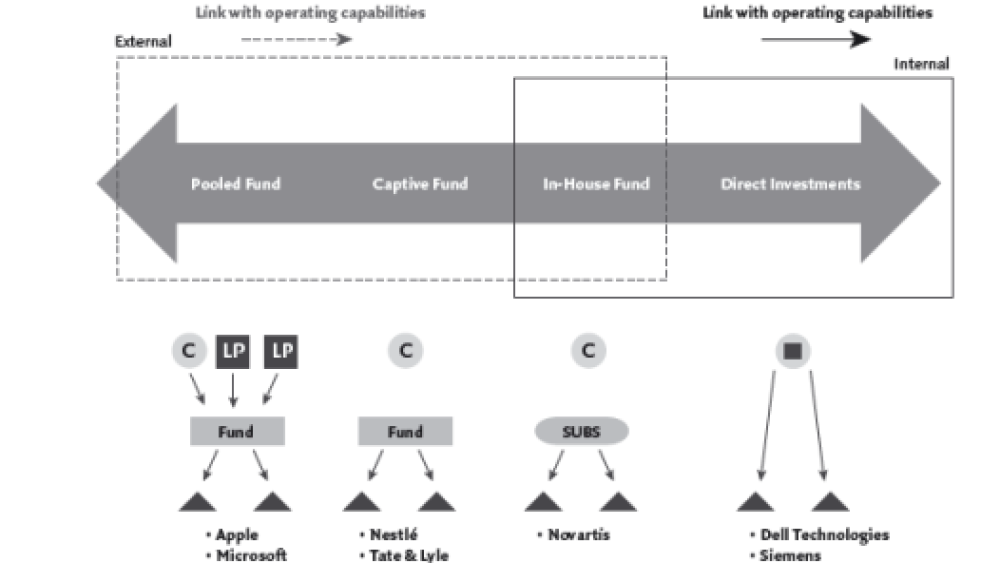
Structuring CVC activities comprises four main elements that should be considered. First of all, there is the general structure of the activities that should be decided on. The investor can opt for an externally managed structure, in this case the investor will act as an LP in a pooled fund or a captive fund. Another option is to set up an internally managed structure, either as an in-house managed fund/subsidiary or by investing directly off the balance sheet. In the latter case, to make direct investments, a company will either create a separate CVC business unit or incorporate its CVC activities into existing business units such as the M&A department or business development department. These internally managed structures allow the investor to manage the investments internally. Subsequent to the general structure, the investor should organize the governance of the investment activities. It is obvious that the organization of the governance goes hand in hand with choosing the general structure, but is also largely impacted by the choice of the general structure. However, structuring the activities does not end after deciding on the general structure and governance at the start of the activities. Investor should, on a deal by deal basis, structure their SPA’s optimally by negotiating the right security design and deal terms.
Impact of the strategy on structural organizational elements
First of all, CVC investor should be careful when choosing or revealing their objectives. Acting too strategically can have negative effects. Strategic investors often invest directly off the balance sheet. This structure does not resonate with the VC ecosystem due to the slow corporate decision making and salary structure. As a result, CVC investors who act overly strategically will have difficulties attracting experienced VC experts to their team. This will reduce the overall quality of the CVC activities. That said, qualitative start-ups might want to avoid these purely strategic investors to prevent a conflict of interest between earlier VC investors, the entrepreneurs, and the CVC investor. Therefore, optimal objectives are moderately strategic or financial.
When beginning its CVC activities, an investor should carefully consider their general structure. Each structure has different characteristics and therefore aligns with certain objectives better than others. The most important characteristic is the degree of involvement of the investor’s existing business units. Since the involvement of existing business units is insignificant in the case of externally managed CVC activities, it can be said that externally managed structures have a higher level of autonomy. Autonomy is a less interesting factor for strategic investors and for investments in start-ups with a close link to the operating capabilities of the investor since a high level of autonomy leads to lower knowledge flow from portfolio companies to parent and negatively affects corporate innovation.
Investors who pursue financial objectives require less involvement from the existing business units to achieve success. CVC investors usually have little expertise in the VC ecosystem and should therefore rely upon experts to make investments focused on ROI. For this reason, externally managed structures are a suitable option. Companies that pursue a purely financial strategy can either invest as an LP in a pooled fund or partner with an institutional VC fund to create a captive fund. In these cases, the CVC activities are fully externalized, relieving the company of the obligation to oversee the staffing and governance of the activities. This is an important advantage for companies that are engaging in CVC activities for the first time or for companies that have a rather small budget for these activities. Moreover, by externalizing them, companies risk no legal liabilities, which reduces overall risk. A valid option for larger or more experienced companies is to create an in-house managed fund. In-house managed funds are beneficial for financially oriented investors since these programs often mimic the functioning of institutional VC funds. These structures can be evergreen or fixed-term, and they provide the management with greater financial autonomy and create more persistent investment management. In-house managed funds and subsidiaries can suit financially oriented investors since they allow the investing company to align the investment team’s compensation with the fund’s financial performance through carried interest. Moreover, this compensation scheme reflects the intentions of the investor and will therefore attract capital-seeking start-ups and VC experts, in turn enhancing the financial performance of the in-house fund. Indeed, a prior study demonstrated just this phenomenon. Siegel et al. (1988) concluded that financial performance is obtained when the corporate venture capital group has nearly independent autonomy and a committed source of funds. However, these attributes did not appear to differentiate strategic performance, excepting possibly in a negative direction when the primary strategic objective was acquisition.
The second dimension of the aforementioned Chesbrough framework can further influence the structure of CVC activities. This dimension concerns the degree to which the activities of the portfolio companies are linked with the operating capabilities of the investor. This link between the portfolio company and investor holds the potential to create synergies. Close collaboration between both start-up and investor will activate these synergies and will allow for the two-way knowledge transfer to take place. Both the start-up and investor, then, will benefit from this collaboration. In financially oriented investments, the knowledge transfer will mainly occur from the investor to the start-up. The more this collaboration and interaction is stimulated, the faster the start-up will learn and grow, resulting in higher returns for the investor. This interaction and collaboration can be stimulated by an internally managed structure. Off-the-balance investments will maximize this activation of synergies and allow the company to customize its governance to match its desired objectives. This will be discussed in the next paragraph. In short, a closer link between the start-up’s activities and the operating capabilities of the investor leads to greater benefits for both investor and the start-up as a result of their collaboration. Therefore, the investor should prefer an in-house managed structure.
Previous discussion has shown that it is possible to create a simplified framework. This framework should allow a company to determine the structure of their own CVC activities. It is important to keep in mind that this is a simplified framework and that the final structure may vary according to other factors, such as budget, experience, magnitude, and industry. The first part of the framework is determined by the investor’s objective. Strategic investors should choose internally managed structures – through an in-house managed fund/subsidiary or direct investments off the balance sheet – whereas financially oriented investors have more choices. They can take an externally managed approach by investing as an LP in a pooled fund or they can create a captive fund in collaboration with an institutional VC fund. They can also, though, opt for a financially oriented in-house managed fund. The second part of the framework is determined by the link between start-ups’ activities and their investors’ capabilities. Investments in start-ups with a strong connection favour internally managed structures. For strategic CVC activities with a strong link between portfolio companies and the investor’s capabilities (driving CVC investments), this means that the-best suited structure is direct investments since this will allow maximal activation of synergies. This contrasts with strategic CVC activities with a weak link (enabling CVC activities) for which the more advisable structure is an in-house managed fund. Direct investments are also possible for investments with a weak link. However, it is better for the investor to create an in-house managed fund, since direct off the balance sheet investments have some disadvantages: slow decision making, indicating misalignment with the interests of possible targets, difficult-to-attract VC experts, and others. If a financially oriented CVC investor plans to invest in a sector that is closely linked to its own operating capabilities (emergent CVC activities), it should incline toward an in-house managed fund. Again, this in-house managed fund will allow more collaboration between the existing business units and the start-up, creating synergies for the start-up. These synergies will eventually help the start-up grow and offer interesting exit opportunities for the investor, resulting in higher ROI. In contrast, when it plans on investing in sectors with a loose link (passive investors), an externally managed structure might be a better fit. For financially oriented investors with weak links, an in-house managed fund is a reasonable option as well. However, since only few synergies between the investor and portfolio companies are possible, an in-house managed fun might be a tedious, expensive, and time-consuming structure.
The same applies to the governance structure as well, a strategic objective and a closer link between the start-ups and operating capabilities leads to greater investor benefits from a governance structure that involve existing business units in the CVC activities. The decision of the governance structure is primarily applicable to in-house managed funds or subsidiaries. If a company structures its activities in-house, it can create governance procedures and structures to maximise collaboration between the existing business units, the investment team and the start-up. For example, referrals from existing business units can be promoted, existing business units can be involved in the due diligence processes or the investment team can give feedback on the market trends it spots when searching for targets.
Along with the collaboration channels between the investment team and the business units, the company should also carefully structure the committees that will be involved in their CVC activities’ investments. The committees are created to support or control the investment team. The first committee that must be established is the investment committee, which is also one of the most critical. This committee ultimately decides whether or not an investment is made. The composition of the investment committee should reflect the objectives the investor is pursuing. First and foremost, the investment committee will include the managers of the CVC team. This is the case for every CVC team regardless of objective. Second, the investment committee includes executives or highly ranked people from the investing company. This category can be influenced by the objectives of the investor. If the investor’s objectives are mainly financial, the investment committee should include the CFO and other financial executives of the investing company in addition to the CEO. In contrast, if the company pursues strategic objectives, more technical personnel – including managers of business unit, CTOs, and CDOs – should be added along with the CEO. The next crucial committee that must be established is the advisory board. Members of the advisory board are usually high-profile experts with deep industry knowledge of the sectors the investment team is interested in. Their role is to advise the investment team on the investment, flag interesting companies, and inform them of evolutions, problems, and solutions for these problems in their sectors. A successful advisory committee can significantly influence the overall success of CVC activities. Companies can choose to establish an external advisory committee and an internal advisory committee or mix internal and external into one advisory committee. External members have no ties with the investing company and bring a crucial external view to the evolutions. The unbiased nature of this view can lead to new investment ideas or lead to the abandoning of particular investments. Internal personnel, however, are crucial for a strategic fit. They thoroughly know the products, technologies, and processes of the investing company and can therefore give advice on what sectors or technologies are interesting to invest in and boost the investor’s own business. Hence, the attendance of internal members on the advisory board will be more crucial to success for strategic investors than for financially driven investors. Finally, also investors in externally managed structures might attempt to negotiate specific rights in the LPA that can augment their involvement in the externally managed structure. In a captive fund, sole LPs will succeed more easily in negotiating these rights than LPs in a pooled fund.
Finally, when it comes to securities design and deal terms, CVC investors can ultimately adapt their investments according to their objectives by negotiating the right securities design and deal terms in the SPA. It should be noted that securities design is hardly influenced by the strategy, both strategic as well as financial investors opt for preferred shares where possible since preferred shares increase profitability, reduce risk, and incline the entrepreneurs to achieve greater exits. So, there is no difference between strategic or financial investments, however the difference is found in deal terms that come with the negotiations of these securities. A financial CVC investor’s deal terms should resemble those of SPA’s of institutional VC funds, whereas strategic investors should negotiate additional strategic rights. However, as mentioned previously, strategic investors should avoid undue aggression when negotiating these strategic rights, such as options to buy, right of first refusals, and others. This could frighten certain potential targets.
Limits of the research
This conclusion is based on a rather simplified world in which companies are either strategic investors or financial investors and that they have either a close or a weak link with the start-up’s activities. The reality, however, will be more complex. It will, then, be up to the companies to determine their main objective, budget, and schedule. Moreover, large companies can have multiple structures depending on the objectives they pursue. This has also been proved by the Solvay Ventures case study. This CVC investor has a mixed objectiveThe case study showed that they made a good trade-off between structural and organizational elements that favour strategic or financial results.