

The ETF industry has seen immense growth in the past decade and continues to defy average statistics for any previous financial instrument. However, the industry can no longer rely on lower costs and quick liquidity to rival traditional mutual funds. This is where Green ETFs come in place, as ESG investing becomes paramount to investors and asset managers alike. This work aims to analyze the performance and volatility dynamics of such exchange-traded funds, defined as those comprising stocks with a positive environmental impact. The paper uses a statistical sample of funds data on returns from January 2015 to July 2019.
The ETF playground
Some previous research focused on the role and performance of exchange-traded funds in the current market scenario. Also called ETFs, they can be defined as a basket of assets aiming to mimic the evolution of an index, by holding the individual members of such index within the fund.
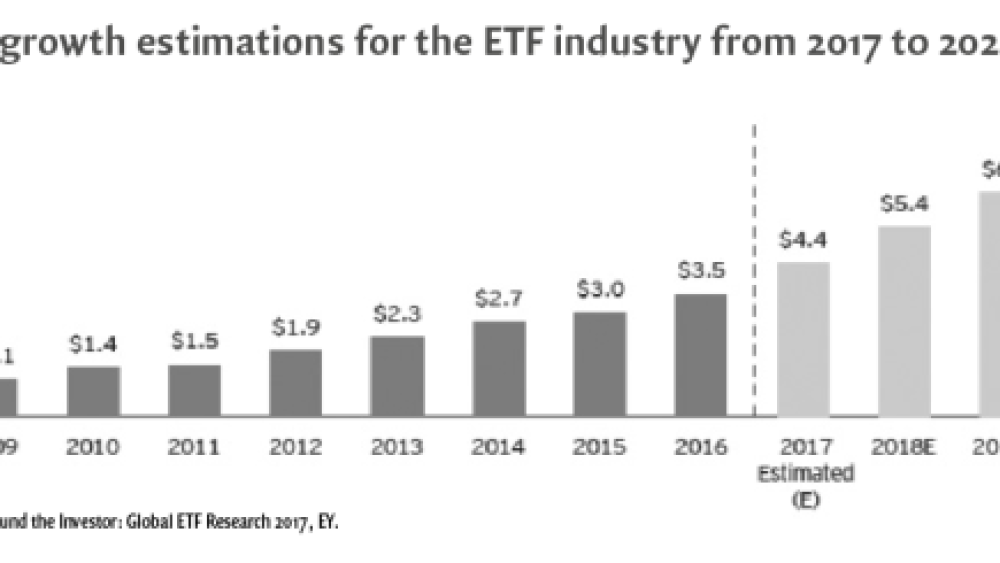
Total ETF assets, which amounted to $417b at the beginning of 2005, have increased to $5.1t in the last quarter of 2018 (growing at a pace of 20% annually). In terms of geographical segmentation, the United States represent two thirds with $3.6t in AUM, followed by the fast-growing European market which achieved almost $0.8t in the same year.
A set of social and financial trends has boosted such remarkable increase in the use of ETFs: autonomous planning for retirement, a low-yield environment, the evolution of technology in investment to facilitate online distribution and an appetite for passive investments in order to reduce costs. On this last point, a growing consensus among investors is that only a selected number of active strategies can constantly yield positive alpha versus its benchmark after costs are deducted.
A survey conducted by EY (see Figure 1) suggests the overall ETF industry might surpass the asset management industry itself, with a predicted annual rate of growth of 18%, and a potential net AUM of $7.6t by the end of this decade.
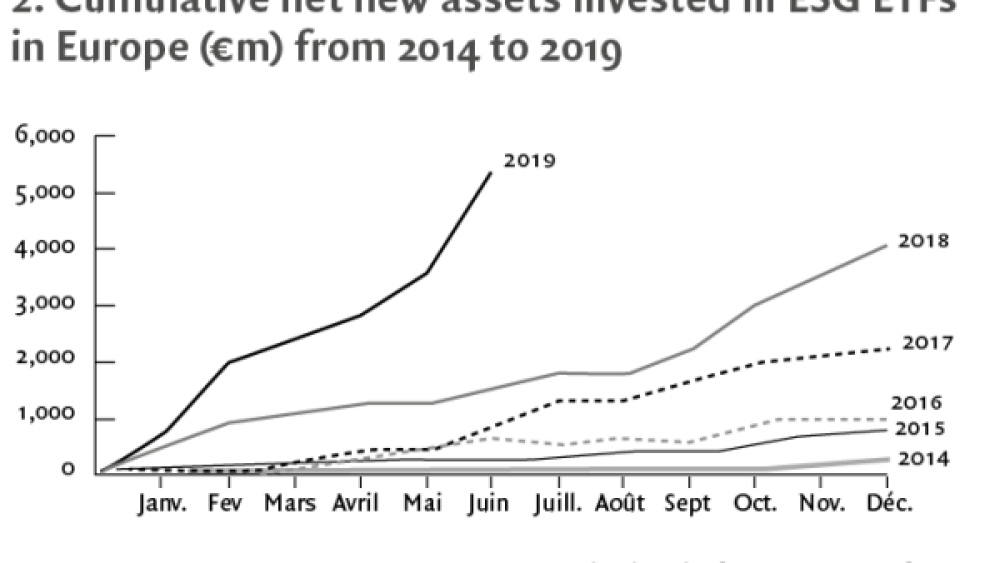
However, despite ETF growth, it is important to signal that the industry can no longer rely on lower costs and quick liquidity to rival traditional mutual funds. Therefore, innovation becomes a key issue for asset managers aiming to provide exchange-traded funds. As a creative response, thematic ETFs have become increasingly popular, allowing investors to take a specific view on the market; something only achievable through traditional mutual funds in the past.
This is where Green ETFs come in place. They are funds with a primary focus in green equities, which are tied to companies with policies that have a positive environmental impact. They are a part of the larger ESG (environmental, social and governance) investing category. Currently, it is in vogue for companies to establish proper ESG strategies, as there is both a responsibility towards shareholders and stakeholders to be socially responsible in this aspect.
According to a survey performed by Brown Brothers Harriman (2019)
Narrowing down the data
To identify our data sample, we relied on the expertise of ETF Database, a platform that has become today’s biggest independent international content provider on these funds. In particular, we selected the database containing environmentally responsible funds ,which evaluates ETFs across sixteen indicators, the main one being Revenue Exposure to Environmental Impact (the fund’s weighted mean of each firm’s percentage of revenue generated by products and services with a positive impact on the environment).
After filtering 1.568 listed funds according to the mentioned criteria, we picked those with an impact above 10%, to get the most representative environmentally friendly ETFs. We then screened those with price and return data available for a minimum span of 4 years, resulting in 43 funds. They are dollar-denominated, with a global geographic exposure (some with a focus in the US or Europe but not exclusively). We finally subdivided the sample in three ranges: high impact (more than 30%, 8 funds), moderate impact (between 15% and 30%, 13 funds) and low impact (between 10% and 15%, 22 funds).
Since data on returns for green ETFs is rather recent due to their late creation, and to have a larger sample of funds than in previous papers, we extracted daily returns for the period starting on January 02, 2015 and finishing on July 31st, 2019. Our research uses data both on risk factors and volatility levels for the same time frame. Given the funds’ predominant global exposure, we extracted daily global risk factors from Kenneth R. French’s online data library, which match the time period and represent an up-to-date version of the ones presented by Carhart (1997). In the absence of a global volatility indicator, and considering funds are dollar-denominated and with a significant percentage of American equity across the different funds, we extracted daily levels of CBOE’s Volatility Index (VIX) as a proxy for market turmoil.
Exposure of returns to systematic risk factors
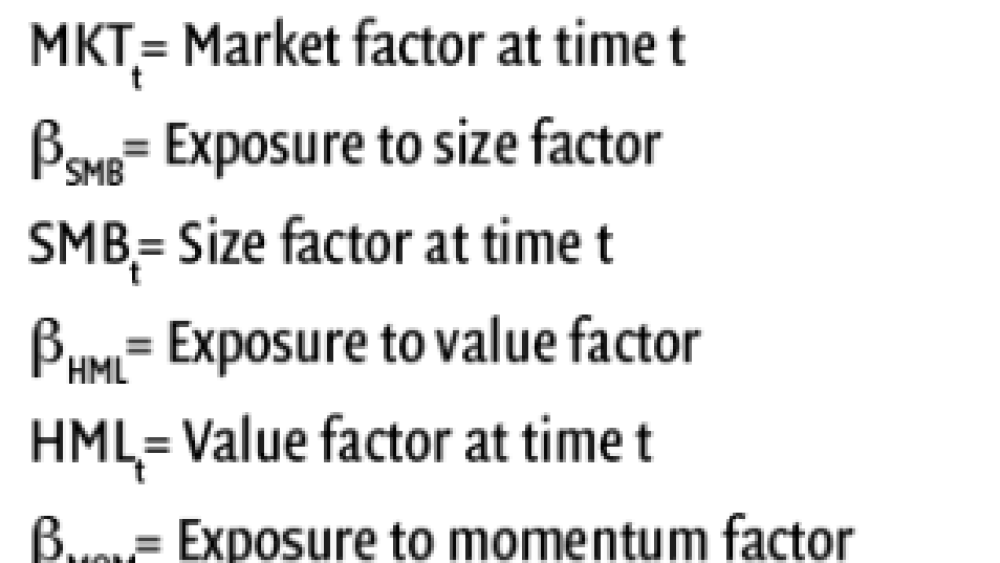
We started by analyzing the performance and volatility of green exchange-traded funds compared to the market benchmark and through the Carhart multi-factor model, with the addition of a volatility factor. We tried to determine what is the exposure of green ETFs in terms of their return performance to five systematic risk factors:
1. MKT (Excess return on the market) is the differential in return between the market benchmark and the risk-free rate of return (in this case the one-month T-bill rate). Given the predominantly global reach of our sample, we used French’s Developed Markets series, which includes an equally weighted portfolio across the key geographies in America, Europe and Asia.
2. SMB (Small Minus Big) is the difference between the mean return on a portfolio of small capitalization stocks and the mean return of a comparable portfolio composed of large capitalization stocks.
3. HML (High Minus Low) is the difference between the mean return of a portfolio composed of value (high book-to-market) stocks and the mean return of a portfolio composed of growth (low book-to-market) stocks.
4. MOM (Momentum) represents the difference between the average return of a portfolio of high-performing companies and that of a portfolio of low-performing companies, with a delay of one month (Carhart, 1997).
5. 2VOL (Volatility) represents an additional fifth factor: market-wide volatility. To use this indicator in our regression model, we verified in the first place if the data series showed a stationary process during the time frame of our research.
Regarding exposure to the market factor, Munoz et al. (2013) concluded that mutual funds with ESG screening criteria tend to underperform the market benchmark. We expected therefore to have underexposure behavior to the MKT factor for our pool of green funds. In addition, we estimated our results would be in line with those of Nofsinger et al. (2014) in terms of positive exposure to the SMB factor. In their research, they proved how green mutual funds are built by using screening policies which invest more in small cap companies. These have a higher profit potential, which makes their cashflow estimations to be solid and their volatility rather stable.
Exposure to HML and momentum factors has been found not significant for ESG and Green mutual funds by previous research (Nofsinger et al., 2014; Leite et al., 2015). Consequently, our intuition regarding these two parameters, as well as our fifth volatility factor (not tested before in the available literature), was that they would not be significant for the vast majority of funds.
To assess the performance of each fund versus the above-mentioned benchmarks, we applied our model individually, and the base multi-factor model tested can be described as the following: see Formula 1
We studied not only the sample of funds as a whole, but also explored three subsections depending on the percentage of revenue with a positive environmental impact (cf. Data Sample subsection), to see if it affects the exposure to the model factors significantly. The results from applying the model to each fund can be found in Table 1 (empty cells represent non-significant coefficients of regression).
To assess the quality of the results, we considered the probability p attached to each coefficient, and considered them not significant when it was above 10% (i.e. the confidence level set for interpretation was 90% at a minimum).
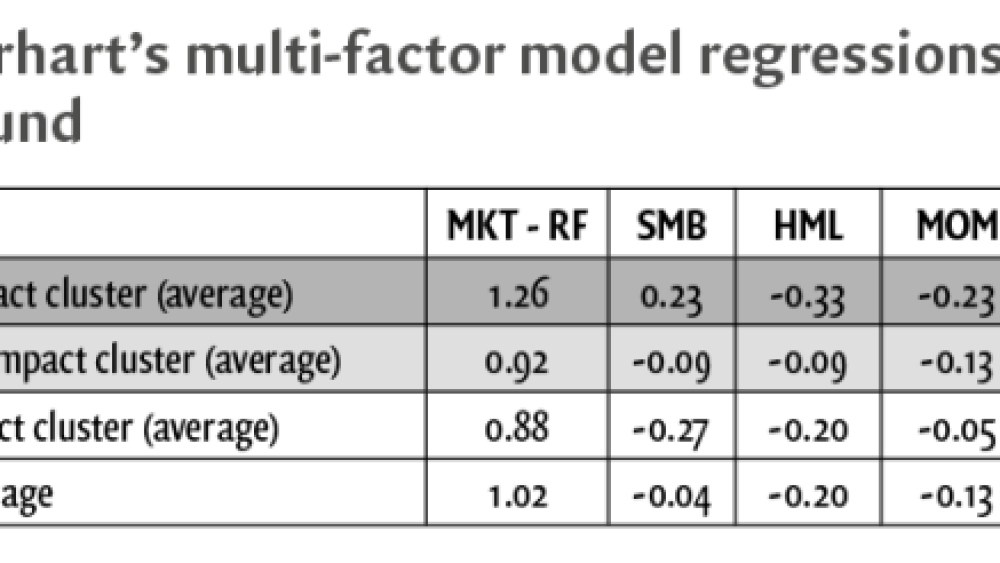
By using the average (among significant cases) of each exposure coefficient, we can observe our first hypothesis to be refuted, as our research contradicts the observations of Munoz et al. (2013). In terms of exposure to the market benchmark, we see this factor is significant across the sample, and in fact most of the funds are over-exposed, as the pool shows an overall β_(MKT) equal to 1.02. This can be interpreted as green ETFs having returns which closely mimic those of the overall global equity market.
Furthermore, regarding size and value factor exposure, we find in fact negative average exposure across our pool of funds. This contradicts our hypothesis, showing a different result to that found by Nofsinger et al. (2014). Our last hypothesis in this section is corroborated partially, regarding momentum and volatility factors, as they are both not significant in the majority of funds. However, exposure to the book-to-market factor is considered significant in more than two thirds of the sample, therefore refuting our intuition on this aspect.
If we perform a comparison across the different subgroups, we observe some of the risk factors behave differently depending on the cluster. Indeed, we can see that funds with a higher percentage of positive environmental impact possess a higher exposure to the market benchmark than those with a lower impact. This is an important conclusion, as we can potentially state that as an ETF focuses more on green and ESG criteria, it increases its beta and could therefore magnify market movements both on the upside and downside. In addition, we observe that for greener exchange-traded funds, the momentum factor becomes relevant in more than 75% of the funds of such cluster, with an average negative exposure of -0.23.
Finally, we can conclude that the average beta for the market factor is significantly higher and more significant to explain the performance of a green fund in linear terms than the remaining risk factors. Concerning the R-squared indicator for each regression, we were only able to obtain a high level of explanatory power (more than 70%) for the model in less than 10% of the fund sample. Such statements justify a suggestion to continue exploring what other factors (such as social trends and presence in the news of environmental subjects) or types of model (e.g. non-linear models), could potentially explain the rest of the performance of green exchange-traded funds.
Introduction of volatility to determine non-linear behavior
After a linear approach, we investigated how market volatility could potentially introduce a non-linear dynamic into the funds’ behavior. Such intuition was further cemented when observing a low explanatory power of the volatility factor under the linear model in our preliminary results.
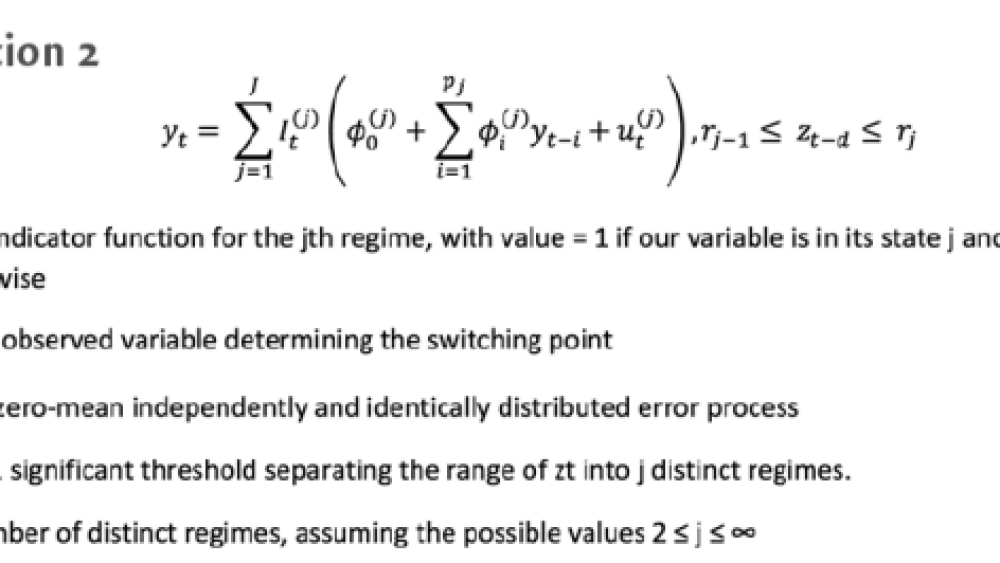
To evaluate how market-wide volatility affects the behavior of green ETFs’ returns, we decided to use a model proposed by Tong and Lim in 1980: A Threshold Autoregressive (TAR) model. It provides a larger amount of adaptability in the use of regression parameters, as it allows to study the impact of our previous risk factors under the perspective of a regime-switching behavior.
Such change in regime (or threshold) will depend on the past values of our volatility data series, and the model will identify them if it finds statistically significant differences in the coefficients of the multi-factor model from one threshold to the other. After carrying out the analysis, we saw discrete variations (three or less) across our entire universe of funds.
As far as we know, no previous study has conducted an assessment on how overall market volatility can affect the behavior of green ETFs and their exposure to a multi-factor model. By introducing a TAR model, we believed it would show significant non-linear behavior in our sample’s returns. In particular, we expected volatility to be significant only in stable periods, whereas in crisis periods we expected it to be non-significant due to potential downside risk protection from this type of assets. For this last interpretation, we tried to see if the results of previous research showing signs of downside risk protection on ESG and green mutual funds (Munoz et al., 2013; Nofsinger et al., 2014) were consistent within the exchange-traded fund universe. Such different factors were tested for non-linear behavior by using the following TAR equation: see formula 2
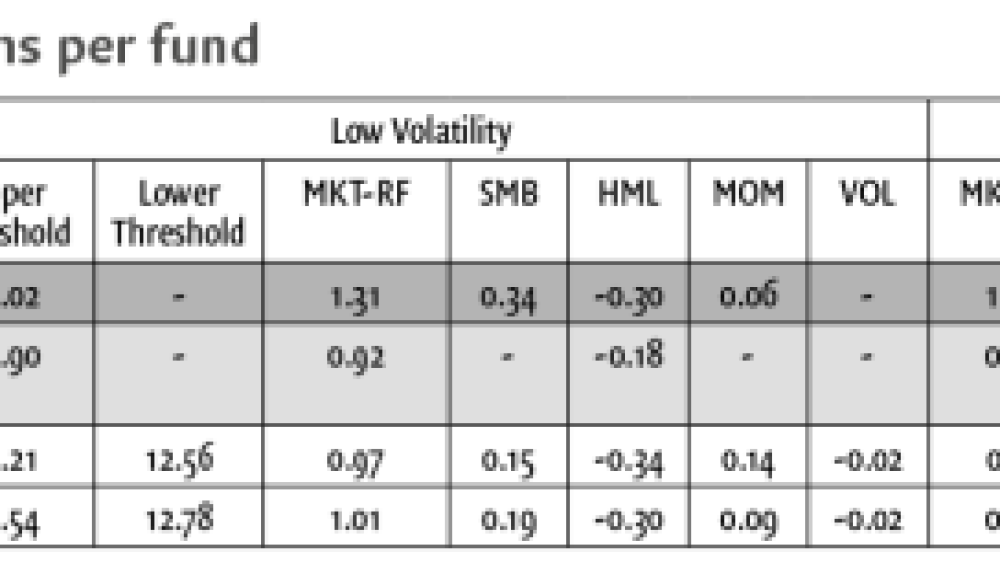
To see if a non-linear model would explain our fund sample better when changing from a regime of high volatility to a regime of low volatility, we first performed our analysis on the pool as a whole, and then applied our granular approach. The results from applying the model to each fund can be found in Table 4 (empty cells represent non-significant coefficients of regression).
We applied once again the same criteria regarding the probability p attached to each coefficient. First of all, we observe that a majority of green ETFs showcase a significant difference in behavior depending on the level of market-wide volatility, with more than 85% showing at least one relevant threshold when applying the TAR model on its historical return series. Our first hypothesis is therefore validated, as there is significant evidence of non-linear behavior depending on the level of volatility.
Regarding the thresholds, we observed the majority of funds only showing two distinct regimes, which we labeled low and high volatility respectively. On average, that threshold was around 18.54 points, which is somehow consistent with common knowledge that when VIX volatility surges above 20 points this indicates market-wide turbulence. Few funds identified a third intermediary regime, which has not been considered for the purposes of this analysis as it included very few observations.
Results convey there is a statistically significant difference in the exposure to the market factor in between regimes. More than 95% of funds decrease their β_(MKT) in periods of high market turmoil, therefore showing that green ETFs lower the amount by which magnify market movements when volatility increases.
With respect to the SMB and HML factors, we notice some cases where a positive exposure under the low volatility regime changes into negative exposure when switching regimes. Unfortunately, the evidence is not conclusive in our opinion, as this is not the case in most funds either as a whole or in the three individual clusters.
Finally, regarding the volatility factor, more than half of the sample presents a significant negative exposure to it when entering a high-volatility regime, whereas it is not significant in general in the low volatility regime. We understand the results do not apply to a vast majority of the sample, but they lead to refuting our hypothesis, which claimed no impact of the volatility factor under market turmoil phases. Our results contradict the notions introduced by authors pushing for downside risk protection arguments (Munoz et al., 2013; Nofsinger et al., 2014). We recommend conducting research upon a longer time series to see if it can carry more conclusive results in terms of significance of the indicators.
Following the granularity approach, the only relevant observation is that the momentum factor has a persistently negative exposure for greener funds. This places the previously identified exposure to momentum to happen mostly on periods of crisis.
Volatility dynamics under a GARCH model
The final research axis focused on determining whether mean-returning properties can be identified in the volatility processes of green ETFs, therefore revealing a stable volatility process. Previous research on the matter of volatility dynamics shows contradictory results.
If we follow the work of Sabbaghi (2011), we can see it points towards green ETFs’ returns following a GARCH model, where conditional volatility relies on past conditional volatility, and with a persistence effect. On the other hand, Chen et al. (2013) conclude that no long-memory or persistence effect exists within the volatility of the returns of these funds.
Given that both studies were conducted in a different time frame, and that the samples of funds were smaller than the one used on this paper, we tested this question again. As some previous research on mutual funds (Leite et al., 2015) shows evidence of lower volatility for green mutual funds, we adopted a hypothesis where green ETFs follow mean-returning behavior, a sign of a stable volatility in returns.
To estimate a GARCH model, we performed Engle’s test to measure ARCH features and ensure the pool of data employed fitted this model. After running our linear regression (with five risk factors including volatility), we tested its squared residual terms and regressed them using q = 4 lags.
After performing such verification, we used the GARCH model itself, developed by Bollerslev. The Generalized Autoregressive Conditional Heteroskedasticity model (GARCH) lets conditional variance (σ2t) of the returns of a fund to be reliant on the long-term variance value α0, information regarding the previous time frame’s volatility (α1 u2t-1) and the values of variance given by the model in the previous time frame (β σ2t-1). The equation used can be found below: see Formula 3
The GARCH model can adopt several lags on both the u2t-p and σ2t-q terms. Following existing literature we used a GARCH(1,1) model with one lag on the squared error term and the conditional variance itself, as we considered it is enough to test volatility clustering in our sample of data and “rarely is any higher order model estimated or even entertained in the academic finance literature”.
Like in previous sections, we first performed our analysis by observing the pool as a whole, and then we applied our granular approach. The results from applying the model to each fund can be found in Table 5.
Only 53% of the funds presented a behavior of returns that can be modeled by a GARCH (1,1) regression. Hence, the scope of our results cannot be considered to reflect most of all green ETFs. However, a significant percentage of funds on the high impact cluster presented this characteristic, with almost 90% of the sub-sample. No majority was found on the other two clusters with medium and low impact respectively.
Regarding the long-term variance coefficient, it was null across all funds, despite the different subsections and in particular in our high-impact cluster. We can therefore point to the lack of a long-term variance constant in the returns of green-exchange traded funds, within the limitations of representativity mentioned above.
When looking at the α1 + β combinations, we observed all the funds showcased a mean-reverting property, as the sum of the two coefficients is always below one. This confirms our initial hypothesis, which pointed towards a stable volatility dynamic for the funds’ returns. In particular, we notice higher values of β for those funds considered greener or with a higher impact, which makes them have a longer return to their mean after a market shock than lower-impact counterparts.
In addition, and consistent with Sabbaghi’s (2011) results, our research shows that present conditional volatility for green ETFs relies significantly on past volatility on a relative basis. On the other hand, all α1 coefficients are below 0.2, which states market shocks do not carry a long-lasting impact on the volatility process of green ETFs.
Conclusion
Regarding the explanation of performance through the linear multi-factor analysis, we obtained statistically significant overexposure to the market factor across all funds in average, followed by a negative exposure to the size and book-to-market factors. However, no evidence of significant exposure to momentum and volatility factors was found. When introducing the TAR model, we found conclusive evidence of non-linear behavior in the returns of green ETFs, with more than 85% of the sample fitting the new model. Regarding exposure to factors, we noticed market beta decreased across all clusters when high levels of market volatility were introduced. Our hypothesis regarding the lack of exposure to the volatility factor during crisis periods was partially refuted, as it was significant in only half of the sample. Finally, when analyzing volatility with the GARCH model, a stable volatility process was observed through the coefficients of the model, confirming our last hypothesis of mean-reverting behavior, in particular for greener funds.
Some limitations were found when writing this paper. The time frame used, even if significant by itself spanning over the course of more than four years, should be enlarged as the funds gain a longer track record on the market. Concerning volatility dynamics, it could be interesting to study how shocks in volatility of these green exchange-traded funds carry a repercussion in the overall stock market and the performance of firms who identify as environmentally friendly. Finally, another area for further research to focus on could be the inclusion of variables that are not market-related (e.g. social media trends, environmental awareness) in order to increase the explanatory value of the TAR multi-factor model in predicting future returns and their volatility.