
Climate change is today one of the biggest, if not the main, concerns of our century. Since the late 1990’s, we have witnessed several attempts to slow global warming down and reduce greenhouse gases concentration in the atmosphere. These attempts are classified into two categories: emission trading systems and carbon taxes.
In emission-trading schemes, such as the EU ETS, the total level of greenhouse gases emissions is capped such that industries with low emissions can sell their surplus of allowances to larger emitters. A market price for greenhouse gases emissions is then implemented through the creation of emission allowances supply and demand.
This paper is therefore focusing on two paths of study: first, analysing market efficiency in the European Union Emission Trading Scheme and, second, identifying the factors driving carbon price formation.
The European Union Emission Trading Scheme (EU ETS)
In 1997, the Kyoto Protocol was adopted with the objective to reduce greenhouse gases emissions by at least eight per cent compared to the levels of 1990 over the so-called Kyoto commitment period, from 2008 to 2012.
In order to reach this target and reduce C02 emissions from the energy and other carbon-intensive industries companies, the European Union implemented the European Union Emission Trading Scheme (EU ETS) as of January 1st, 2005. The EU ETS is a cap-and-trade market in which the tradable asset or commodity is the right to emit a specific amount of C02.
Being the first of its kind, the European Union Emission Trading Scheme quickly became of interest, as it set a new market that would be able to open the way to other schemes.
The carbon market has become more complex over time with a full range of instruments from vanilla ones, like spot, to more exotic ones such as derivatives. Therefore, not only regulated installations but also risk managers and traders are taking positions in the carbon market and have to hedge themselves against any unexpected and sudden price change. While regulated installations may be more focused on the long-term price in order to be ready for compliance period, risk managers and traders are involved in both long and short-term positions.
The interest of studying the price of carbon lies in its artificiality. The difference between carbon trading and usual commodities trading indeed mainly stems from the fact that the underlying of carbon trading is the absence of carbon and not its existence. By producing less emissions than they are allowed to, sellers are able to sell their surplus of emission allowances to the regulated installations that emit more than allowed. As a consequence, emission allowances can either be defined an asset or a liability for the obligation to cover carbon emissions.
Market Efficiency in the EU ETS
Fama (1970) characterises the “ideal market” as “a market in which firms can make production-investment decisions, and investors can choose among the securities that represent ownership of firms’ activities under the assumption that security prices at any time fully reflect all available information”. This characterises an efficient market, in which no abnormal profit can be earned from past information and no systemic prediction can be implemented.
The relative youth and immaturity of the carbon market were able to explain the lack of market efficiency across Phase 1 of the European scheme.
On the other side, the second phase of the EU ETS has been considered as market efficient (Montagnoli and de Vries, 2009), suggesting the European carbon market started to demonstrate signs of maturation as soon as the first period of Phase 2, after a learning and trial phase. This progression in the EU ETS market efficiency was mainly due to the changes implemented across Phase 2 in order to develop market confidence and increase market liquidity, through the revision of short selling and banking restrictions.
Data
In order to test the EU ETS market efficiency and compare the results between Phase 2 and Phase 3, we used the daily spot returns of European Union Allowances from the European Energy Exchange (EEX) denominated in euro. The data sample runs over the period from January 1st, 2010 to December 31st, 2012 for Phase 2 and over the period from January 1st, 2013 to September 30th, 2019 for Phase 3 of the EU ETS. The start date has deliberately been defined after the real start date of the EU ETS second phase, which is in 2008, to avoid any noise in the results due to the 2008 economic crisis.
Hurst Exponent Analysis
We used the Hurst coefficient (or exponent “H”) to capture long-term dependence structure and therefore evaluate the European carbon market efficiency across Phase 2 and Phase 3 of the European Union Emission Trading Scheme.
The Hurst exponent value allows comparison between time series based on their dependence structure. For H = 0,5, long-term memory is considered to be inexistent such that the market could be consistent with market efficiency. For 0,5 < H < 1, there is a long-term dependence structure, qualified as a “persistence effect”, implying that “the time series will show clusters of comparable values”. Finally, for 0 < H < 0,5, the market shows a short-term dependence structure that can be qualified as an “anti-persistence effect” (Fouquau and Spieser, 2014).
Results
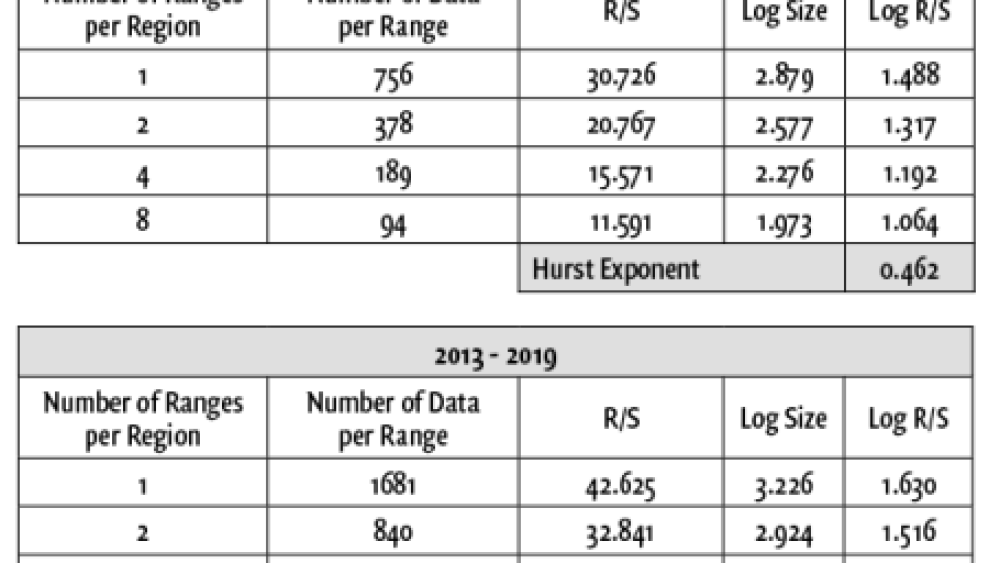
The results (see Table 1) show that the European carbon spot market can be qualified as efficient. For both Phase 2 and Phase 3, the Hurst exponent value is approaching 0,5, which represents random walk behaviour in the market returns. We can also see that the Hurst exponent value is closer to 0,5 for Phase 3, showing that market efficiency has improved between Phase 2 and Phase 3.
Carbon Price Drivers
Once the emission allowances are allocated for the compliance period, they are considered as a tradable asset, which price is formed by the market’ supply and demand. Nonetheless, emission allowances value differs from the one of classical stocks. The value of a stock indeed derives from the expected profits of the underlying firm while the price of emission allowances is driven by the expected market scarcity.
Emission allowances also differ from more traditional commodities, as they actually represent the non-existence of CO2 emission. These allowances therefore are considered either an asset or a liability for covering firms’ emissions.
Carbon price drivers can be split between two categories: the policy and regulatory issues and, on the other side, the market fundamentals reflecting the production of CO2.
Short-term prices are particularly impacted by changes in policy directives or regulations. The effect these changes have on emission prices can be compared to the impact bad or good news have on a company share price.
On the other side, carbon prices are sensitive to fluctuations in CO2 production levels, coming from various sources, such as “weather data (temperature, rainfall and wind speed), fuel prices and economic growth” (Benz and Trück, 2010). Energy variables have been identified as the most important drivers of the EUA prices, mainly because the electricity sector accounts for about a third of the European CO2 emissions and hence is the main sector covered by the EU ETS regulation.
Unexpected environmental events have also been identified as having a significant effect on EUA prices (Mansanet Bataller et al., 2006) and as shocks on supply and demand.
Carbon prices also depend on economic activity and growth, as they react to the health of the main economic sectors the EU ETS covers through their emissions net short/long positions (Alberola et al., 2007).
Data
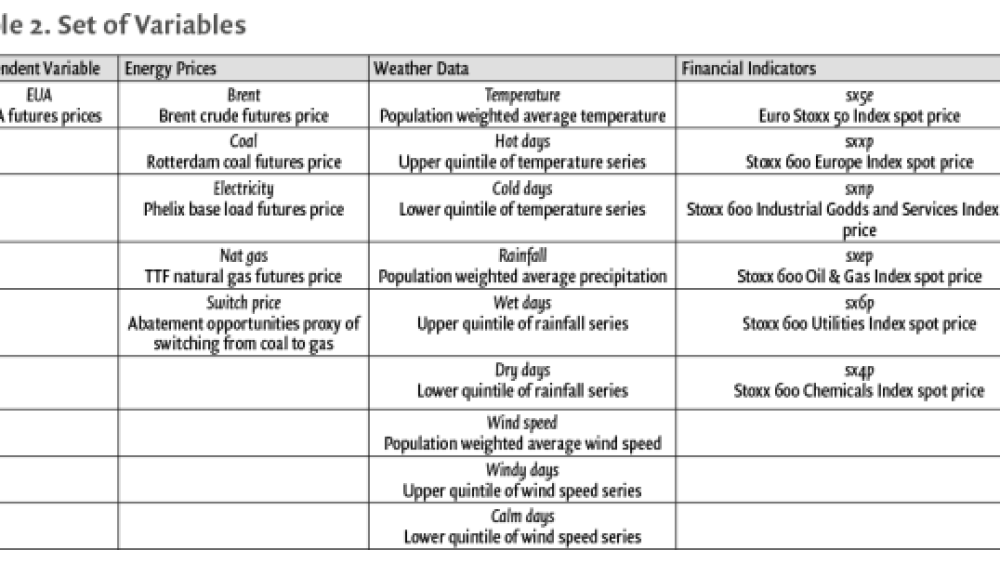
We classified identified carbon price drivers among three categories: energy variables, weather data and financial indicators; and our analysis focused on 20 specific drivers from these categories (see Table 2). The dataset covers the same periods as for market efficiency analysis.
Time Series Analysis
In order to identify the significant drivers of carbon price in Phase 2 and Phase 3 of the European Union Emission Trading Scheme, we used linear regressions through two different processes to highlight both long-term and short-term relationships.
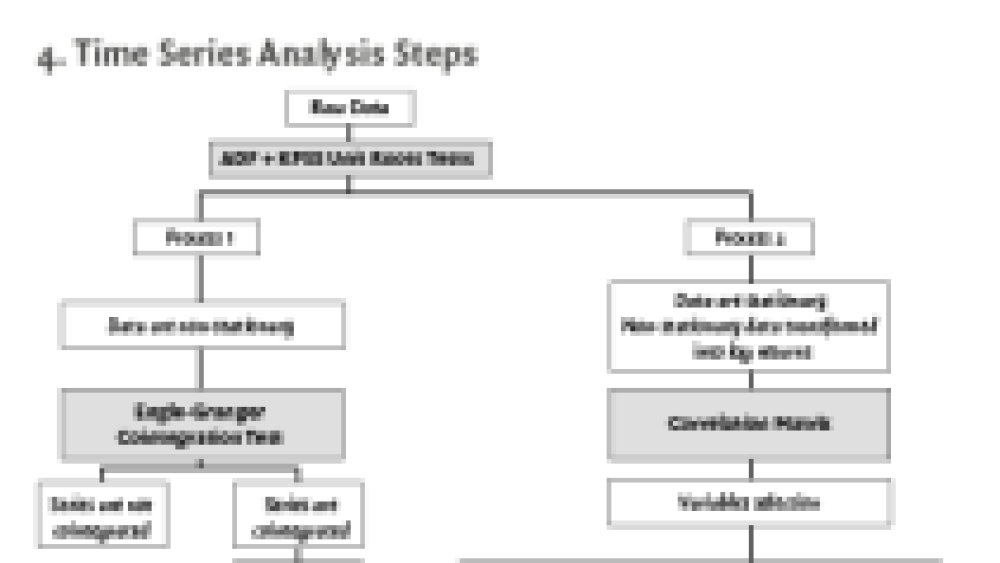
For both analyses, the first step consisted in testing whether the series are stationary or not. The Augmented Dickey-Fuller (ADF) test and the Kwiatkowski, Phillips, Schmidt and Shin (KPSS) test were used.
For long-term relationships, if time series were found to be non-stationary, the Engle-Granger cointegration test would be performed in order to define whether time series were cointegrated. If that was the case, OLS regressions would be drawn accordingly in order to identify long-term relationships between the futures price of carbon and the explanatory variables.
For short-term relationships, if series were found to be non-stationary, they would be transformed into their natural logarithm first difference. A correlation matrix has then been constructed to identify the potential explanatory factors. This matrix measures the relationship intensity between the dependent and explanatory variables as well as between the explanatory variables themselves. It allowed building various regression combinations, taking into account co-linearity between explanatory variables.
For each regression, specification of heteroskedasticity and autocorrelation in the equation residuals were tested to increase the model validity.
If neither heteroskedasticity nor autocorrelation were found, Ordinary Least Squares (OLS) regressions would be used to identify the significant short-term drivers of carbon price. If heteroskedasticity existed, the Huber-White adjusted method would be used while the HAC (Newey-West) adjusted method would be performed if autocorrelation alone was found or if both heteroskedasticity and autocorrelation existed.
Finally, the regression with the highest explanatory power was tested for heteroskedasticity ARCH effect. If an ARCH effect was found, the model would be re-evaluated through an ARCH regression (see Figure 4 at the end of this article)
Long-Term Relationships Analysis Results
For Phase 2, the regressions results show that the price of coal and electricity and the Stoxx 600 Utilities Index (SX6P) value have a significant positive impact on carbon price while the Stoxx 600 Oil & Gas Index (SXEP) value has a significant negative driving effect.
When adding weather data variables, we see that temperature has a significant positive impact on carbon price while the driving effect of wind speed is negative, even though less significant than temperature. Also, both hot and cold days are found to have a significant impact on carbon price, respectively a positive and negative one, while only windy days have a significant negative impact on the price of carbon.
For Phase 3, the regressions results highlight that the price of electricity, the Stoxx 600 Utilities Index (SX6P), the Stoxx 600 Oil & Gas Index (SXEP) and the Stoxx 600 Industrial Goods and Services (SXNP) value have a significant positive impact on carbon price.
When adding weather data variables, we see that wind speed has a significant positive impact on carbon price. Then, hot days only are found to have a significant negative impact on carbon price while both windy and calm days have a significant impact on carbon price, respectively positive and negative.
Short-Term Relationships Analysis Results
For Phase 2, the regressions results (both Least Squares and ARCH) show that electricity, natural gas and switch prices along with the Stoxx 600 Chemicals Index (SX4P) value have a significant driving effect on carbon price, all positive except for the switch price.
For Phase 3, the regressions results (both Least Squares and ARCH) show that Brent, electricity and natural gas prices along with the Stoxx 600 Industrial Goods and Services (SXNP) value, dry days and calm days have a significant short-term driving effect on carbon price; all positive except for dry days. In Phase 3, weather data have therefore a little more impact than in Phase 2.
Conclusion
The results prove market efficiency across both phases, with an improvement between Phase 2 and Phase 3. We can therefore consider that the EU ETS is now a mature and efficient market.
Long-term relationships analysis results show that electricity and the Stoxx 600 Utilities Index (SX6P) value are the most stable drivers of carbon price over Phase 2 and Phase 3. These results also highlight that weather data are also significant drivers and that, as time passes, extreme weather events are becoming more significant than the basic weather series.
As for the short-term relationships, even though some regressions designated several variables as significant drivers of carbon price, we conclude that, due to these regressions weak explanatory power, no short-term relationships can be identified for either phase.