

How large asset managers exercise their control rights is an important part of the investment process.
Active ownership, or investment stewardship, includes proxy voting, engagement, and other forms of influence that investors can use as financial stakeholders. These forms of influence can be used in combination as complementary strategies to manage investment risk and create investment opportunities.
By voting on items that appear on corporate proxy ballots, shareholders can shape corporate governance practices. The influence exerted through proxy voting can be leveraged in asset managers’ engagements with investee companies. Proxy voting can be used as an escalation strategy where engagements do not progress satisfactorily and can also signal an asset manager’s conviction that a specific issue is a material market-wide financial risk.
Across the financial system, investors and regulators are focusing more attention on the stewardship role of financial institutions in addressing sustainability risks. The new UK Stewardship Code 2020 “…recognises that asset owners and asset managers play an important role as guardians of market integrity and in working to minimise systemic risks as well as being stewards of the investments in their portfolios”.
With the growth in fund investing over the last 30 years and the more recent rise in passive investing, large asset managers’ investment choices have powerful market impacts. Regulatory developments and stewardship codes, global investor coalitions, and rising expectations of fund investors and institutional clients are shaping a new stewardship practice that emphasizes the fiduciary responsibility of asset managers to be stewards of capital markets. This means that asset managers have a responsibility to exercise their influence as owners to protect portfolio value on behalf of clients and beneficiaries, as well as to address system-wide risks such as climate change, biodiversity loss, human rights and political capture.
This article reviews recent Morningstar research on proxy voting and climate-related engagement practices by large global asset managers.
Asset Manager proxy Voting
Recent Morningstar research looked at how asset manager providers of 50 large U.S. fund groups voted on 1,033 sustainability resolutions across five years: from 1 July 2014 to 30 June 2019.
Two key findings emerge from this research.
1. Asset managers are supporting more ESG resolutions, but the largest asset managers lag
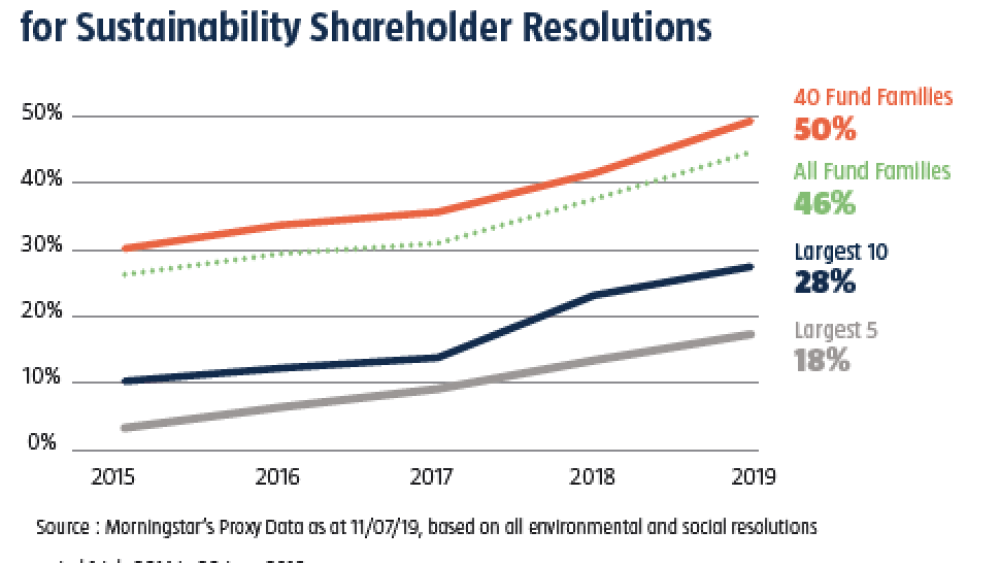
Historically, large asset managers have been less likely than other types of investors to vote against management on shareholder-initiated ballot items. However, the past five years have seen strong growth in the proportion of votes cast in support of ESG issues by most of the largest asset managers offering funds in the U.S. Average support for the 1,033 ballot initiatives voted over 5 years by the 50 fund groups surveyed, not weighted by assets under management, increased from 27% to 46%.
Much of this increase was in the past two years (2018 and 2019). Fifteen fund groups’ support rose more than 20% in 2019 compared with the average for the previous four years, with American Century, Eaton Vance, and Fidelity’s index fund manager, Geode, showing the greatest increases.
However, support by the largest five fund groups, accounting for more than 63% of the combined assets under management of all 50 fund groups considered, lagged the others by a long way – increasing from an average of 4 percent in 2015 to an average of only 18 percent in 2019.
The largest two fund groups, offered by BlackRock (including iShares) and Vanguard, only supported 3 and 4 percent of the 1,033 resolutions voted across the five years, respectively. On the other end of the spectrum of support, Allianz GI and DWS supported 78 and 87 percent of ESG ballot initiatives, respectively (figure 1).
2. Large asset manager opposition understates investor concerns about ESG risk
The ongoing shift to passive investing has led to growing concentration in the asset management industry. With large asset managers controlling significant portions of the vote at most public listed companies, it matters a great deal how they cast their votes on important issues that shape market-wide risks.
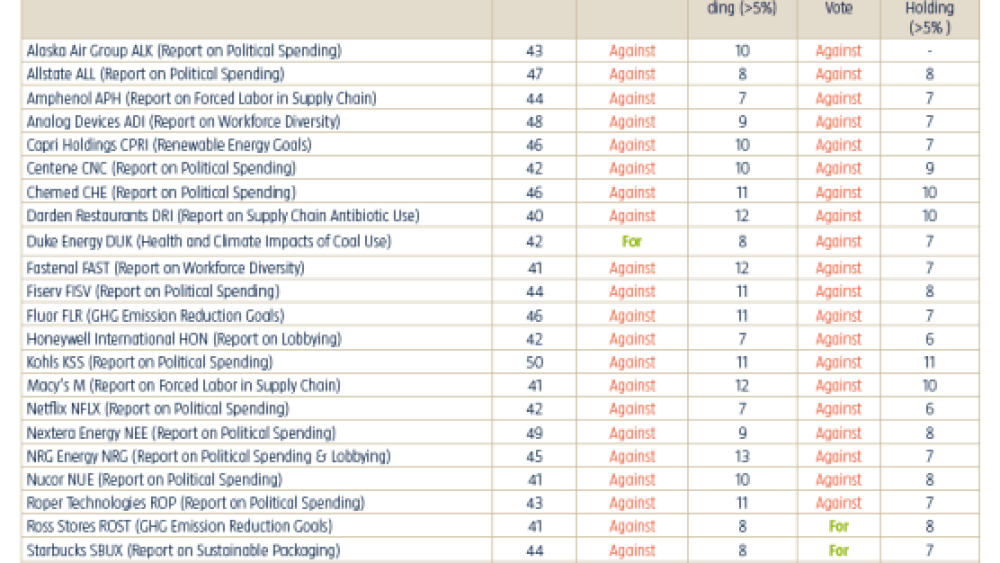
The failure of large fund groups to support sustainability proposals kept a surprising number of these initiatives from passing with majority shareholder support. Out of 23 sustainability resolutions that earned between 40 and 50 percent shareholder support, nineteen would have passed by a majority if supported by Vanguard. Fifteen would have passed if supported by BlackRock.
For instance, if either BlackRock or Vanguard had supported a resolution at Fluor, an engineering and construction firm, asking for greenhouse gas emission reduction targets and disclosures, the resolution would have easily passed. If both had voted in support, the resolution would have earned 64% shareholder support – a signal that the board and management of the company would not be allowed to ignore (figure 2).
Asset Manager Climate Engagements
Investors have a shared interest in market-wide actions to address climate risk. Yet Individual private engagements with companies are expensive and time-consuming. It follows, therefore, that cost-sensitive asset managers may be incentivized to underinvest in private engagements and overrepresent efforts.
Collaborative investor initiatives collectivise investors’ power and extend their reach. This raises the visibility of engagements, typically conducted in private, and amplifies the voice of individual investors with respect to issues that have market-wide investment risk implications.
Recent Morningstar research examined asset manager engagement reports and profiled asset manager collaborative engagement activities to identify how climate engagement reporting relates to climate engagement collaboration.
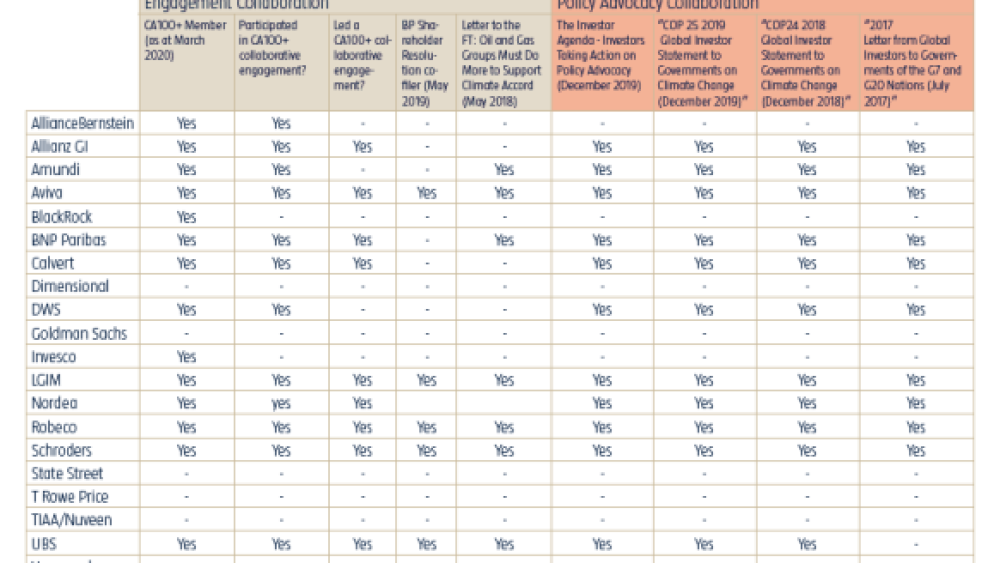
Fourteen of the 20 asset managers surveyed are presently members of the Climate Action 100+ (CA100+) initiative, including all 10 of the European asset managers and four of the U.S. asset managers surveyed. In their engagement disclosures, 12 of the asset manager members reported having participated in at least one CA100+ engagement initiative and nine indicated having led or co-led an engagement initiative.
In 2019, CA100+ investors achieved notable successes in engagements with Equinor, Shell, Total, and Glencore, entailing commitments to conduct lobbying activity reviews, link executive pay to climate targets and set emissions goals. Five of the asset managers surveyed -Aviva, LGIM, Robeco, Schroders, and UBS- were co-filers of a resolution on GHG emission target-setting and disclosure that that earned 99% support at BP’s 2019 annual shareholder meeting with the endorsement of BP’s board and management.
Close inspection of most recent annual engagement reports revealed that asset managers, in general, did not provide enough concrete evidence of the outcome of engagement activities, defined by eight indicators. While based on qualitative evaluations, six asset managers stood out as having undertaken a greater range of collaborative engagement activities and offered stronger outcome-oriented climate engagement reporting: Aviva, BNP Paribas, Calvert (Eaton Vance), LGIM, Robeco, and UBS.
With BlackRock and JP Morgan joining the CA100+ coalition in January 2020, total assets under management represented by members swelled to US $41 trillion (figure 3).
Conclusion
The ability of governments to manage the economic fallout of the coronavirus pandemic will depend largely on the resilience of financial systems. Financial market supervisors, regulators, and large investors have come to recognize long-termism in financial decision-making as the key to sustainable business, and sustainable business as the key to resilient economies.
Asset managers are becoming more vocal in their concerns about ESG risks and more forceful in their stewardship activities. Two examples from the 2020 proxy season illustrate this point.
In BlackRock’s letter to CEOs in January Larry Fink gave expression to concerns about the enormous investment risks of climate change: “…companies, investors, and governments must prepare for a significant reallocation of capital” and warned CEOs of investee companies that BlackRock would be “increasingly disposed” to vote against management for inadequate progress on sustainability-related disclosures and business practices.
Resolutions coming to vote at Chevron, Delta Airlines and United Airlines ask boards to explain how company lobbying aligns with limits on global emissions required to limit global warming and what risks would follow from misalignment. These were filed by BNP Paribas and represent the first time a large asset manager has filed resolutions that are opposed by company management. As a member of the CA100+ investor coalition, it is likely that BNP’s resolutions will attract support from a broad shareholder base when voted in late May.
The unfolding impacts of the coronavirus pandemic on economies, businesses, workers and society compels investors to consider how to make the financial system more resilient against future crises. More large asset managers, including those who’ve remained passive in their voting and narrowly focused in their engagements up to now, will likely take stronger positions on ESG risks. It is very likely this will lead to stronger collaboration amongst investors on engagements and more sophisticated approaches to voting to advance stakeholder governance, including voting purposefully on directors and executive compensation and using shareholder resolution filing.