
The IPO market is undergoing a significant change with the increasing interest in alternative methods to the traditional IPO, which is intermediated by investment banks. The main catalysts driving this trend are (i) companies’ frustration regarding the costly and lengthy traditional IPO process, (ii) companies staying private longer, and (iii) unprecedented access to financing through private markets. These current financing trends and the shift in companies’ needs and objectives support an increasing interest in alternatives to the traditional IPO process.
A growing interest in IPO alternatives
In August 2004, Google made a statement by going public through an open auction process rather than the traditional IPO. Indeed, Google was the first large and well-known company to express its frustration regarding the prominent role played by investment banks and their control over the traditional IPO process. According to Moritz (2019), Google’s move did not take off because “banks closed ranks and succeeded [...] in portraying the IPO as a flop”. More recently, Barry McCarthy, Spotify’s CFO, also complained about the investment banks’ control over the amount that should be raised by the company, the lengthy roadshows, the allocation that implies selecting who is “permitted” to price and buy the shares, the overallotment option that enables to raise more money than the company’s objective, as well as the lack of flexibility in the compensation structure (Moritz, 2019). Moreover, another criticism expressed with regards to investment banks is that the latter systematically underprice IPOs, which leads to a lower amount of money raised than what the company would have otherwise. Critics denounce the “price pop” objective on the first day of trading (Kruppa, 2019). Furthermore, this sentiment of frustration is also shared by investors with a long-term investment strategy and willing to buy a large share of the company’s stock. They deplore the preferential allocation of shares by the underwriters to favoured investors, which results in a lead-time for building the position they initially wanted (Moritz, 2019). These institutional investors have also experienced a change in their approach. They no longer meet companies for the first time during the roadshows, as they invest more time into identifying promising private companies and building relationships with them (McGurk, 2019). Furthermore, stock exchanges are also supporting and contributing to this shift towards alternatives to the traditional IPO process by introducing new rules. For instance, in February 2019, the Nasdaq filed a notice with the SEC in order to clarify and amend its rules to facilitate direct listings. Finally, technology also plays a role as evidenced by Google’s auction process where the online clearing price was used to determine the offering price. A more recent evidence of this phenomenon is the SEC’s approval of the Long-Term Stock Exchange (LTSE) (McGurk, 2019). The LTSE presents itself as a network of long-term focused institutional investors aiming at supporting new companies in their long-term growth development. It not only aligns interests between companies and investors, it also provides software to support the companies.
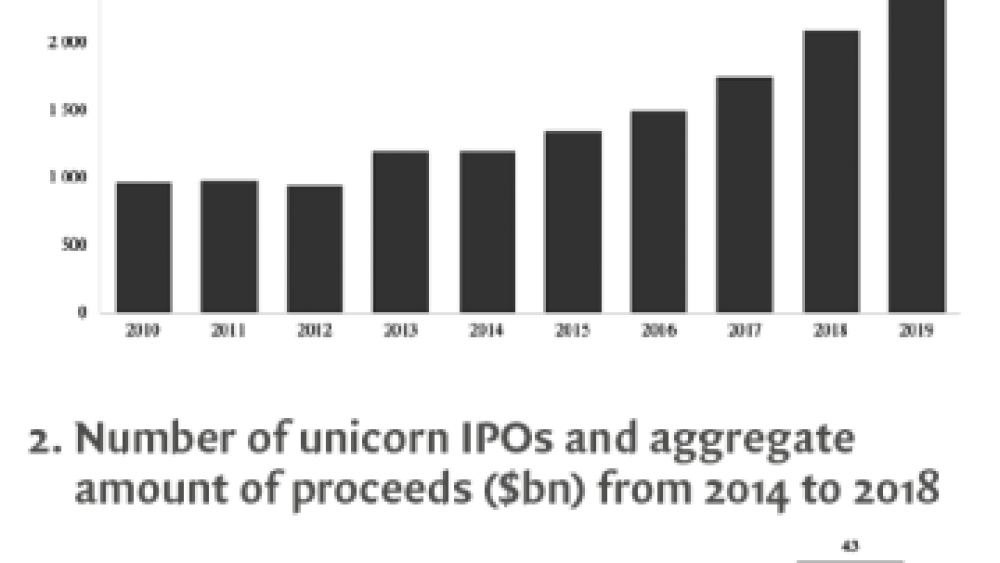
An additional interesting trend has been witnessed recently. Companies are staying private longer and the amount of money available in the private capital market, or dry powder, raised from pension and sovereign wealth funds reached record levels. First, this implies that companies have acquired significant experience in raising capital without the involvement of any intermediaries. On the buy side, institutional investors usually participating in IPOs, independently identify private companies with a promising future (Moritz, 2019). According to the Financial Times, the build-up of unspent cash reached a record amount of USD 2.5 trillion as of June 2019. Thus, there is an emerging trend with private companies being in their late stage of development when deciding to go public. A significant number of private companies have reached valuation of USD 1 billion, so-called unicorn. These companies are financed by investors who used to be only involved in the traditional IPO market (Pinedo, 2018). The authors raised two major concerns: (i) big returns will be reaped by the initial investors including the institutional investors (versus retail investors), and (ii) public markets could become a place composed of mature low-growth companies. Finally, the SEC deplores the decreasing number of listed companies and actively seeks to find a solution to this phenomenon.
Large companies with significant visibility willing to go public and avoid the disadvantages relative to the traditional IPO process, cast a sharp spotlight on already existing IPO alternatives: Google’s Dutch auction in August 2004 and more recently Spotify’s direct listing in April 2018. The latter drawn significant attention and paved the way for other large companies, starting with Slack’s direct listing, one year later, in June 2019. More recently, Asana, the business software company led by Facebook’s co-founder Dustin Moskovitz, announced their plans to enter the public markets via a direct listing and confidentially filed the S-1 registration statement in February 2020.
An unprecedent interest in direct listing
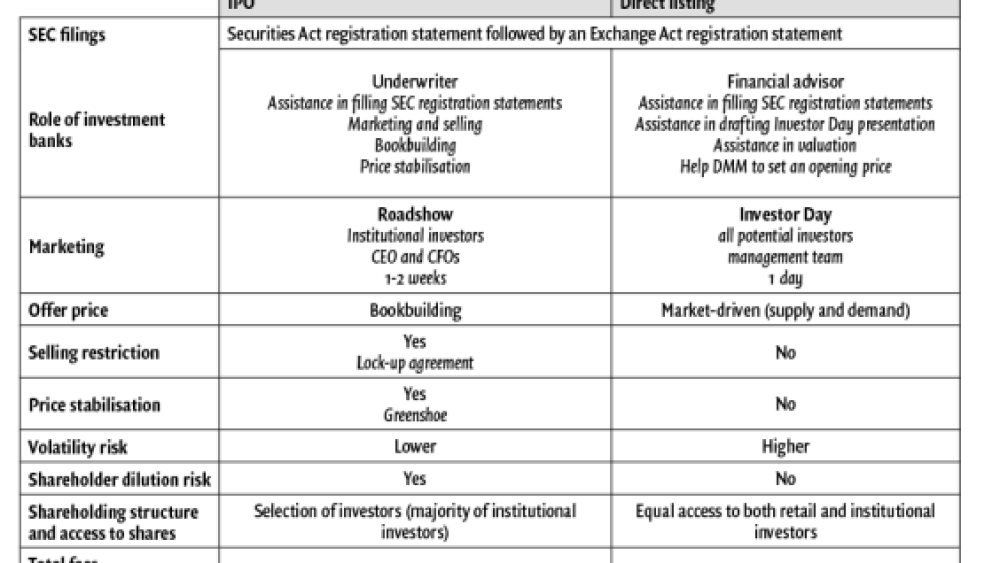
In 2018, Spotify’s direct listing received extensive media coverage and raised many questions. Why this sudden interest in a financial product that already existed and very little used? Why is it gaining momentum? In order to answer these questions, it is important to understand the key features of the direct listing and what it brings to the table compared to the traditional IPO. The direct listing allows private companies to register their existing shares on an exchange and trade publicly without a primary or secondary offering. This means that there are no underwriting banks acting as an intermediary buying large blocks of shares to sell them to selected investors at a fixed price on the eve of the first day of trading. The absence of underwriters influences the process at different levels in terms of marketing, equity dilution and aftermarket activities. In fact, unlike the traditional IPO process, there is no roadshow supported by bankers to market the direct listing. Therefore, the offering price is neither based on the relationship between the investors and the underwriters, nor based on the underpricing allowing short-term gains to investors. The offering price is the market-clearing equilibrium price directly based on supply and demand. In terms of aftermarket activities, there is neither lock-up clauses, nor price stabilisation activities. The investment banks do not have a role on both clients and investors sides; they act as a financial advisor to their client. This configuration results in banks having aligned interests with the company. The costs associated to the direct listing are thus lower than that of a traditional IPO.
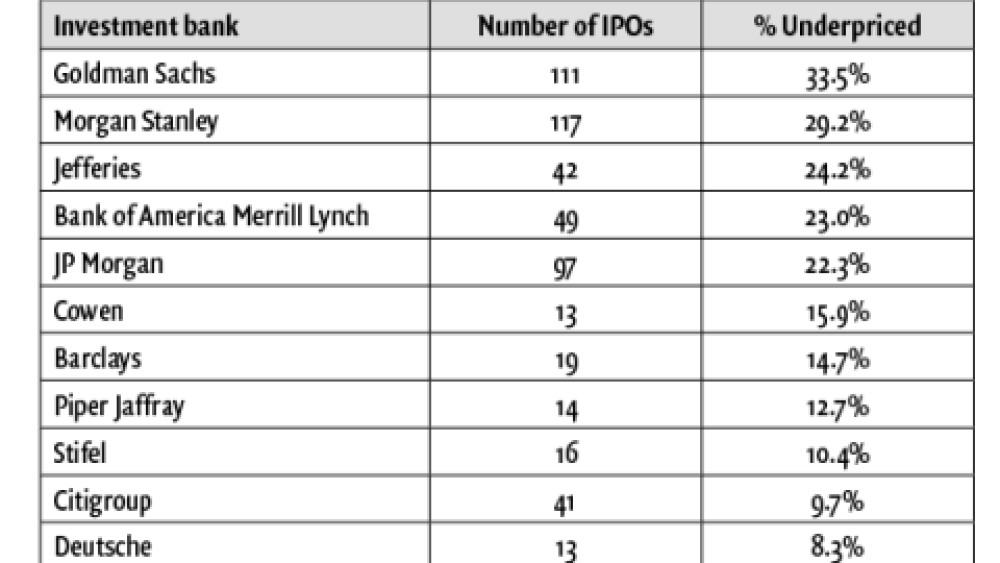
The direct listing’s features present strong rationales for companies to bypass the traditional IPO. With all the unspent cash available in the private capital markets, companies do not need to rely on the traditional IPO process to raise capital. At the same time, these companies still have the possibility to develop long-term relationships with investors. Thus, private companies’ willingness to go public seems to be supported by motives other than raising capital. In this sense, direct listing appears as the right choice for companies that do not have an immediate need for cash. One of the major reasons supporting direct listing is its ability to provide liquidity to the initial shareholders (i.e. employees, VC funds, private equity funds, etc.) who can quickly sell their shares to the public in a more egalitarian and transparent process, without any bias in favour of some investors (McGurk, 2019). Indeed, both institutional and retail investors have access to the company’s shares, although retail allocation is not as significant as that of institutional investors. This process also enables initial shareholders who are not selling their shares in the process to avoid dilution. They also have access to a market price at which they can value their position (Pinedo 2018). According to Phillip Braun, professor of finance at Northwestern's Kellogg Business School, founders do not particularly benefit from direct listings and are indifferent to the listing process. As for investors, they can directly build up large and significant positions, instead of waiting for more shares to be released on the market at the end of the lock-up period. Furthermore, the way the offer price is determined in a direct listing allows to attract a better pool of investors with aligned long-term interests compared to the bookbuilding process of traditional IPOs that has more of a “transactional” aspect (McGurk, 2019). Another major motive for direct listing is the costs associated with the process, which are significantly lower than that of a traditional IPO, as there is no underwriting fee. In addition, the company does not leave money on the table as there is no underpricing. Indeed, Bill Gurley (former board member at Uber, current general partner at Benchmark, a Silicon Valley-based VC fund), a strong advocate of the direct listing, incisively denounces the IPO underpricing by arguing that it is a business incentive for investment banks to provide investors with a discount in order to keep these investors around for future deals that might be less attractive. He qualified the first day “price pop” as a built-in first day pop. Jay Ritter analysed the underpricing phenomenon between 1980 and 2018, the figures show that it cost companies USD 165 billion. So far in 2019, that cost is about USD 6 billion. The biggest investment banks, Goldman Sachs and Morgan Stanley, have an average underpricing level of respectively 33.5% and 29.2% over the past 10 years.
On the other hand, the absence of underwriting banks also presents some risks, as there is no safety measure to sell the company’s shares. The share price could also suffer a significant drop, as there are no price stabilisation activities. Therefore, the company’s share price may experience greater volatility. Opponents also argue that the selling pressure is more difficult to assess in the absence of lock-up agreement. However, McGurk (2019) stressed that the absence of lock-up agreement results in the absence of illiquidity related to the constraint in the number of shares during the lock-up period. According to Kruppa (2019), the company loses control of the composition of the shareholding structure as direct listings result in few committed and patient investors with a long-term investment strategy, while the IPO enables to hand-pick investors but involves mispricing. In addition, Horton (2019) indicates that investment banks are not incentivised when acting as a financial advisor. According to the author, banks are less financially incentivised and have less reputational risk in a direct listing. In addition, the banks play the role of “gatekeeper” in the traditional IPO process by allowing only “worthy” companies to go public and protecting investors from “frauds” as well as companies that will not be able to provide a positive long-term performance. Horton (2019) argues that banks are less motivated to play this role in a direct listing.
Precedent and recent transactions: direct listing, not for everyone?
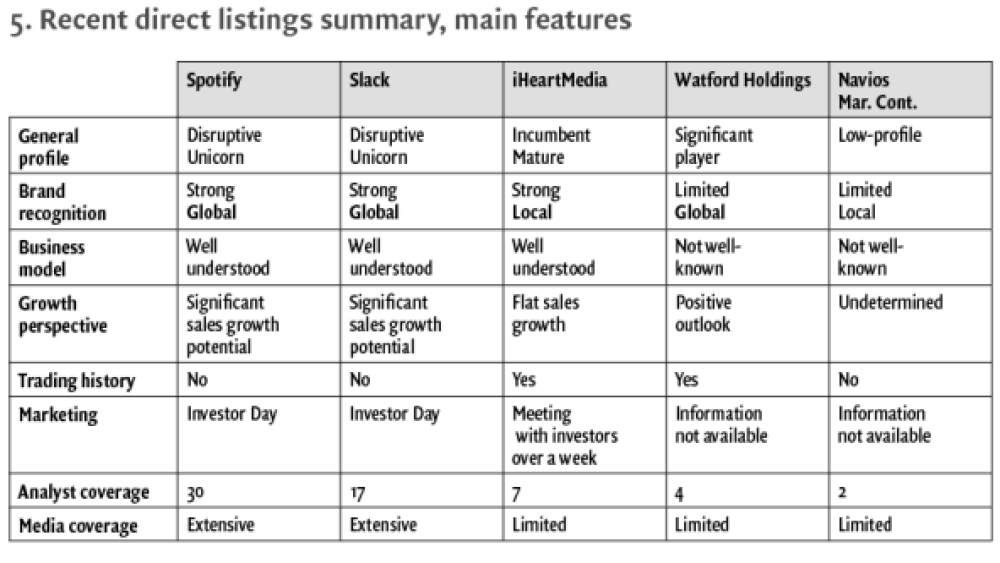
Past direct listings included small companies uplisting from an OTC market to a national exchange or niche real estate investment trusts (REITs). In addition, Pinedo (2018) states that many life sciences companies have used this alternative method in an unfavourable IPO market, then aimed to raise capital through private investment in public equity deals, also known as PIPE transactions. If these small and early-stage companies had access to the traditional IPO market, they would have benefited from the assistance of underwriters in order to market their stocks. As a result, these direct listings often failed due to a lack of trading and little institutional ownership and resulted in difficulties to raise capital once publicly listed. Since Spotify’s direct listing, many argue that direct listing cannot be successfully completed by any company and that a particular profile meeting the following conditions and criteria is required: (i) large-sized, (ii) well-known brand, (iii) an easy to understand business model, (iv) a significant private market valuation, (v) no immediate need to raise capital, (vi) a comfortable cash position and (vii) a large and diverse ownership structure allowing a high-level of liquidity on the first-day of trading. The direct listing thus appears to be the most efficient way to go public for unicorns that are companies meeting most of these criteria. However, in recent times, Spotify and Slack were not the only ones that picked direct listing over the traditional IPO. iHeartMedia (a radio station operator), Watford Holdings (specialised in the property and casualty insurance and reinsurance markets) and Navios Maritime Containers (a part of Navios Group that owns contracted containerships) completed their direct listings. These companies did not grab the headlines and drew far less attention, as they do not have the ‘specific’ profile repeatedly described in the press by experts. These smaller listings shed into light an interesting aspect of direct listing: flexibility. The direct listing could be a viable path for mid-cap companies with flat revenue, limited or no brand recognition, limited investor appetite for less attractive businesses. It also appears to be a solution for start-ups that would allow them to be listed on a public exchange without being financially weakened by high fees and leaving money on the table. In addition, they are given the possibility to raise capital only when needed without diluting their shareholders when going public. iHeartMedia and Navios Maritime Containers had specific circumstances that led these companies to go public via a direct listing: iHeartMedia recently exited its bankruptcy reorganisation, while a public listing through the traditional IPO process presented unfavourable conditions in the case of Navios Maritime Containers. Both situations are part of the main motives that historically led companies to pursue direct listings. iHeartMedia, Watford Holdings and Navios Maritime Containers first filed with the SEC for a traditional IPO process then withdrew their application, which could explain why none of them undertook further marketing of their direct listing with an Investor Day for instance. Either way, these companies achieved the objectives stated by their CEO, including liquidity for shareholders and most importantly access to the public capital markets. iHeartMedia and Watford Holdings both issued senior notes following their direct listings in order to finance their needs. They neither experienced a large increase in share price in their listing debut, nor did they experience a decrease in the share price as sharp as that of Spotify or Slack. Navios Maritime Containers’ share price performance could reflect the concerns of many experts regarding companies lacking brand recognition, which prevents analyst coverage and deter investors, leading to liquidity issues.
Potential for development: raising money & direct listing?
The direct listing has a certain number of aspects to tackle before gaining market share currently held by traditional IPOs. The main reason being that direct listing does not allow to raise cash through the process. Involving primary capital raises in direct listings could fulfil the SEC’s objective of increasing the number of publicly listed companies, while some experts are worried that it might cause a high level of volatility on the first day of trading. The at-the-market offering represents the closest precedent in which companies progressively sell new shares on the open market. McGurk (2019) suggests the decoupling of raising money and going public. Companies could raise the cash needed and abundant in the private capital markets, then as a second step conduct the direct listing process. Decoupling should enable the company to determine the optimal number of shares and the right market price. Then, if the company needs more financing, it could leverage its access to the public capital markets and conduct seasoned offerings. Latham & Watkins – legal advisor mandated on the direct listings of Spotify and Slack – has drafted a term sheet to help companies raise a pre-listing round, which has already received an interest to participate from large private equity firms and managers already involved in private funding rounds. Another potential solution for raising capital right before the direct listing proposed by VC funds include the issuance of private convertible notes (Kruppa, 2019). Further developments and evolution of this IPO alternative are subject to the SEC’s approval that has already shown support when the NYSE’s wanted to change its rules in order to facilitate direct listings.
Conclusion
Spotify and Slack’s successful direct listings gave a fresh start to this financial product that has been historically used by smaller and less attractive companies. The factors that would allow the direct listing to create a place for itself in the public listing market is the education around this process by successful companies such as Spotify and Slack, the effort from the investor community to adapt and learn, the support from the various stock exchanges that could sell it aggressively to companies with various profiles, and finally the support of the SEC that is aiming to increase the number of publicly listed companies.