

For the past 40 years, leveraged buyouts have been increasingly popular, complying with a growing volume of dry powder allocated to these investments. Despite the subprime financial crisis of 2007-2008 that caused a freeze down of the capital markets, the buyout activity resisted and is now more solid than ever.
An increasing exit option supported by the advantageous debt market conditions
The evolution of the private equity world resulted in the creation of a sub-market for secondary buyouts (SBOs). Traditional exit routes following the internet bubble in early 2000 such as the trade sale to a strategic buyer or an initial public offering (IPO) were not easily attainable. Since General Partners (GPs) had to return money originating from their investments to their Limited Partners (LPs) following their capital allocations, the wave of SBOs began in cold IPO market circumstances. This new trend peaked in 2007, right before the financial crisis, illustrated by Kaplan’s demonstration (1991) claiming that companies stay for longer periods under the control of a private equity firm. However, direct SBOs remained a controversial topic, as shown by Nikoskelainen and Wright (2007), claiming that direct SBOs are less attractive than IPOs and trade sales since they generate lower returns (lower IRR) and sometimes even destroy value. Differing views coming from press releases and economists emerge in such contexts, questioning the idea of consecutive buyout transactions and their effects on the value creation of the targeted companies. The main criticism against LBOs stipulates that PE funds will launch drastic cost-cutting procedures affecting the employment status of the targeted companies because of its investment policies, the working conditions, and the R&D programs developed to enhance their financial returns.
According to Johannes Huth, head of KKR EMEA, exceptional valuation environment is a shadow of the economic recovery that took place, principally in developed economies and since the global financial crisis. Rare exit conditions generated large size funds. GPs are facing challenges in finding new targets and closing new deals at attractive prices, mainly due to the intense competition. In parallel to this, dry powder levels have been on the rise since 2012, reaching a new record of approximately USD 1.7 trillion in assets as of the end of 2017, according to Bain & Company. Without omitting to mention that the debt market offers excellent low-cost leveraging conditions, satisfying GPs interests. Due to this context, the average purchase price multiple for investments in Europe expanded to an average of 10.6x EV/EBITDA in 2017.
Private equity firms actively look for targets to develop their portfolios and businesses. Therefore, investor’s objectives are often positioned over the ones of the targeted companies. Dealing with such expanding asset levels have sometimes become a confrontational relationship between PE firms and Chief Financial Officers of operated companies.
Over the years, sponsors are expecting greater returns and lower entry fees, combining increasing regulatory and compliance obstacles. In parallel to this, competition within the PE atmosphere continues to sharpen itself.
Proven differing positions on a controversial topic
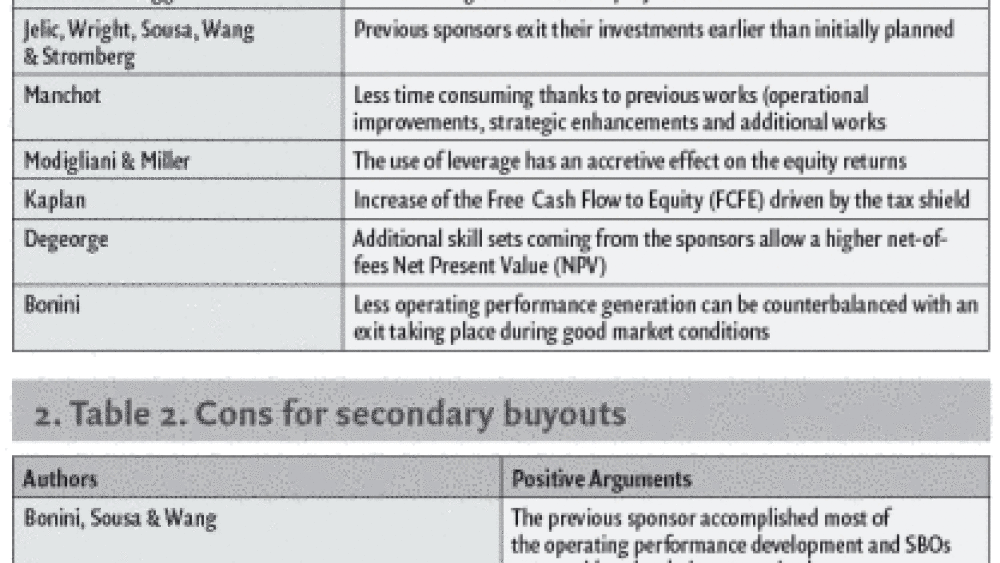
Numerous academic researchers have worked on the question of the efficiency of SBOs in the past. This professional thesis sampled 15 authors studies over a 70-year range period. The collected results could be classified into two categories: the pros and the cons.
Pros for secondary buyouts
Even in “cold debt markets” conditions, SBOs could be worth it if, for example, the previous sponsor has been forced to exit its investment earlier than initially planned. This could be due to the following reasons: (i) if the fund approaches the end of its lifetime (Jelic and Wright, 2011, Soussa, 2010); (ii) if the PE firm aims to develop a more extensive track record to continue to convince investors in their roadshows (Sousa 2010, Wang 2011); (iii) or if it seeks to maintain a stable cash flow profile by lowering its exposure (Stromberg 2008). Successive financial sponsors could be benefiting from less time consumption as well. In fact, primary financial sponsors need to put in place the governance structure and processes required during the LBO context, which is frequently considered as a long process (Manchot 2010). Whereas, PE firms, during SBOs, can rely on the seasoned management team and focus solely on ways to improve the operating aspect.
François Degeorge found that, when applying the Net Present Value formula on a sponsor-to-sponsor deal occurring between two firms having additional skill sets (geographical establishment, network, industry knowledge, and functional expertise), they tend to have higher net-of-fees NPVs. Parallelly, SBOs accomplished lately in the investment periods, not only underperform other forms of buyouts, but they additionally achieve negative NPVs for the Limited Partners.
Cons for secondary buyouts
First of all, previous sponsors achieved most of the possible operational improvements. Therefore, value creation is thought to be limited under SBOs investment periods. Nevertheless, this negative aspect can be neutralized through deleveraging and multiple expansion if the PE firm succeeds in applying a good asset allocation strategy.
Secondly, SBOs rely a lot on the debt market conditions. In fact, the recent increase in the SBO activity coincides with greater liquidity of the leveraged markets. This could suggest that SBOs are only attractive if the following sponsors entering the capital of a targeted company are able to take advantage of attractive debt market conditions. Applying the following strategy will increase the financial risk of the transaction and compensate with inevitable reduction potentiality in operational improvement.
Thirdly, SBOs are often said to be overpriced. In fact, the selling financial sponsors will always try to capture the maximum out of their investment thanks to excellent negotiation and market timing abilities. The selling sponsor will usually want to sell the operating company once it sees that the marginal return of value creation is lower than the marginal cost.
Finally, agency costs between the GPs and the LPs might often take place. GPs could be facing pressure to capitalize on unemployed funds and to catch up on their investment rate.
Application of real cases scenarios based on the academical framework
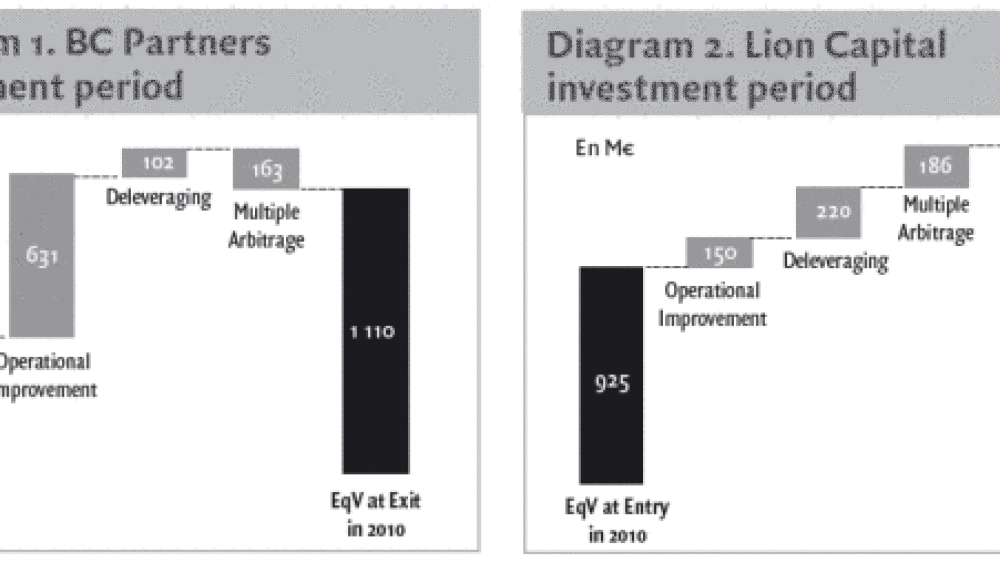
Previous scientific results could be challenged against some analysis of well-known French case studies in the PE world. Following, is an example taken from the companies that have been analysed for the purpose of this research. The example chosen here is the frozen food company Picard Surgelés. The companies Maisons du Monde and Terreal were also analysed but were not included in the present article. The idea of such analysis is to demonstrate the split of the value creation evolution for successive financial sponsors under the same targeted company. Each holding period has been illustrated by a bridge analysis identifying the three potential value creation levers for an LBO transaction: operating performance, deleveraging and pricing (multiple expansion). Furthermore, each bridge analysis will be complemented with additional details regarding the holding periods.
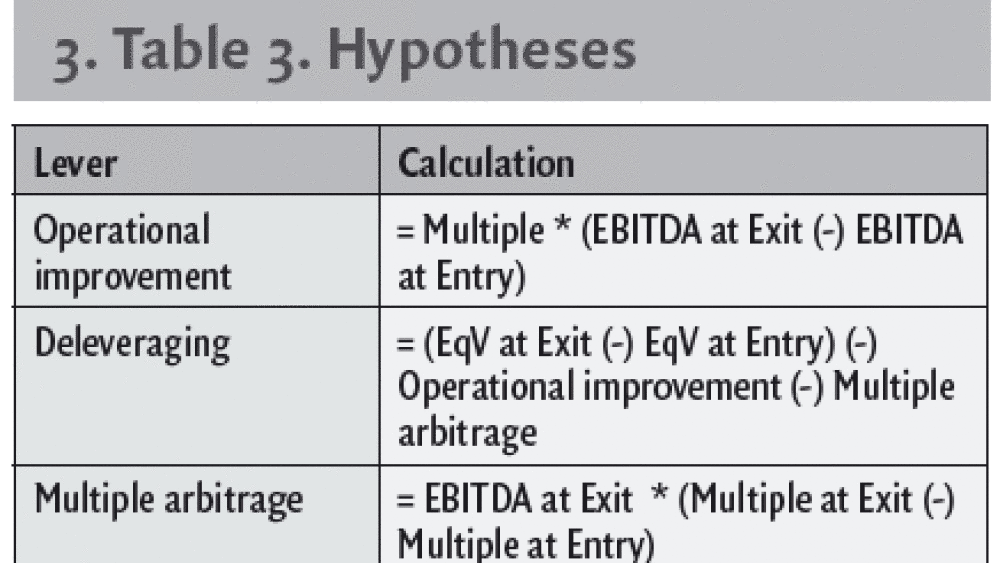
Hypothesis 1: Secondary buyouts generate higher operating performances than the previous buyouts
Operating performance improvement is measured through the increase of the cash flow of the portfolio company. This growth includes the sales growth, the margin expansion and the respective volumes of capital expenditure and working capital. These improvements are generally driven by an alignment of governance and engineering on the first hand, and by the provision of smart money (Stromberg, 2009) on a second hand.
Operating improvement may also be related to the debt increase that often tends to discipline the management team and force them to allocate the firm’s free cash flow in a more efficient manner. The previous fund, usually did most of the job on this aspect during its holding period, providing easily realized measures for the following financial sponsor. Furthermore, but not least, if the following sponsor has differing skill sets in comparison to the previous one, it may result in additional substantial improvements.
Hypothesis 2: Secondary buyouts generate higher deleveraging gains than the previous buyouts
Value creation during SBOs investment periods could be driven, from an equity holder point of view, by the way leverage is used. It helps boost equity returns by increasing financial risks, as supported by Modigliani and Miller’s conclusions (1958). Expanding the usage of leveraging has a straight effect on the tax shield and consequently on the cash flow available for the equity holders. This particular value creation lever could be optimised by reducing steadily the initial debt level during the entire holding period. This method entails that the portfolio company generates stable and strong cash flows in order to refund its debt.
Hypothesis 3: Secondary buyouts generate higher multiple arbitrage gains than the previous buyouts
Knowing that the characteristics of the selling PE firm directly and mainly influence pricing (multiple arbitrages), such variable is at the center of the valuation of the buyout at entry. Multiple arbitrage profits could improve the market value of the operating company via facilitating a true extension story, defining precisely the company’s long-term strategy, or by diminishing its risk profile for example. Valuation is also subordinated to external factors, such as the macroeconomic climate (debt market conditions).
The distinctive value creation levers were calculated as follow for the bridge analysis:
Picard Surgelés is known for being one of the most successful European buyouts
BC Partners investment period
BC Partners managed to pull a huge volume from its operational improvements. It might be due to the fact that the previous MBO led by Candover lasted only 3 years. Moreover, the four previous funds did not have any specific expertise in the consumer/retail sector, leaving room for further operational improvements. BC Partners entered when the GDP growth was at its highest level since 2000 (2.79 %). The fund was pressured to spend its dry powder at the end of its funding period (c. €1.308 million at 12x EBITDA). During the holding period, they focused on the direct-to-consumer channel (online distribution) as well as shifting towards “simpler” products (including a change of the CEO).
Lion Capital investment period
Lion Capital entered the capital for €1.9 billion at 10.7x EBITDA (being the 3rd LBO for the operating company). This fund has strong expertise in the consumer/retail sector and therefore has succeeded in extracting some additional operating improvements. The EBITDA CAGR was of c. 1.5 % during the investment period (much lower than the BC Partners results, meaning that Picard was nearly reaching a maturity status, and a strategic buyer might have been the only option at the time). The company was then sold to Aryzta (strategic buyers are known to acquire companies at a higher price than financial sponsors would thanks to the potential synergies).
Results showed no particular evidence that secondary buyouts generate less value than the previous ones
As illustrated previously, direct SBOs (sponsor to sponsor deals) are becoming increasingly more popular in comparison with other forms of exits such as IPOs or strategic exits (trade sales). In this professional thesis, the academic literature consensus has been implemented with additional case studies with the aim of validating or not what authors claimed on SBOs. Answering the hypothesis previously established, the following results were concluded.
Hypothesis 1: Secondary buyouts do not tend to generate higher operating performances than the previous buyouts
Based on the analysed case studies, 50 % to 80 % of the equity value at the exit was generated by operating improvements during primary buyouts — moreover, by 0 to 40 % during SBOs. This hypothesis is therefore not supported, affirming the previous research and claims from authors in the literature review. Most of the cases studied were based on value creation related to organic growth decisions; further research could be interesting to be undertaken on additional external growth factors strategies. Although this hypothesis is contested, results are still encouraging for the future of sponsor-to-sponsor deals, as we’ve seen an open window for other types of sales and EBITDA growth, in some cases. What is interesting to note in this section as well, is that usually, the shorter the previous investment period rounds were, the higher the operational improvement was, for the following PE firms.
Hypothesis 2: Secondary buyouts do tend to generate higher deleveraging gains than the previous buyouts
Profits related to the deleveraging phase shouldn’t vary too much since the amount of debt injected has to be adapted to each particular context and type of target company held. However, results show that during the preliminary LBO rounds, this specific lever contributed from 7 % to 9 % to the equity value at the exit, while it contributed by 12 % to 14 % during the secondary ones. This hypothesis is therefore approved. PE firms will boost leverage during the latest LBO rounds in order to compensate for the fewer operational improvement capacity available. Usually, it is because the operating company will maintain a constant cash flow generation able to deleverage the company quickly and even more, pay some exceptional dividends.
Hypothesis 3: Secondary buyouts do tend to generate higher multiple arbitrage gains than the previous buyouts
Multiple arbitrage is usually impacted by the economic context at the specific date of the transaction (entry and exit). Calculating this value creation lever throughout the case studies, it can be observed that primary buyouts usually destroy value and SBOs create some. Therefore, the hypothesis is affirmed. Multiples are tending to increase until another financial crisis hits, where they will then tend to quickly decrease. Therefore, such value creation lever could be mentioned as being a market factor. Usually, PE firms have the knowledge to sell at the right momentum in order to avoid additional risks. In fact, the analysis of the different cases scenarios shows that bad results in this particular lever correspond to longer investment periods and bad timing entry/exit decisions.
On an overall vision, results based on the case studies and on the literature consensus do not suggest that secondary buyouts always generate lower value creation compared to the primary ones. Results found should motivate future generations to investigate more into this controversial problematic.