
This paper’s main focus is to investigate the link between commodity power house Glencore’s stock return, and the very commodities it trades. We have worked over a sample of 8 commodities, including Aluminum, Brent, Copper, Corn, Nickel, Wheat, WTI and Zinc, taken between the 5th of August, 2011 and the 9th of May, 2017. We were keen to assess the long and short term link between Glencore and one or more of our variables, using cointegration analysis and auto-regressive distributed lag models. Our findings show that there are strong links on the long term and the short term between Glencore, Aluminum, Zinc, Corn and Nickel.
A lot of papers already looked into the relationships between stock markets and commodity prices. Some have assessed the short term link between oil price changes in GCC (Gulf Coopération Council) countries and stock returns (El Hedi Arouri, M. and Fouquau, J., 2013). Those countries being major energy players, they have found that oil change is positively correlated to stock markets returns in Qatar, Oman and UAE. Other studies have focused on the impact of oil price changes in economic activities, and have found, in some cases, positive relationships: Cunado and Perez de Garcia (2005), Lardic and Mignon (2005), Balaz and Londarev (2006), Gronwald (2008), Cologni and Manera (2008), and Kilian (2008). Yet, despite their major role in commodities trading worldwide, there has not been any study on the relationship between commodity prices and commodity houses’ stock price. Despite the fact that commodities are essential products, all the line of business surrounding them (producing, trading, storing, etc) are still very much opaque. As a matter of fact, commodity houses generate annual revenues of tens of billions of dollars, but are still in a lot of cases privately owned (Trafigura, Gunvor, etc). Our study will focus primarily on Glencore. It is one of the few commodity houses which successfully conducted an IPO in May 2011, and is a Top 3 worldwide market player today. Its 155,000 employees are active in more than 50 countries, generating $177.4 billion in revenues (2016). The firm has interests in 3 major fields: metals & minerals, energy products and agriculture. In the first, the company produces and markets alumina & aluminum, copper, ferroalloys, iron ore, nickel, zinc and lead. It also has stakes in companies that operates in mining, smelting, refining and warehousing. Regarding energy products, Glencore covers industrial and marketing activities for coal and oil, and has made strategic investments in handling, storage and freight. Finally, in agriculture, the firm is focused on cotton, oilseeds products, grain and sugar.
Data
On the course of our study, we used daily data for the main variables we have considered. All variables are considered in US Dollars, except Glencore stock price that we kept in GBP.
We have considered those variables because of the main areas where Glencore operates. In 2016 they actively produced, in more than 50 countries, 1.4 million tons of Copper, 1.1 million tons of Zinc, 155.100 tons of Nickel, 844 million barrels of Oil products, 911 million barrels of Crude Oil and 71.4 million tons of agricultural commodities.
Tests and results
In our study, we considered several different variables to try to explain the evolution of our variable of interest, Glencore’s stock price. In order to prevent future bias due to correlation between our explanatory variables, we have conducted several tests to select the best set of variables for the rest of our study (see Table 1).
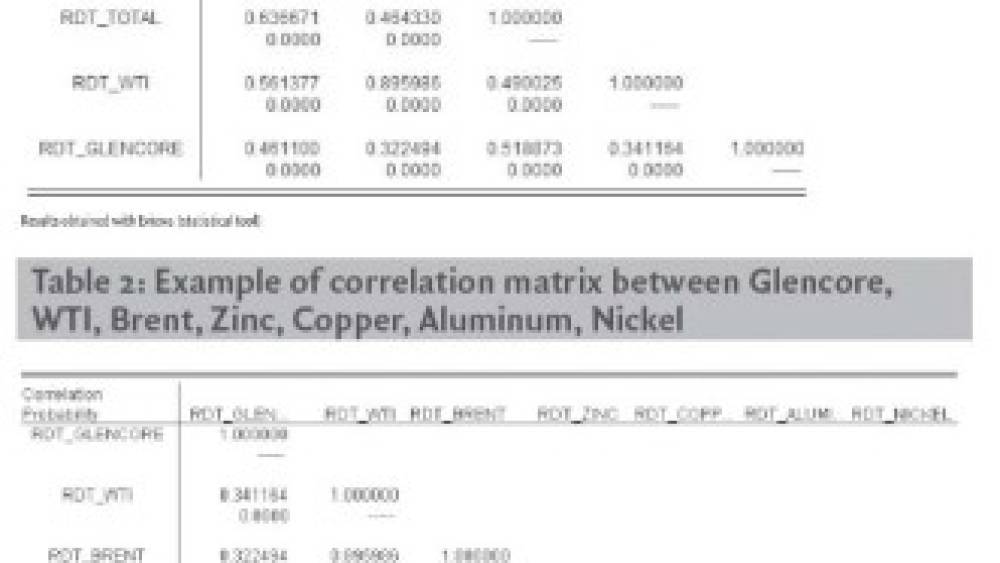
Those first correlation tests allowed us to see more clearly the initial relationships between our variables. To avoid collinearity bias, we separated our explanatory variables WTI and Brent from each other and we did not combine Zinc and Copper with Aluminum at the same time. On the short term Corn and Wheat have no explanatory power, but we have still used them to assess the relationships with Glencore on the long term with our cointegration analysis. This gave us the following correlation table sorting out our data according to what we found above (see Table 2)
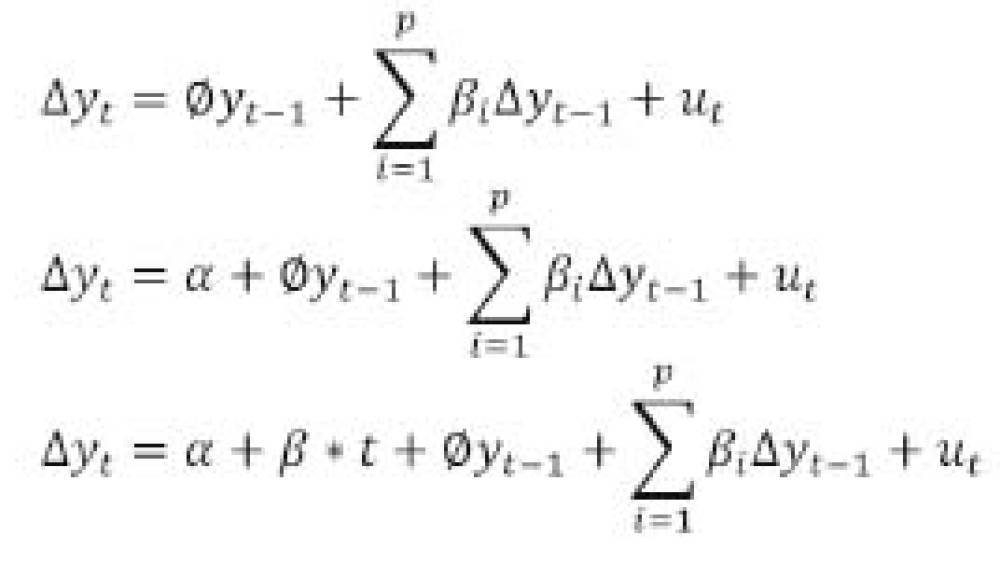
When the statistical properties of a set of data, such as mean and variance, are constant, we say that the series is stationary. Economically speaking, the persistence of a shock in time will be infinite for non- stationary series. A non-stationary series is one that has unit roots. To test the stationarity, we had 3 tests at our disposal. Augmented Dickey Fuller (ADF) and Philips Perron (PP) that assume the non-stationarity as the null hypotheses (presence of a unit root), whereas the Kwiatkowski-Phillips-Schmidt-Shin (KPSS) assumes the stationarity as the null hypothesis (absence of a unit root). In the following we have chosen to use ADF (in level and subsequently in first difference): voir Formula.
Our ADF test in level (yt ) show that we cannot reject the null hypothesis: there is a unit root in our time series sample, so our first conclusion is that our data is non-stationary. To correct our time series, we performed an ADF test in first difference {Δyt }. The results are outstanding: we strongly reject the null hypothesis, meaning we managed to eliminate the unit root from our sample. Our time series is now stationary.
At this stage, our ADF test showed non-stationarity in level and stationarity in first difference. The problem is that this test is very sensitive to values close to 1: for instance, it will hardly distinguish between 0,98 and 1, confounding short and long term memory. Thus, to verify our result, we use KPSS in level and first difference as well, which does not share those biases. We have managed to correct the non-stationarity of our data by conducting ADF and KPSS tests in first difference. We now have a series samples that is stationary and we can proceed with the cointegration test.
A cointegration relation can be vulgarized as a long term relationship between sets of variables. Cointegration analysis is very useful because we often find that time series can move together on the long run without being stationary. Thus in that case, the reason for those series coordinated evolution could be market news or trends for instance, and that is modeled by cointegration analysis. Another way to look at it is that 2 sets of variables can differ at one point on the short term (because of different reaction to instant market evolution for example) and then resume their coordinated paths. When, and if we deal with non-stationary variables, we might encounter what we call a “spurious regression”, arising from the fact that standard regression analysis fails to deal with non-stationary variables. In those cases, interpreting solely the R-squared might suggest a link between 2 variables whereas in reality there is none. As Illustrated by Brooks, “if standard regression techniques are applied to non-stationary data, the end result could be a regression that ‘looks’ good under standard measures (significant coefficient estimates and a high R squared), but which is really valueless”. Generally, if we linearly combine 2 variables that have unit roots (integrated series of order {I (1)}), the combination of the 2 will also be {I (1)}. An integrated series of order {I (1)} is one that has a unit root and that is {I (0)} in first difference, meaning it is non-stationary in level and stationary in first difference. Let's note that 2 series with the same order of integration will give us stationary residuals.
Engle and Granger (1987) have proposed a solution to model that relation, in 2 stages. First, they used OLS (Ordinary Least Squared) to estimate the relation between y and x: See Formula 4.
Then they recovered the residuals and tested the stationarity using an ADF test with corrected critical values (residuals being estimated). Under the null hypothesis, the error term is non-stationary, then the series are not cointegrated.
But this approach poses a problem: the error term ut could be autocorrelated, which is damageable to a study of finite time series. The ARDL model (specific Error Correction Model) was introduced in 2001 by Hashem Pesaran, Yongcheol Shin and Richard Smith. The idea was to be able to use I (0) and I (1) variables in the same set of data, without inducting some spurious
We have conducted the 2 tests presented above (Engle-Granger and ARDL), according to our early findings on correlation and stationarity. Contrary to our set of tests relating to correlation, here we are able to assess the long run relationship between our variables. For Engle and Granger test we proceeded by testing Glencore’s stock price against each of our explanatory variables, adding one each time to see if it enhanced or degraded our previous relationship. The optimal set of data we have obtained is: Glencore, Corn, Nickel and Zinc. This suggests a strong link on the long term: Aluminum alone (as it is the only variable integrated alone with Glencore’s stock price), and Corn, Nickel and Zinc together can explain the stock return of Glencore on the long term.
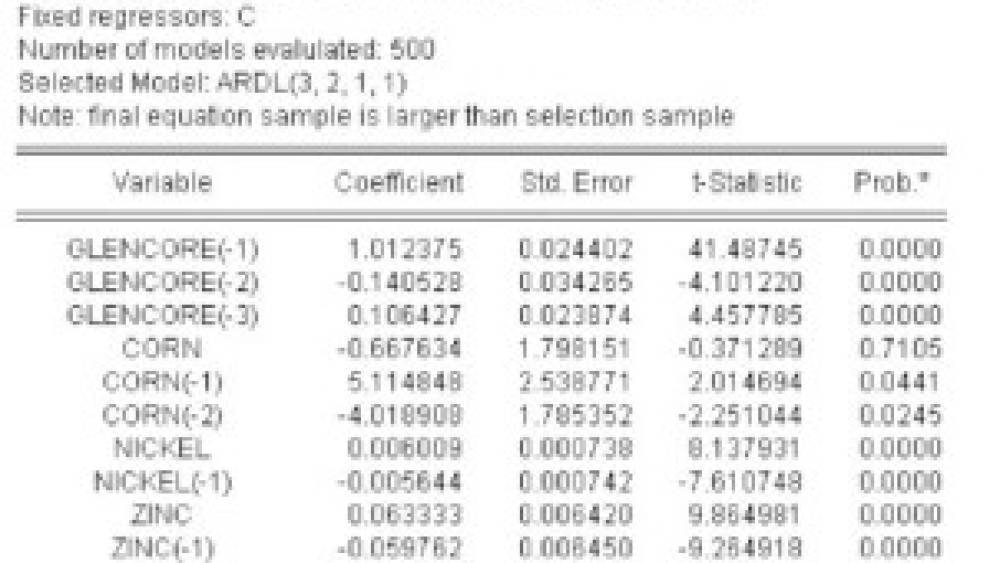
To go deeper into exploring the relationship within our best model so far, we have conducted an ARDL on the set of data Glencore, Corn, Nickel and Zinc. We have used the automatic selection and 4 lags maximum for the dependent variables and the regressors (see Table 3).
As we can see from above, after evaluating 500 different models, the procedure chose to conduct an ARDL (3,2,1,1), meaning 3 lags for the dependent variable Glencore, and for the regressors, 2 lags for Corn, 1 for Nickel and 1 for Zinc.
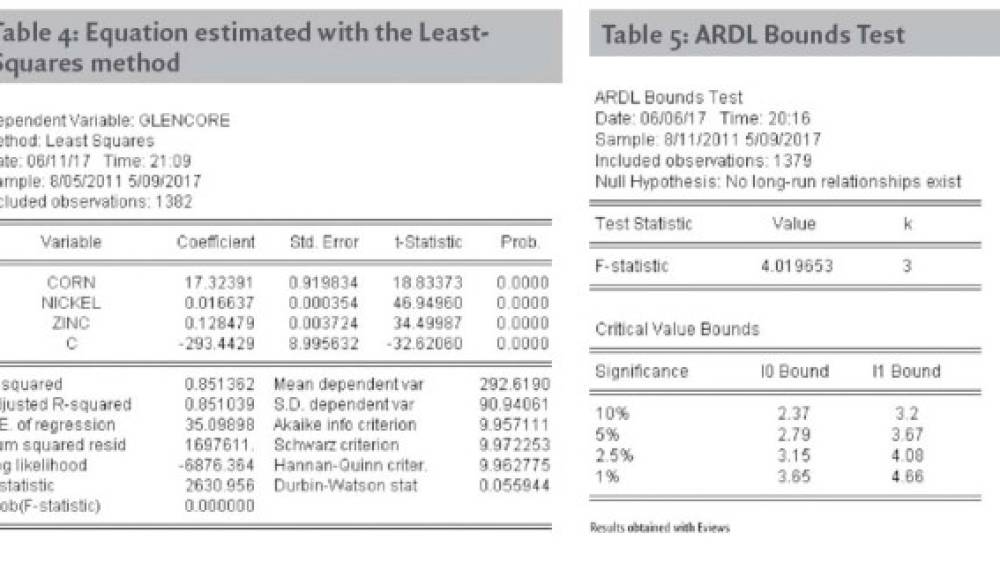
Now looking at the long-run coefficients, the results are consistent with what we found above: the regressors are significant.
We can strongly reject the null hypothesis (5% risk) with respect to the I1 Bound. There is a long run relationship between Glencore and Corn, Nickel and Zinc. The last set of tests allowed us to confirm our previous findings.
Conclusion
Our ultimate goal on the course of this paper was to achieve cointegration tests and ARDL to test the long term relationship among our set of data. In order to do that, we had to perform preliminary tests (correlation, ADF, KPSS) to make sure our series were fit to perform cointegration.
Glencore is today one of the biggest commodity houses, worldwide. Everything started with Marc Rich, who, among other disciples, trained Claude Dauphine, who later founded its direct competitor Trafigura. Perhaps even he did not think his company would grow as much as it did.
That aspect motivated us to look a little bit more into what its evolution could be linked to, aside from geopolitics and macroeconomics alone. Obviously, we initially thought that we would find a strong link on the short and long term with all the different commodities Glencore was active in. But our study has shown that it is not the case for all of them, and that only a select few maintain a long term link with Glencore.
At the time of writing this paper, for the past month (08/06/2018 to 06/07/2018), Aluminum is down -10%, Zinc -15%, Corn -9%, Nickel -10% and Glencore -14%. Eventhough this paper does not ambition to be a prediction tool, these results suggest that our previous findings are verified over the period.