

Over the last decades, the volatility of financial markets has gradually increased, returning to levels often seen in the 19th and early 20th centuries, from the onset of modern bourses up to the initial shocks of the Great Depression in 1929. The present increase in volatility was coming after several decades of calmer waters, induced by the New Deal regulations and compounded by the effects of the 1945 economic post-war settlement. Coincidentally, most of what is now known as classical financial theory was established during those decades of calm.
A conflict of facts and theories
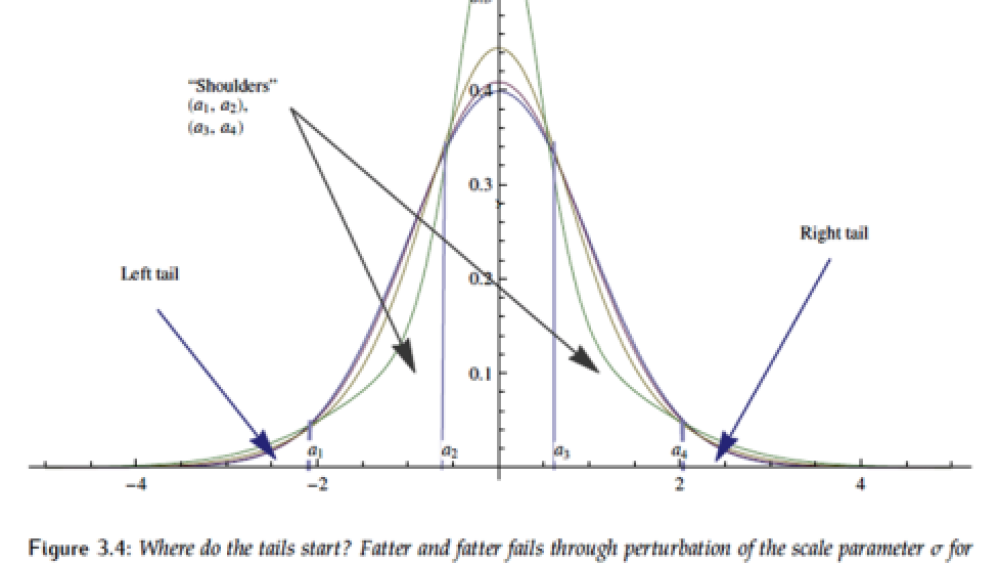
Considering the vision of the markets, which is put forward in the works of academics such as Harry Markowitz (1952), William Sharpe (1966), or Eugene Fama (1970), this correlation should not be particularly surprising. True enough, building on the earlier work of Louis Bachelier (1900), classical financial theory argues that market returns are identical and independent variations that follow a “normal” or Gaussian distribution. In this framework 99.6% of price changes always fall within three standard deviations of the mean, and any variation, beyond those three sigma, has a probability so low that it shouldn’t occur in upwards of thousands of years.
Nonetheless, in the recorded market data, sudden and major variations have been occurring with a growing frequency, which has been dismissed by many as mere “anomalies” (Fabozzi, 2019). Yet there is an alternative to the classical financial framework, found in the works of French mathematician Benoît Mandelbrot (1924 – 2010), and of ex-trader cum thinker Nassim Nicolas Taleb (born in 1960). Both contend that financial markets are far more volatile and riskier than is agreed upon in the classical theory. Mandelbrot exposes that the price variations of financial assets are more often than not distributed according to power laws (1963, 1967), and identifies the financial markets as multifractal objects (1997, 2005). In contrast to Mandelbrot, Nassim Nicolas Taleb begins with a focus on rare events called Black Swans that, on the financial markets, can materialise through single price variations greater than three standard deviations. An prime example according to Taleb is the October 1987 Black Monday, during which the S&P 500 stock index lost over 20% of its value. Yet this volatility isn’t limited to stocks, but encompasses all tradable financial assets, which were found to have kurtosis measures above that of a “normal” distribution (Taleb, 2011).
Of Fragility, Antifragility, and Robustness
This leptokurticity
In what can be called the Mandelbrot-Taleb framework, the high volatility of financial assets means that their exact distribution is never really knowable. All that can be known is the past, which will always be a sample of the total, and depending on the sub-period analysed, the first and second moments of an asset’s distribution will vary, sometimes greatly. Therefore, rather than working on an assumed, but potentially erroneous, second moment, it is simpler to stress-test the investment portfolio and see where it falls in the Fragility triptych. Alternatively, it is possible to adopt the portfolio allocation suggested by Nassim Taleb himself in order to maximise Antifragility of the investments. This allocation is as follows: 85% – 90% of the portfolio is to be invested in “safe” assets such as real-estate, gold or investment-grade bonds. The remaining 10% – 15% of the portfolio is to be invested into a diversity of riskier assets, which allow the investor to bet on eventual positive Black Swans. Such assets that can include venture capital are far more speculative in nature.
Where on, for portfolio management?
Although the case in favour of the non-normality of financial assets is gradually being settled, the practical consequences in terms of portfolio management remain sparse. Over the last decades, there have been several innovations in the field. The greatest being passive investing, which has brought numerous investors to the markets whilst limiting their risks. Yet, buying shares in an index linked fund means that one will enjoy all the upside of the market, but also all the downside. In some ways, passive investing is the institutionalisation of the average performance. However the average can be dangerous as it hides the potholes in the road, and remains vulnerable to a blow-up. For instance, an investor holding only a Dow Jones index fund in early March 2020 would have gone down the whole way with the index. Hence the pertinence of another investment trend of the last decades, which is “risk-parity investing”.
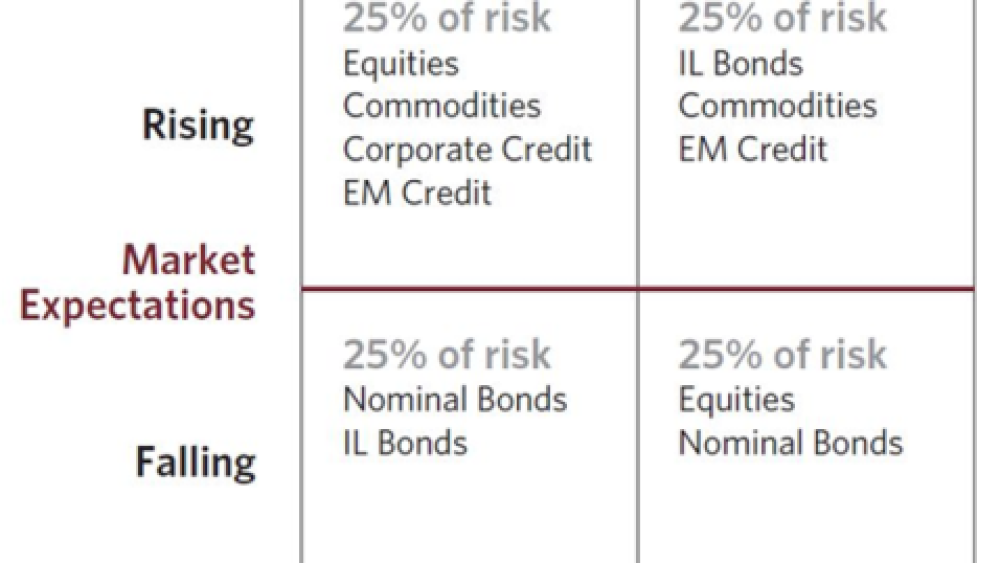
This approach has been pioneered by Ray Dalio, founder and chief investing officer of Bridgewater Associates, a hedge fund. The initial idea was to create a portfolio allocation which would do well in all economic environments. These were boiled down by Bridgewater to four scenarios: rising or falling growth and rising or falling inflation. Depending on the prevalent scenario, different asset allocations would be chosen based on the relationship of each asset class (equities, bonds, commodities, and gold) with the two economic variables. Bridgewater explains that those relationships are more durable and less transient than the correlations between assets, which change over time (Prince, 2011). This All Weather Portfolio was further simplified in 2011 into the All Seasons Strategy, providing investors with a simple allocation that can be implemented by anyone with a brokerage account and an excel spreadsheet. The All Seasons portfolio is allocated 55% in bonds (long and intermediate term), 30% in equities, 7.5% in gold and 7.5% in commodities. The differing percentages allow each asset’s risk to be offset by the others leaving only the market return of each class.
Testing the All Seasons Strategy
The All Seasons Strategy is known and popular enough for its performances to have been tested several times and presented on the Internet. Nonetheless, most of those studies rely solely on exchange traded funds and seldom test the portfolio prior to the 2008 global financial crisis. Albeit limited in time, their results show that the portfolio seems to have a clear degree of resilience when confronted to the changing winds of the financial markets. Yet, testing a portfolio during a mere dozen of years provides limited insight as to how and where it would fall in the Fragility triptych. As Taleb illustrates in his works, the law of large numbers can be slow to manifest itself, as in the case of a 80-20 Pareto distribution, in which the mean stabilises beyond 10000 data points. When it is considered that in one year, there are a mere 250 days of trading, it seems prudent to test a portfolio over several decades, in order to get more precise indications of its ability to resist market shocks. This is all the more true in the case of a portfolio whose avowed goal is to do well, no matter what, by targeting the intrinsic return of each asset class.
Due to this specific objective, it would be logical if the All Seasons Strategy fell squarely into the Robustness panel of the triptych. Yet, the idea of profiting no matter what is also indicative of aspirations to a measure of Antifragility. Therefore, to best assess how the portfolio falls, a specific scale has been designed for the purpose of the study. The scale employed is inspired by Eugene Fama’s efficient market hypothesis, as we have the following levels: weak Robustness, semi-strong Robustness and strong Robustness. The Robustness of the allocation is measured in the case of a shock which is at least the size of a market correction, i.e. a 10% fall in the general market index which serves as the yardstick of the study. As we are here, for practical reasons, focused on the United States, the general market index is the S&P 500:
– The portfolio will be deemed to be weakly robust if it loses less than 5% during the correction; – It will be semi-strongly robust if it loses less than 2.5%;
– Strong Robustness will be considered achieved if it loses less than 0.5% during the same market shock.
These levels are identical for Antifragility, albeit with different corresponding measures:
– Weak Antifragility will correspond to a gain between 5% and 10% during a correction;
– Semi-strong Antifragility will be illustrated by a gain between 11% and 20%;
– Strong Antifragility will be achieved in the case of a gain above 20% during the correction.
Testing scenarios
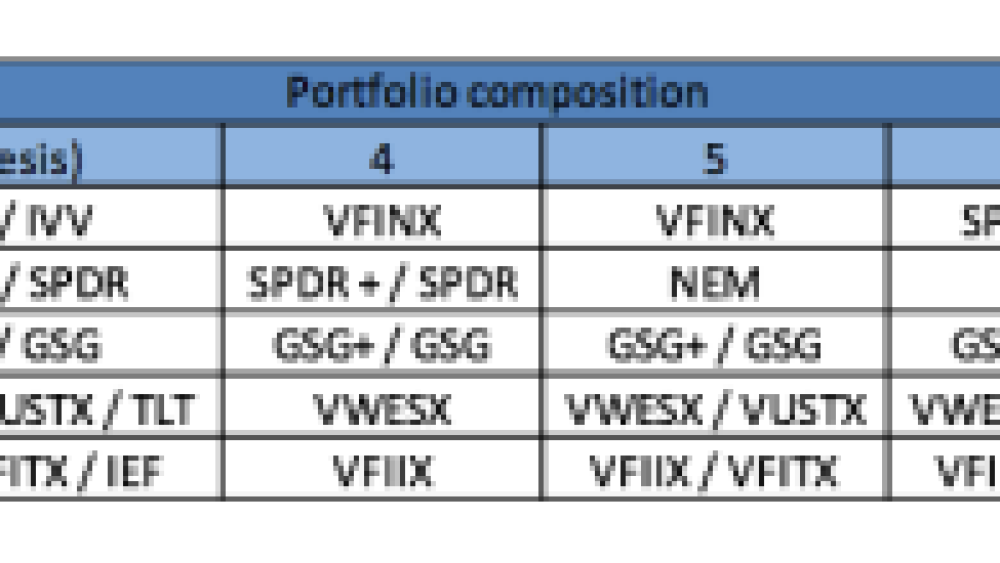
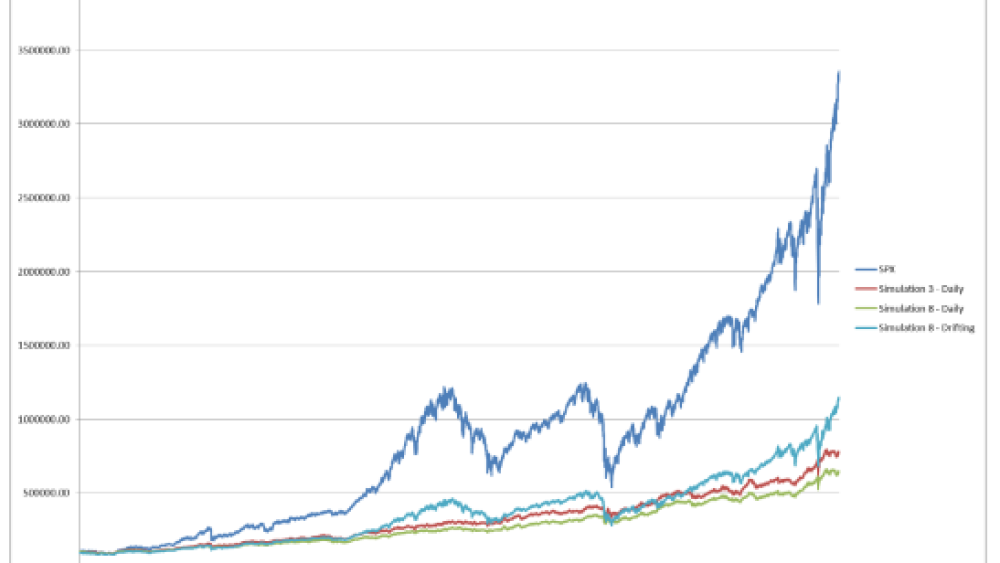
In order to simulate the All Seasons Strategy over a forty year period, it has been chosen to invest US$100.000, starting on September 30th 1980, allocated according to the different ponderations of the strategy. The money is initially invested in mutual funds, which are gradually changed for ETFs’ when the latter become available. It should however be noted that there are two exceptions. One asset class – commodities – is invested in a reconstituted ETF, as no diversified commodity fund existed in US$ before their advent. This reconstituted fund is created by subtracting the fees of the ETF to the past performance of the tracked index. Another asset – gold – is initially held physically, before going on to a gold-tracking fund. An alternate possibility is explored by investing in shares of a gold producing company, prior to the 21st century. Up to eight different combinations of the allocation were tested in order to compare both the performance and the resilience of the strategy.
The study also takes into account two different modes of investment management. One scenario calls for the portfolio to be rebalanced daily, under the hypothesis that there are no transaction fees. On the other hand, the second scenario is more radical as it lets the strategy drift with the markets, in a pure buy and hold manner. Changes in fund holdings are done at existing levels of allocation and the ponderations are never rebalanced, this being a departure of the risk-parity principles. All scenarios assume that any taxation on capital gains is avoided by the immediate rebalancing, as no real profits are actually taken by the investor. Furthermore, it is worth noting that the length of the studied period encompasses a diversity of major market crises and fits with the timeframe of the increasing volatility mentioned above. For instance, the period covers October 1987’s Black Monday, the market collapse of September 2008 after Lehman Brothers filed for bankruptcy, and the more recent “Corona-crash” of February/March 2020.
A solid and resilient portfolio
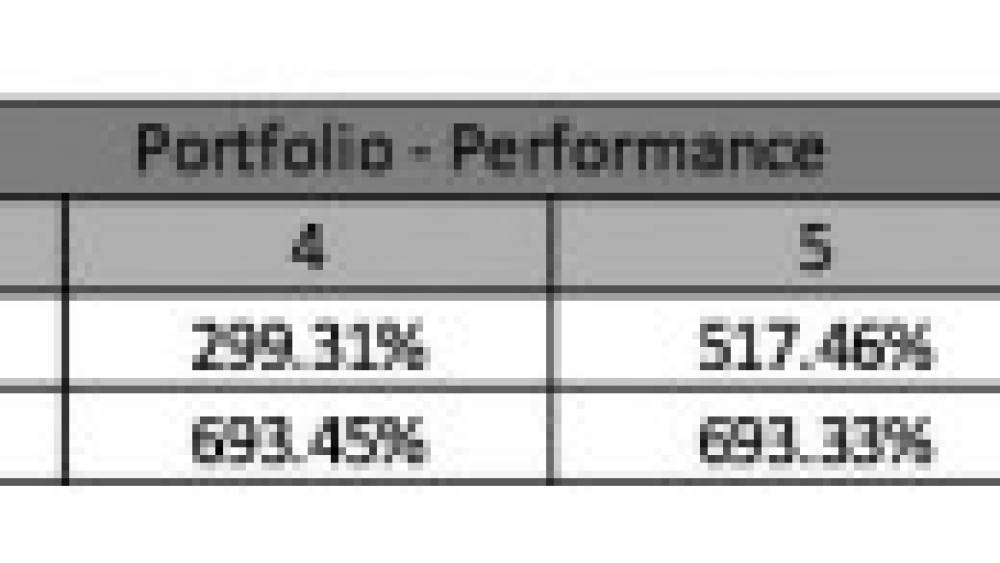
Firstly, it is abundantly clear, from the simulation, that the All Seasons Strategy is a defensive investment portfolio. This feature is most apparent through the comparison with the performance of the study’s benchmark. Whereas the S&P500 gains 3232.67% between 1980 and 2021, the All Season’s when drifting and never rebalanced gains only 1137,95%. The best performance when rebalanced daily is 675.99%. In the end, this dampening of performance is essentially due to the allocation, either initial or rebalanced, which has only 30% of equities. The resilience of the portfolio is further exhibited through clear instances of Robustness either weak, semi-strong, or even strong in some rare cases. The results of the simulation set a clear distinction between isolated market corrections and larger financial crises and Robustness per se is more distinct in the former situations.
The amplitude of the 2008 and 2020 market falls is too large for even this portfolio not to budge. Although most of the market drop is absorbed, the portfolio does lose more than 10% between the top and the trough of the market. In the two best cases of 2008, it actually lost ~15% when the S&P 500 lost 43%. In 2020, the portfolio was down 7/8% to the index’s 32% fall. There are also instances of localised strong Robustness. On March 16th 2020, whilst the benchmark fell 11% in one day, the portfolio at best lost only 0.67%. On average, the portfolio does only 1/3 of the fall has a time to recovery which is at most half of that of the whole market. Lastly, it is worth noting that the performance of the portfolio in terms of Robustness did not extend to Antifragility. True enough, there are scant traces of the latter, and it cannot be excluded that they are merely caused by imperfect data, as they are well within the margin of error.
The All Seasons Strategy provides a fairly simple and well diversified and robust allocation. Although the study demonstrated it isn’t calibrated to profit from market volatility, it does absorb the effects of most market downturns. In this, it lives up to the goal of “doing well across all environments”, and could find its place as an integral part of a larger investment strategy.