
Our contemporary financial market is defined by its global and volatile business environment and, of course, its technological breakthroughs which have quicken the pace of development of financial innovations. One of them were the insurance-linked securities (ILS), introduced as a way to transfer an insurance risk to capital markets. Typically used by large institutional investors such as pension funds or sovereign wealth funds, the insurance linked securities (ILS) are investment assets whose value is affected by insured loss events. This means performance is uncorrelated with traditional asset classes such as bonds, stocks or money market instruments. Such investment vehicles are considered as a relevant asset class category for diversification purposes. These debt instruments have a determined maturity date, which may be fixed by reference to the period of the underlying risk.
Nowadays, the best-known ILS asset is for sure the catastrophe bonds also recognized as “cat bonds”.
A growing catastrophe bond market
Since its first issuance in 1992 by American insurers as a consequence of the Hurricane Andrew and the Northridge earthquakes, which caused together over $40 billion (Charpentier, 2002) in damage, the catastrophe bond market capitalization expanded at an impressive rate. As a mark of confidence in this asset, the cat bond issuance in 2020 reached a record-high, as the market saw over $11 billion of pure property cat bonds issued for the first time. $761 million of cat bonds supporting specialty, life, or health insurance risks were issued during the year, as well as almost $351 million of private catastrophe bonds.
The backdrop of the Covid-19 pandemic largely contributed to the 2020’s active year of cat bond issuance.
The impressive catastrophe bonds market growth result displays a testament of the resilience of the ILS market and its participants. It finally attested the usefulness of such a tool even more during a pandemic. Indeed, the cat bonds are a way for insurers and reinsurers to transfer risk to new sources of capital.
For ILS investors, these investment assets benefit from uncorrelated returns with the financial markets. On the other hand, the ILS fund managers have proved their ability to trade through tough times. That being said, the cat bond industry has potential for additional growth, and innovation is increasingly seen as the key to attracting fresh capital.
A specific structure
Catastrophe bonds differ from traditional corporate bonds by their specific structures. Fully collateralized instruments, they are traded on the OTC markets. More specifically, a company cedes a natural disaster risk by issuing bonds whose repayment is conditional on the occurrence of such event in a given region.
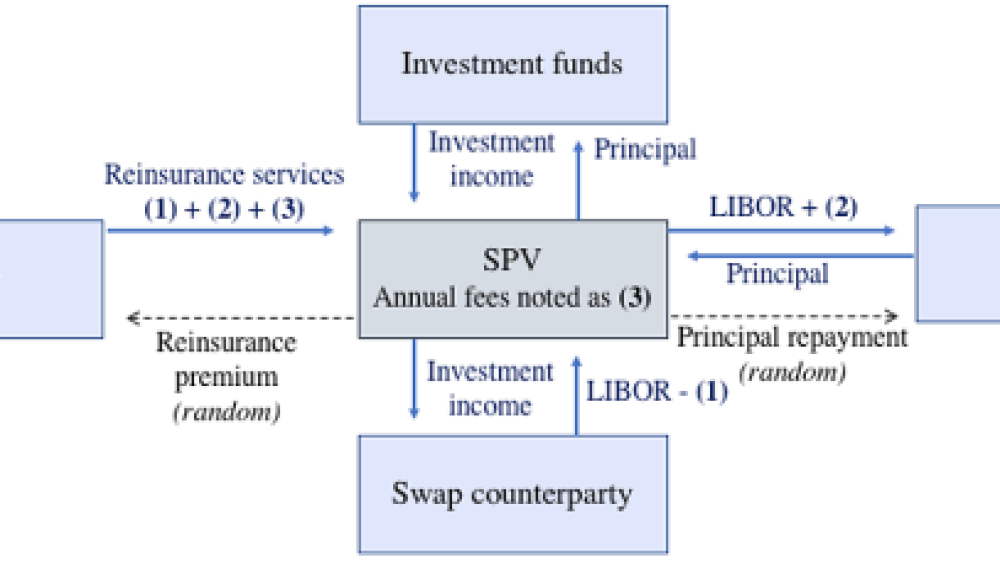
The structuring of the operation begins with the risk transfer from the sponsor (or ceding company – commonly insurance company) to an ad hoc “Special Purpose Vehicle” (SPV) via a traditional reinsurance contract upon payment of a reinsurance premium. Perceived as essential in the isolation of financial risks, this separate legal entity is created for a specific objective only. When domiciled in an offshore location such as Bermuda or the Cayman Islands, it guarantees ease of licensing and lightened and often lowered tax requirements. In a collateral account of the SPV, the investor deposits the bond’s nominal value.
Finally, the vehicle issues cat bonds to investors and invests the proceeds in very liquid, low-risk financial products or short-term securities such as Treasury bills.
The investment income generated by the fund will be captured by the SPV and may be swapped so as to exchange the income from these financial products against the LIBOR rate - (1).
In addition, the SPV generally issues investors coupons, or interest payments made from the collateral, at variable rates reflecting the LIBOR rate plus a risk premium (2).
Charged fees attributed to the management of the SPV we will noted (3).
Finally, the SPV concludes a reinsurance contract with the insurance (or reinsurance) company in return of an annual reinsurance premium payment worth (1) + (2) + (3).
As a result, the purpose of this mechanism is to provide loss protection to the sponsor.
During the contract, two options appear:
- If no trigger event occurs then the collateral is liquidated at the end of the cat bond term and investors are repaid by the principal amount plus a risk premium which includes the interest earned from risk-free investments. This gain makes the investment very attractive;
- If a qualifying event occurs which meets the trigger conditions to activate a payout, the SPV will liquidate collateral required to make the payment and reimburse the counterparty according to the terms of the catastrophe bond transaction to the detriment of the investors.
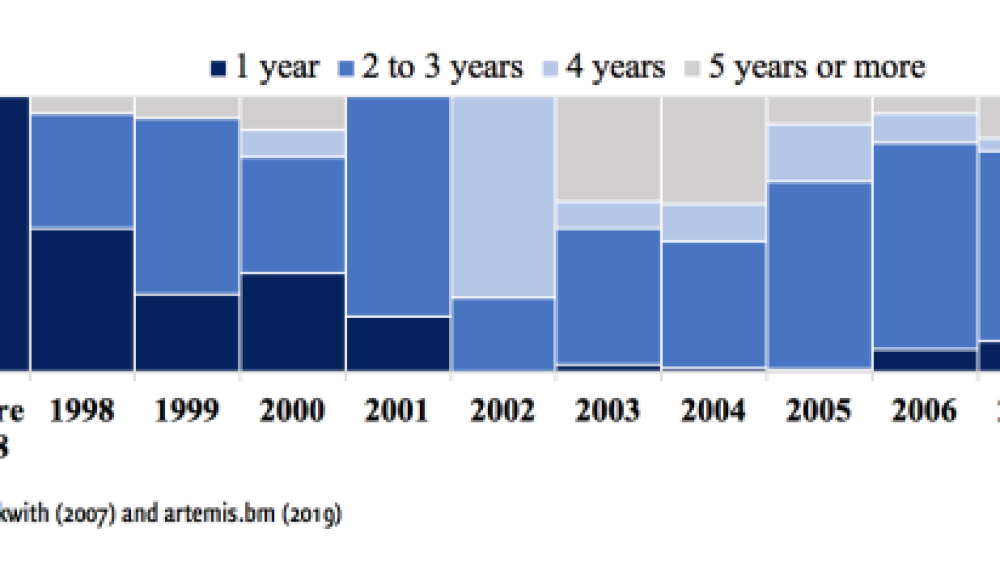
Initially, many of the cat bonds had short-term maturities of one year or less and had lower risk charges. More recently, since 2003, the cat bond’s maturity has decreased from five years to three years explained by the parametric triggering contingencies and the heightened vigilance from investors over prolonged periods of risk. On the opposite, reinsurance last about a year. Therefore, according to Cummins (2008), the sponsor of a cat bond is protected against the cyclical behavior of the reinsurance market.
Catastrophe bond triggers
One of the key aspects of any catastrophe bond is the specific terms under which investors begin to lose their investment. Such triggers with defined parameters have to be met to start accumulating losses.
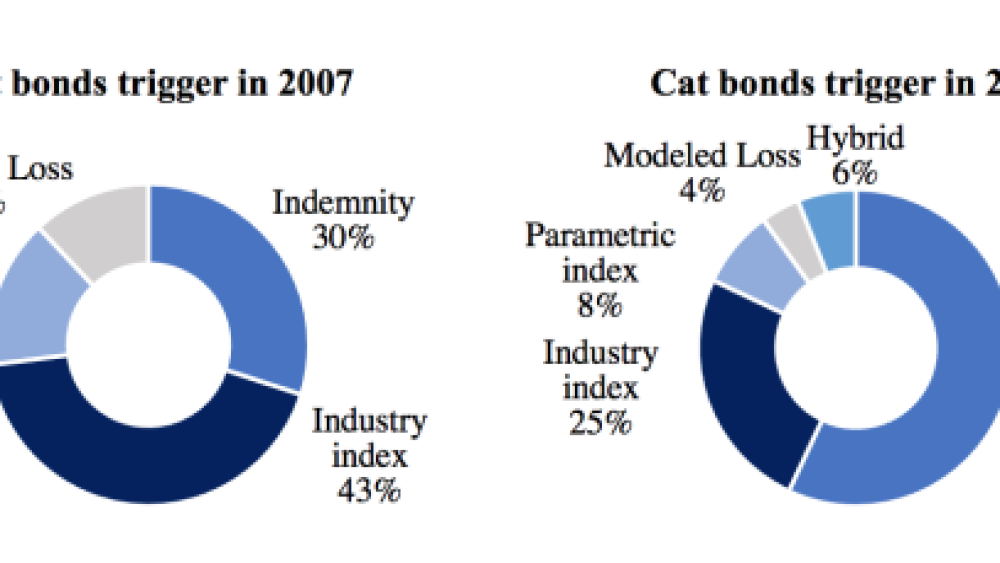
Triggers can be structured in many ways from covering actual excess loss experienced by the issuer (indemnity) to non-indemnity triggers which include the following:
Industry loss trigger where payouts are activated based on whole-industry losses from an extreme event;
Parametric index trigger where payouts are triggered by a reported index based on exceedance of specified natural parameters, such as wind speed of hurricane, magnitude of earthquake, location of earthquake, etc.;
Modeled loss trigger where the coverage is based on events’ parameters estimated or projected and put into a fixed model to compute losses.
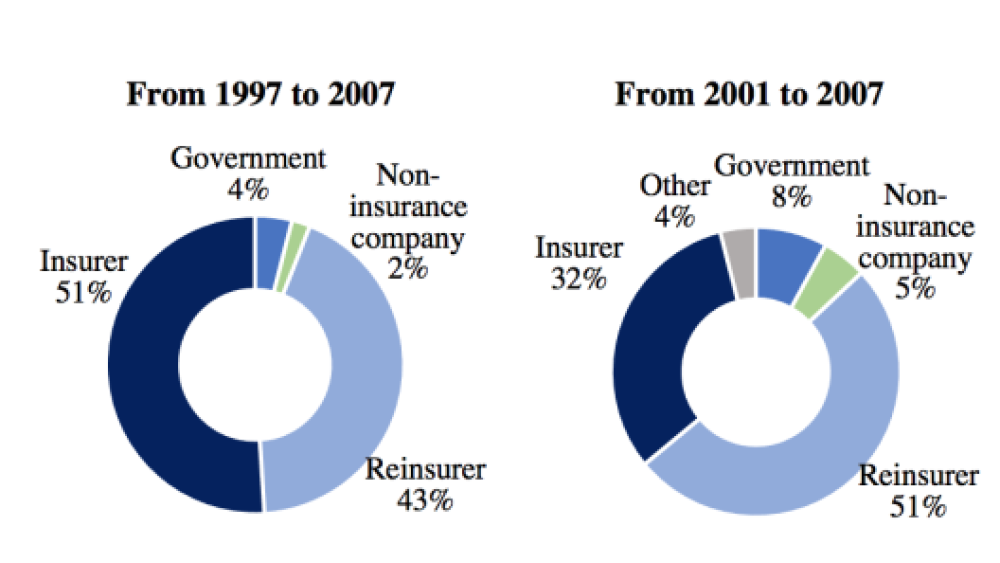
An important feature is that the breakdown between the different triggers has evolved since the inception of the cat bonds market. Published by Swiss Re, we note that between 2007 and 2012, the indemnity cat bonds extended their leading position. In addition, so-called hybrid cat bonds emerged, incorporating a mix of the previous triggers’ particularities.
Leading corporate companies: New cat bonds issuers?
Globalized markets and technological progress, particularly in terms of modeling the risks of natural disasters, have accelerated financial innovations. Cat bonds financial products initially intended for insurance were propagated and adapted to the needs of the rest of the economy, thus benefiting to non-financial companies.
The sponsor benefits from the cat bonds offerings by giving it access to capital markets that have the demonstrated capacity to receive a higher source of funding in the event of a natural disaster than the traditional insurance market. To meet its particular necessities, the sponsor has the ability to issue tailor-made cat bonds, making it more flexible than other ILS products dedicated to corporate companies (such as insurance-linked derivatives or contingent capital facilities).
Classified as a high-yield debt instrument, the cat bonds offer lower tax costs than that of shares, especially due to the interest paid on bonds deductibility. Moreover, the financial rating associated with cat bonds is generally BB or B-, which is equivalent to so-called “non-investment grade junk bonds”, and is usually based on the probability of occurrence of the predefined catastrophic event rather than the issuer credit rating. Investors are therefore expecting higher return and attractive coupons compared to corporate bonds.
As mentioned before, when the SPV is located in an offshore country, the sponsor benefits from a tax optimization on its premiums. Lowering costs for sponsors will push the market to expand.
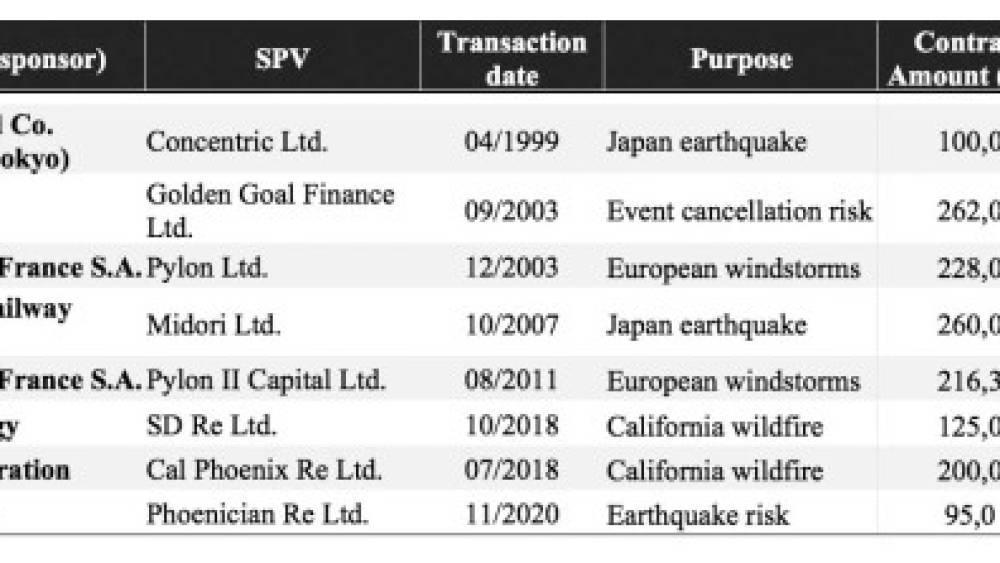
Between 1999 and 2020, only eight corporate companies have issued cat bonds, testifying that this product is still quite unknown and so rarely deployed (table 1).
The first issue was that of the corporate was Oriental Land, owner of Disneyland Tokyo, for an amount of 100 million dollars. In April 1999, the company securitized the earthquake risk associated with the SPV Concentric Re on a parametric trigger basis.
Subsequently, corporate concerns were to insure overhead power lines against the risk of a storm, earthquake, or even cover themselves against forest fires. Last but not least, Alphabet, which acts as a company on behalf of Google, first issued a cat bond to give its assets in California greater earthquake protection. At the light of these data, there is no privileged sector for corporate companies to issue a cat bond neither a preferred natural catastrophe-type event to be insured.
As a financing tool or risk management strategy, the targeted objective of their use is to act as a relevant alternative or a complementary tool to the traditional insurance products, notably offering portfolio diversification to investors.
The issuance of the cat bonds suffers from constraints making it tough for corporate companies to use.
First, the implementation process is expensive and time-consuming due to its complexity (costs to implement the SPV, to produce the legal documentation, to perform the modeling, fees to the intermediary, etc.). Another inconvenience arises from the information requirements. Since transparency is imposed by investors to build trust, confidential information about the company’s possible casualties are provided. Since the company’s strict business confidentiality is no more kept, the public or competitors may exploit the sensitive data to decrease the sponsor’s competitive advantage. Finally, the understanding of the risk factors and the financial model’s sophistication require an in-depth professional knowledge.
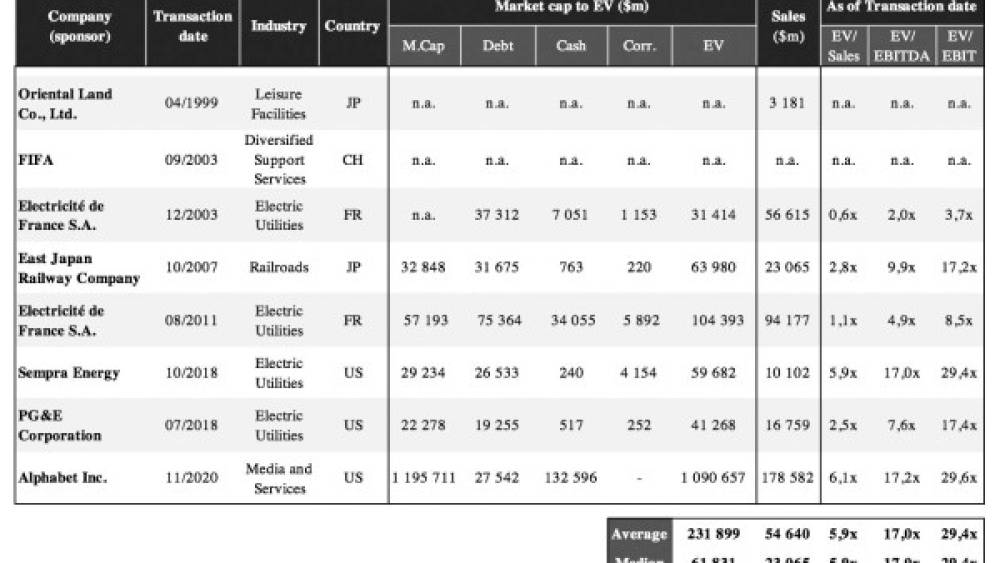
The table 2 depicts the corporate company’s financial information in order to determine the suitable structure for a cat bond issuance.
For non-financial companies, the decision to issue such product should be proceeded based on its balance sheet analysis and its risk profile.
Therefore, cat bonds can only be applied by leading international companies listed on the stock exchange with the following characteristics: (1) A market capitalization above $20bn; (2) A balance sheet size above $ 75bn; (3) A desire to cover against extreme risk with no alternative options available.
Such high level of criteria upon corporate companies tends to make the cat bond application very rare. It justified the leading position of institutional financial company in the cat bonds ecosystem. The costs of setting up and the financial expertise by investors required are potentially strong obstacles to the democratization of this tool.
On an overall vision, results based on the case studies and on the literature consensus suggest that the use of cat bonds by corporate companies is still recent. Results found should motive future generations to investigate more into this problematic.