

The origins of Bitcoin lay in ideas about what money should be, the future of its underlying technology, Blockchain, will probably be determined by an understanding of what money really is.
Blockchain’s origins lay in the creation of Bitcoin, the currency/payments technology which always had a strong element of ideology in its objectives. Bitcoin attempted to create a world where money (and the payment process) can be free from the inflationary tendencies
The Bitcoin experiment
Whether you regard the Bitcoin experiment as an offshoot of libertarianism, a layer of technology around a clever scam or simply an effort to improve economic efficiency, strong elements of that belief about how the world should be (and what money should be) have migrated into the growing enthusiasm for Bitcoin’s underlying technology the Blockchain. In fact the enthusiasts go further talking about Blockchain changing the nature of democracy or the arts etc.
However Blockchain is generally put forward as a technology that can deal with problems within the existing financial and economic system. It is presented as a solution that can cut costs and improve efficiency, not only in the way financial institutions deal with each other, but within their own infrastructure. Fintech companies and consultancies have estimated potential annual savings in the tens of billions of dollars. Whatever the truth of these stories, they have an incredible appeal to the banks; desperate to cut their costs in a post-crisis world where compliance costs, fines and capital charges are destroying their profitability, if not undermining their basic business models.
Behind these claims is the concept having money, other financial assets and even Honduran land deeds embedded a Blockchain (or what some people refer to as a distributed ledger – though they are not totally synonymous). Once everything is in a single (but technically “distributed”) place, transfers and exchanges of all types should become simpler and faster, with minimal needs for intermediaries. Bitcoin as a currency has some elegantly beautiful (though fundamentally peculiar) characteristics. These minimise the need to integrate it into the world financial system or understand the real nature of money.
Bitcoin was created specifically as an integrated hybrid of currency and payments systems, with Blockchain as its underlying technology. However, if you want to create systems based on Blockchain that integrate with existing elements of the finance, there are some things you need to make very clear. Notably what is exactly is the “money” stored in the Blockchain and how does that money relate to the existing forms of money.
What is Money?
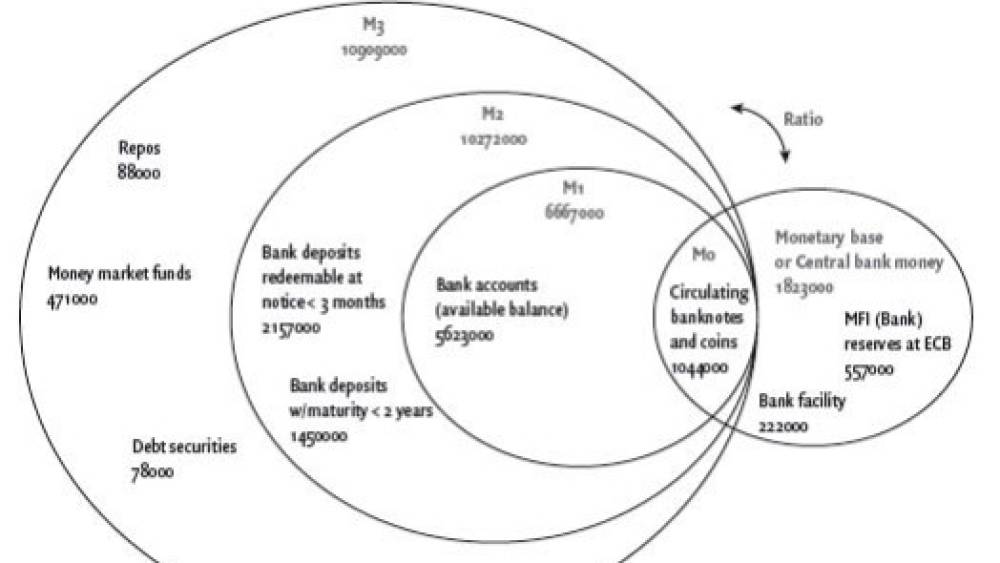
There have been many, many books written defining money, the characteristics (store of value, medium of exchange, unit of account etc.) or the forms of measurement, should you use M0, M1, M2? Many of these works are not dry technical books, they are parts of long and heated debates, often with an underlying political agenda. However, we just need to consider some basic characteristics of money in order to put Blockchain into perspective (Fig. 1).
xxxmettre ici Schéma 1xxx
Put simply (some would argue too simply) there are four main types of money (or at least “money like” things) used in the world’s functioning
Bank Notes and Coins
Nature. Coins and bank are physical IOUs from the government/central bank to repay the bearer. No banknotes actually have “I Owe You”, written on them but Bank of England notes come close with the inscription “I promise to pay the bearer on demand”. The intelligent school girl may ask “Repay you with what?” to which the confusing answer is, “More of the same”.
Creation. Print it, or mint it and spend it. Typically, coins are minted by the mint (a direct arm of the state) and notes by a central bank. In more primitive/more cash based societies, simply printing and spending money is an option open to governments. In more developed nations the creation of physical money is actually driven by commercial banks. When they need more physical cash for their customers they can reduce the balance on their account at the central bank and receive an equivalent amount of physical cash. Conversely they can deliver excess physical cash to the central bank and have the value credited to their account. We will discuss central bank reserve accounts shortly.
Acceptability. Generally, your local currency is one of the most accepted forms of money in any economy. Only where you get to the payment of larger sums, do people start preferring more electronic forms of money because of the reduced costs and risks in handling it. In some countries there even are mandatory limits on the size of cash transactions. There are of course situations where the local currency is so debauched that even the issuing government does not want it; in situations of hyperinflation or where there is an “official” exchange rate, completely out of line with market rates.
Why people so willingly accept central bank/government money (whether physical or electronic) is another question. Suggestions include habit or because we have to. One of the most creditable answers is the central bank/government money can always be used to pay taxes and in many cases buy goods and services from the government. Finance professionals sum this up simply as “the central bank/government has the lowest credit risk” or at least in the local currency. It is also common in many countries for governments to mandate its
How to spend it? Using physical currency seems to come naturally to all of us, remove it from a wallet or purse and hand it over in exchange for goods or service.
Commercial Bank Money
Nature. Commercial bank money is by far the most common form of money. This is money that people believe they have in their bank accounts. At its simplest this form of money is an IOU (“I owe you”) from the bank to its customers. The money that customers deposit, or gets deposited by their employer, does not exist as a pile of banknotes in a vault. It only exists as entry in the bank’s
Creation. The creation of commercial bank money is one of the most misunderstood mechanisms in finance and economics. When a customer wants a loan, a bank can simply create money by crediting their customer’s bank account. This magic trick becomes more understandable if you look at things from the accounting perspective. Banks have Assets (things they own of value) and liabilities (things they owe to other people). When a bank makes a loan it creates an asset (the money the customer owes them) and a liability (the money the bank credits to the borrower’s account). You started with nothing and when you add the asset to the liability you still have “nothing”. However, when the customer that has just received a loan looks into their bank account (just one side of the equation), they see money which they can freely spend. Part of the reason for the confusion around credit creation is that most people believe that deposits are always necessary to enable loans.
Acceptability. In terms of acceptability, commercial bank money is just as acceptable as cash and of completely the same value in purchasing goods and services (except perhaps if you are interacting with the black economy). Buy 20 happy meals in McDonalds and they are equally happy if you pay with a commercial bank money (using a cheque or debit card) or with banknotes. Acceptability is the same and the amount on the bill is the same. You may ask, why do people believe this form of money is worth exactly the same as physical money? The government went to the trouble of printing attractive looking pieces of paper and will always accept them. Why is the money “made up” by bankers still so trusted?
There are quite a few reasons not to trust commercial bank money. There is the mysterious and greatly misunderstood credit creation process, even people that studied economics at very respectable institutions will tell garbled stories of “fractional reserve banking”. When a bank’s liabilities exceed their assets (as is the case when too many borrowers fail to repay their loans), banks become bankrupt and our IOU may become worthless. An even faster moving disaster, is caused by too many customers demanding their money back at the same time. A bank’s assets will typically be less liquid than their
Bank runs and bankruptcy have happened as long as there have been banks or “bank like things”. So governments have put in place mechanisms to make commercial bank money even more acceptable. To stop scared customers asking for all their money back at the same time, deposit insurance was invented. Deposit Insurance means most customers have the reassurance that a significant proportion of their money will be repaid by the government if the bank folds. Banks are monitored by accounting firms and the central banks to make sure their assets are at least as big as their liabilities. To deal with runs banks are required to keep reserves at the central bank and central banks can provide emergency funding. Banks are also required to have Capital to absorb losses on their
The only people who generally show reluctance to accept a commercial bank’s money are the criminals (who much prefer cash or bitcoins) and bankers at other banks, for reasons we will shortly discuss.
How to spend it? Making payments with commercial bank money (at least domestically) is generally straightforward using cheques, debit cards and a variety of payment methods. Payment generally only gets a little more tricky (and expensive) if the recipient does not have a bank account or there is need to send to money abroad, with the need for it to be exchanged for a foreign currency.
Reserves at the Central Bank
Nature. Reserves at the central bank are the money that banks have on deposit at a central bank.
One of the key roles a central bank is to act as the banker’s bank, at least within a given country. Every bank has an account at its central bank called reserve accounts (or just reserves). Just as money in a commercial bank account is an IOU from the bank, reserves at the central bank are an IOU to the relevant bank. Though a dollar in an account at the central bank is equal in value to a dollar in a bank account with a commercial bank, bankers treat reserves as a better class of IOU. This is because a central bank can never run out of widely acceptable money (because they have the option to create more) but commercial banks can only create credit for others. They can never create money to pay off their own creditors.
While we are discussing Central banks there are a few other points worth mentioning. Though at times they have been independently owned, they now exclusively owned by governments (or in the case of the European Central Bank by a group of governments). Even when independently owned (as was the Bank of England until 1946) they were effectively controlled by the state. In recent years it has been fashionable for central banks to be given a high degree of independence, in order to control inflation. This independence was based on the currently widely agreed monetary policy which carries some of the same ideological principles as Bitcoin (as well as the practical example of the German Bundesbank) i.e. inflation is always bad and governments cannot be trusted to preserve the value of the currency.
Creation. Reserves are created through the purchase by the central banks of government bonds from the commercial banks or the loan of funds to the banks in return for collateral such as government bonds or more recently loans to their customers. Recent years have seen this done on a massively larger scale, not just of government bonds but also of less credit worthy securities and loans. This is called Quantitative Easing (or just QE).
Acceptability. Banks always accept central bank money. Things get a bit more difficult if you do not have an account at a central bank (as is the case for pretty much everyone apart from banks). When non-banks receive funds from governments or central banks it ultimately ends up as commercial bank money in their bank account, even if as part of the overall transaction their bank ends up with a net increase in their reserves.
How to spend it? Central bank money exists primarily to deal with two problems. One is that banks do not really trust each other and central banks (and governments) worry about banks running out of money.
When banks are creating money through the normal process of lending money, the money created and loaned out does not just get spent with people who also use the same bank. Some of it is paid to people who use other banks. So if Barclays makes a loan to Mr. Smith who pays Miss Jones with a cheque she deposits at NatWest, Barclays ends up owing money to NatWest. NatWest does not want to end up with large debts from Barclays. Banks (or at least some of the bankers in each bank) generally have an idea of how money is created and how other banks can go bust, so some caution is understandable.
For this reason the clearing process was invented. In the normal course of events not only are Barclays bank customers paying money to Lloyds bank customers but Lloyds bank customers are paying money to Barclays bank customers. The clearing process lets the banks net off their debts to each of other and settle the difference by transferring money between their reserve accounts at the central bank.
This does not mean that banks are completely unwilling to lend each other money. They do and on a very large scale but in each case it is by deliberate choice, for a given period of time, at a given rate of interest and often with other conditions. The average interest rate that the major banks are willing to lend to each other is
Banks are forced to keep reserves at the central bank because it gives the central bankers the reassurance that banks will be able to give their customers physical cash if they want it (banks obtain additional physical cash by asking the central bank to exchange some of their reserves for central bank cash as discussed earlier) or to support transfers of cash to other banks (which requires the transfer of reserves between banks).
“Near Money”
The final type of money (or perhaps types) is what some people describe as “near money”. These are things that look and smell like money but are not quite the same as the other forms of money discussed. This definition of near money (and there are others) includes the various form of bonds, commercial paper and term deposits. Near money is also a collection of IOUs, from governments, commercial banks or corporations; they are denominated in monetary terms; they can generally be quickly converted into the other forms of money by selling them or using them as collateral to borrow “real money”. Some forms such as government bonds, can be extremely quickly exchanged for cash (through sale or a Repo transaction), other forms which you might call “further away money” such as corporate bonds, are harder to turn into cash. What you cannot generally do with near money is to use it to buy things or to pay taxes. Term deposits (where you have to wait to get your cash back) or Notice deposits (where you have to give a certain number of days’ notice or pay a penalty to get money back quicker) also fit into this category because you cannot simply spend the money.
Depending on the economic or financial circumstances it can be much easier or harder to convert near money into one of the other forms. Commercial and Central banks have long carried out Repos trades where bonds are temporarily exchanged for cash; often on an overnight basis. In the years leading up to the last financial crisis ever poorer quality bonds (including the toxic bonds created from sub-prime mortgages) became extremely easy to convert into cash, with devastating consequences for the world economy. An interesting example occurred in the early stages of the financial crisis. Bear Stearns had two hedge funds which invested in mortgage banks securities. To increase their return, the Hedge Funds able to easily convert the securities they bought into more cash using repo trades. Banks lent 80 %+ of their face value, this cash was used to buy more securities, which were repo-ed to provide more cash etc.
Back to Bitcoin and the cryptocurrencies
What does all this mean for the Blockchain? If Blockchain/Distributed ledgers are going to have an impact on the financial infrastructure (with particular emphasis on payments, the issuance of securities and processing of financial trades) we need to be very clear what the money represented on the Blockchain actually is. In particular, how it relates to existing infrastructure and concepts of money.
Simply claiming you can represent various forms of cash and securities in messages and on a ledger means nothing. I can represent money on a spreadsheet, or in a database but unless it links to current world of money it is a meaningless and valueless exercise.
Representing Cash Balances in a data model – Meaningless and Valueless by itself
Patrick|USD|23434.34
Mary|USD|543.45
Dennis|GBP|765343.00
To think more clearly about this question we need to go back to Bitcoin, the currency that gave birth to Blockchain. So we will look at the Bitcoin cryptocurrency through the same four lenses.
First we have to re-cap some of the key characteristics of Bitcoin for those lacking an in depth knowledge. There is no central record of who owns which Bitcoin, there are many shared copies of a ledger and techniques employed to stop alteration of the shared copies of the transaction records. Bitcoins coins are exchanged through a network of interested parties whose incentive for this public service is earning/creating bitcoins through validating transactions and updating the ledger. This means there is no need for banks. However, things get a little more complicated (and expensive) if you want to exchange your bitcoins for conventional currency or if you want to borrow or lend them.
Nature. The weird thing about Bitcoins is that they are not IOUs. You hold a Bitcoin and nobody owes you anything. You may think this is a strength but in reality this is actually one of Bitcoin’s greatest weaknesses. Money is used not because it is rare per se. Money is something that has grown out of our nature as social animals. We have always done each other favours, made exchanges, been in each other’s debt. With Bitcoin nobody owes you anything, which means ultimately no one has an obligation to do anything for you in exchange for your Bitcoins. However, Bitcoins have some of the attributes of monetary tokens: easy to verify trustworthiness, difficult (if not impossible) to counterfeit, limited supply.
The other basis for money is intrinsic value. Gold and Silver coins were made from a material that it is shiny and makes pleasant ornaments. Cigarettes became of a form of money in Germany after the end of Second World War and the collapse of its economy because in the worst case they could be smoked. Some bloggers have described bitcoins as “electronic tulip bulbs” in reference to the tulip mania in the 17th Century Netherlands, which crashed the Dutch economy but that is a little harsh to tulips. Even if you were a ruined Dutch financier you could at least plant your tulip bulb or feed it to the pigs, something that is not an option with a Bitcoin.
At the same time there is something strangely beautiful about Bitcoin and its derivatives (the many “Altcoins”). Bitcoins exist in the shared electronic ledger i.e. the Blockchain, without the need for banks. A monetary asset really created out of nothing defying the laws of double entry bookkeeping. It is an asset without a liability.
Creation. Bitcoins are created, as most people interested in this topic know, through the mining process. A computational process that involves both the solving of complex algorithms and the validation of outstanding Bitcoin transactions. Some other cryptocurrencies have more or less the same model. Others have a central body that creates all the electronic money.
Acceptability. Bitcoins are accepted throughout the world by technology enthusiasts, anti-government libertarians and by criminals. Nobody else seems that keen on accepting them, particularly governments. One hundred thousand businesses are reputed to accept them but to put that in perspective it is only just over twice the number of Chinese restaurants in the United States. The existence of numerous bitcoin exchanges does make it relatively straightforward to convert bitcoins to more accepted forms of money, assuming they do not get stolen in the process because there is trust involved in the exchange process.
How to spend it? Find someone that accepts Bitcoins, though it is not guaranteed you will find Bitcoin friendly merchants who sell what you want to buy. Get the public key of the seller, use your bitcoin wallet to create a transaction for the relevant amount of Bitcoins and send to their “public address”.
Where is the money? What is it?
Now we are clear about the nature of money and weird beauty of Bitcoin, we can try to understand why the nature of money has such an impact on potential uses for Blockchain but first let us play a simple game for three post-war financial innovations called “Where is the money?” We will play this with the idea of a tax haven, African SMS based banking and the Liberty Reserve dollar.
An offshore tax haven claims its banks have billions of dollars of deposits. Where is that money really? Well apart from slightly soiled cash in the vault, all those billions of dollars exist in reality as entries on the ledgers of US banks. The offshore banks need to instruct onshore US banks if their clients ever want to do anything with their money, such as spend it.
One of the greatest recent innovations in financial technology is the use of the mobile phone networks (particularly in Africa using the M-Pesa technology) as substitute for current accounts and as a payments network. The utter simplicity of the core idea, that a cell phone balance can be made to operate like a current account balance, and that “old fashioned” SMS technology can be used on not-very-smart-phones to make payments, puts it up there with the ATM in terms of banking innovation (and far beyond “innovations” such as the Credit Default
Long, long before Bitcoin was the Liberty Reserve Dollar (and the Liberty Reserve Euro). From 2001 until 2013 it was possible to send money cheaply and quickly around the world using a new electronic currency, the Liberty Reserve Dollar. All customers needed to provide was a name, a date of birth and an email address. Liberty Reserve had over a million registered users and transferred huge amounts of money. Real dollars were converted to Liberty Reserve dollars, which were then transferred to a recipient. The recipient could use them with whoever accepted Liberty Reserve Dollars or convert them back into real dollars. This sounds in some ways more above board than Bitcoin. At least you have a name and date of birth of the customer (though they were potentially fictitious).
Where was the money though? It took a while but eventually the US authorities realised all those liberty reserve dollars were just a shadow of real dollars sitting in real US bank accounts. If Liberty Reserve Dollars are really just dollars, then that meant the guys running it were operating a US payments service without obeying the relevant US laws (in addition to making life easier for money launderers). The management were prosecuted and even the Chief Technology Officer received a sentence of 5 years in prison.
Now on to the Bitcoin and Blockchain: how do they relate? Blockchain is the underlying mechanism on which the Bitcoin is build. Bitcoin can be viewed as a proof of concept of the Blockchain because it is a real world demonstration that it can support a full scale global payments process that is resistant to cyberattacks. As the same time you have to remember that many of the features in the original Blockchain implementation were designed specifically to make the Bitcoin model work.
The Blockchain idea is to have a transaction ledger which is at the same time wide open to the world and immutable i.e. not subject to malicious or fraudulent amendments. These seemingly contradictory properties allow it to be replicated on many computers in the world – a network that is very difficult to bring down compared to a centralised IT system. As one of the founders of a Blockchain system says: “we have created the world computer, unalterable, unstoppable”.
A Bitcoin can be exchanged between participants on the Bitcoin Blockchain ledger, there too, anyone can participate. The bitcoin supply is finite by design which encourage belief in its value and a number of marketplaces are offering exchange rates with real world money. Since the Bitcoin does lack physical existence, the obligation of anyone to accept it or anyone’s guarantee of its value, its “value” is entirely based on supply and demand. This leads to that value being highly volatile.
How did this happen? With the early growth of the internet, it had become obvious that computer messages had to be secured by cryptographic means. The use of cryptographic software and methods, formerly considered as military weapons became authorized around 1998-2000. How does cryptography help? Cryptography is based on “one way” functions with which one operation can be done but the reverse is so difficult that it is impossible with current and foreseeable computers. Cryptography allows to build things that are both easy to prove correctness and impossible to counterfeit, is not that the ideal banknote?
If Blockchain solutions do not genuinely have a form of money “within the system” they just are simply another layer on the top of the existing banking system. A useful layer in some cases but not something that radically simplifies market infrastructure or cuts costs or makes things quicker that existing alternatives.
Forms of Blockchain Money
Assuming that the money in a Blockchain is a distinct form of money, there are only a small number of logical forms of Blockchain money. Without plunging into technical detail it should be possible to assess the potential of different Blockchain solutions simply by answering some questions about the nature of each of those type of Blockchain money. What exactly is the nature of that money and where did it come from? If it does genuinely exist in the Blockchain rather than in the conventional banking system, how does it change back and forth from the type of conventional money described earlier? Could this new type of money existing in a Blockchain ever displace the need for parts of the banking system?
Let’s explore the 6 forms of Blockchain money that comes to mind.
1. Cryptocurrency
What is its nature and where does it come from?
We have already discussed Bitcoin in detail but you could potentially create a cryptocurrency that is more secure and easier to police than Bitcoin (some of these Altcoins already claim to be superior but share the same broad constraints). Somebody still has to create the “money” though. The current models of creation are still somewhat unsatisfactory. The mining process is in Bitcoin is prohibitively expensive on a large scale and the alternative of simply allowing the founders of a cryptocurrency to create vast amounts of the currency potentially awards them a great deal of money for doing very little. Even commercial banks cannot create money for themselves, only for clients.
How does it convert to and from conventional money?
Technically it is not that hard to build an exchange between a cryptocurrency and a real world currency but for the reasons described above for Bitcoin, it will always be hard to get widespread acceptance of a cryptocurrency.
You can scream and holler and spend a fortune lobbying but governments are unlikely to accept them and then you have volatility issue. A little accepted currency that is not really linked into the real world, a real economy or the real financial sector is always going to suffer from unacceptable levels of speculator driven volatility.
Then there are all the other issues relating to controlling the supply of the cryptocurrency (should it get further in acceptance than Bitcoin). Looked at from the monetary perspective the supply of a currency needs the ability to be able to grow or shrink, in response to both economic activity and the degree to which real assets in an economy have corresponding financial assets.
Could it displace part of the current system?
There is always a demand to move money around the world, evading the eyes of the authorities. Bitcoin has in many ways simply replace Liberty Reserve but Bitcoin (and its many competitors) have failed to achieve a breakthrough because of the fundamental acceptability issues.
2. Synthetic currency linked to a real currency
What is its nature and where does it come from?
Why not simply create a synthetic currency that is linked in value to an existing currency? Let’s say I start issuing a new currency, the eGroat and promise it is worth 10 US Dollars (and I guarantee it is freely exchangeable at that rate), much like the link between the Hong Kong dollar and the US dollar or the parity between the US Dollar and the Disney Dollar (a very attractive Disney themed paper money useable at Disney theme parks and store). Both the Hong Kong Dollar and the Disney Dollar have stood the test of time. The Hong Kong dollar is backed by a currency board with sufficient reserves of US dollars to change all the local paper currency into US dollars. The Disney dollar is backed by a highly credit worthy company that is willing to exchange their currency into US dollars or a range of colourful merchandise.
How does it convert to and from conventional money?
It should not be hard to get someone to offer a conversion service (at fee), just look at the number of bitcoin exchanges. The problem is that a synthetic currency without a currency board backing it would be subject to over enthusiastic speculators driving the price up and breaking the link or panicked holders of the currency trying to sell their eGroats en masse.
Could it displace part of the current system?
The speculative problems do not mean it is impossible to populate a Blockchain with eGroats, it would just be challenging to preserve their value. Then there is the risk that the authorities who issue the currency you have linked to, will just look through your currency and treat it the same as the underlying currency (at least for tax and regulatory reasons). Thus crushing the potential for simplification that comes from not using an existing currency.
3. Issuance by non-bank
What is its nature and where does it come from?
Why not just allow non-banks to issue dollars, euros and pounds onto the Blockchain for people to use as in the Ripple model, where “Gateways” can produce “issuance”. In the Ripple model a company connected to the Ripple network can simply create currency, label them as dollars, yen, pounds etc. and hope people will accept them. It is not as great as a money making scheme as it seems because they will be labelled as “Whatever is the name of the gateway” dollars and anyone that distrusts you can easily ignore/reject them.
How does it convert to and from conventional money?
The problem with money issued by non-banks or by banks that are not formally part of a clearing systems comes back down to acceptability and trust. In a world where even banks supported by central banks and tied together in a clearing system do not fully trust each other why should anyone trust a quasi-bank to issue money? Similar situations have existed in the past. The value of currency issued by local banks in the United States used to decline with each mile you travelled from bank’s head office. “Country Bank” notes issued by regional banks in the UK were accepted at a discount by the Bank of England in the 19th century.
Could it displace part of the current system?
Electronic pounds or dollars with differing levels of acceptability can only lead to a more complicated system and more charges from intermediaries.
4. Commercial bank money issued by commercial banks
What is its nature and where does it come from?
Potentially the currency in the Blockchain (or some other form of distributed ledger) could be commercial bank money. The first constraint in doing this is that you cannot change the fundamental nature of commercial bank money. A loan is made, this creates an asset and the funds deposited in the customer’s account are a liability for the bank i.e. money for the customer.
The key question is what does that representation of the money in the Blockchain mean and how does that change mechanics of using it?
It could simply be a representation (in whole or in part) of the customer’s bank account. Payments or exchanges of value (i.e. settlement of a trade) could take place but ultimately the transaction executed via the Blockchain would have to update the system recording the bank account’s balance. The existing systems would remain in place as would the main clearing mechanism between the banks.
A somewhat more creditable model is where funds are entirely “moved” onto a Blockchain. The bank no longer has a specific liability against a customer but against a Blockchain as a whole. This could facilitate quicker payments.
There are three things you need to ensure to make this model creditable :
- Money needs to be fungible i.e. in everyday transactions people are indifferent to the ultimate source of the cash, just as today retailers are indifferent to who issued the debit card used to purchase goods;
- Banks need to control credit risk against each other;
- Customers need to control the risk they face against the banks. Today they can do this by limiting the amount in any given bank account to that covered by deposit insurance;
- However, whoever holds (or ultimately holds) those funds created by a given bank still has the promise from that specific bank. The assets of the bank after all are the thing that gives the liability/money value and the hope of it ever being repaid.
Assuming that having a money in a “single place” would be beneficial from the perspective of more quickly as easily settling transactions, whether for the purchase of the goods or the settlement of financial transactions, a simpler alternative would be for each bank to have a Blockchain. This would store its liabilities, each address (i.e. the identifier of the owner of the funds) would belong in a given Blockchain but different bank’s Blockchain’s could interact to make payments (without going through the existing infrastructure). If Euros are sent from an address on Deutsche Bank’s Blockchain to an address on Santander’s Blockchain the additional funds are added as a liability to Santander but at the same time another transaction would be stored on the Santander Blockchain chain that records a new asset for Santander, the funds now owed by that Deutsche Bank.
Processes could run periodically netting off the asset records form the different banks’ Blockchains with residual differences being settled using central bank reserves.
How does it convert to and from conventional money?
Transfer to a conventional account in your bank to create “old time” commercial bank money, which can then be used for purposes not necessarily supported by the Blockchain, perhaps higher value transactions or conversion to physical cash.
Could it displace part of the current system?
This model of using commercial bank money could potentially work. The question is would it be better? Why would banks transfer money onto a Blockchain than simply credit their customers account? There reasons for conventional methods of banking would be swept away are not yet compelling. Potentially this could speed up the processing of funds if supported by a suitable implementation of a Blockchain and potentially it could support near real time settlement of financial transactions. Extend the model. Each family of Blockchains for a given currency area could interact in a similar way for carry out international payments and foreign exchange transactions.
5. Reserve bank money issued by commercial bank
What is its nature and where does it come from?
There is a form of money everyone loves, reserves at the central bank. Why not just allow the clearing banks to mint some of their reserves into coins that can circulate on the Blockchain? Commercial banks would mint the coins but the ultimate “IOU” would be from the government. This is more or less the situation in modern day Scotland. In Scotland commercial banks issue their own bank notes that have parity with the notes issued by the Bank of England. In Scotland these notes have the same degree of acceptability as Bank of England notes. The basis for this acceptability is that for every pound note issued a pound of reserves has to be set aside at the Bank of England.
How does it convert to and from conventional money?
Much the same as the previous option. Banks issue them but you could turn them back into other more conventional forms of money by depositing them (electronically at a bank). Once in your account they could be spent via the conventional means for commercial bank money or taken out as cash.
Could it displace part of the current system?
The big question is why would a bank “mint” some of its reserves to turn into electronic coins and in what scenarios would it do so? Some banks would clearly do this to impress clients and other banks with their degree of technical sophistication but that is not enough of a reason to re-engineer the banking system. If you look at the example of Scottish
6. Reserve bank money/virtual cash issued by Central Bank
What is its nature and where does it come from?
Central bank money in electronic format. Central banks would have to create it. Potentially it could be distributed via commercial banks or simply by paying state employees in this form.
How does it convert to and from conventional money?
Convert it back into conventional money by putting it in the bank. Commercial banks would happily accept it and it should be cheaper for them to process than cash. Individuals could potentially make payments without going through the banking sector (depending on the economics of other details of the infrastructure).
Could it displace part of the current system?
This depends on how much you create but potentially the central bank could entirely replace coins and banknotes with a form of money that exists electronically but not in a bank. At a stroke low level tax evasion may become close to impossible if the right software is put in place to support this form of money.
There is a very big problem with allowing non-banks to hold unlimited amounts of central bank money in a Blockchain type system. In a low interest-rate environment who would ever want commercial bank money rather than central bank money? You can just sit on it; interest may eat away at it but it would be perfectly safe. Great at the individual level but highly deflationary.
You could though have a technical limit on the amount of money people are allowed to hold in this form. A limit that could be systematically enforced. Keep too much for too long and it could automatically be moved to a bank account or some form of national savings account.
Conclusion
Any Blockchain or distributed ledger type technology that purports to be able to improve the flow and management of money, including the settlement of securities and other financial transactions needs to be very clear about the nature of the money within the system. Without this clarity it is unlikely the venture will succeed technically or commercially. Ambiguity in any systems development increases costs and the risk of failure. Ambiguity in terms of monetary definition means the technology will simply not be able to interface to the rest of financial system. This means there is potential for Fintech companies and banks to waste vast amounts of money and in some cases risk imprisonment because they think laws do not apply to the innovative.