
Internet banking is nowadays the most e-banking service used in the developed countries. Whereas, in the developing and emerging countries the use of Internet banking is still weak, especially in African and Arabic countries.
As a review of the literature many studies are based on Technology Acceptance Model (TAM) as a conceptual model in order to describe the effect of factors influencing the intention of consumers to adopt and to use Internet banking. The TAM which has been developed by Davis in 1989, argued that perceived ease of use and perceived usefulness have a positive effect on intention to adopt and/or use a technology. The basic model of TAM is extended in many studies by others factors as
Moreover, in order to identify the profile of Internet banking user, a number of
In this actual research an extension of TAM is chosen as the conceptual model, which takes into account the specificity of the Tunisian context.
In order to explain the reasons of weakness of Internet banking demand in Tunisia, I have conducted qualitative and quantitative research. The qualitative investigations led to the identification of hypotheses and specify the research model. Whereas, the quantitative analysis reveals the determinants of the adoption and the usage of Internet banking by Tunisian consumers.
The comparison average’s analysis and perception tests between users and non users of Internet Banking permit to identify the user’s profile of Internet banking in Tunisia.
The results of the regression analyses show that, on one hand, perceived ease of use, perceived usefulness, trust and security are motivators’ factors and on the other hand, perceived costs and personal features are inhibitors’ factors to the adoption and the usage of Internet banking by Tunisian consumers.
The article is organised as follow: section 1 describes Internet banking in Tunisia ; in section 2 research methods with sample characteristics are presented, as welle as hypotheses and the conceptual model in. Analysis and results are shown in Section 3 and conclusion with future developments in Section 4.
1. Internet Banking in Tunisia
1. Internet in Tunisia
Since the first use of Internet in Tunisia in 1995 until now, the number of Internet users is growing regularly. In fact, the number of Internet users is jumped from 1000 users in 1995 to 400.000 users in 2001. In 2003 this number was 572.000 and recently it is reached 1.6 millions in 2007. Figure 1 below presents the growth of Internet users (figure 1).
1. Development of Internet banking supply
In 2004, the number of Tunisian banks that were offering Internet banking is limited to four. Nowadays, this number is doubled so that 80% of the commercial banks in Tunisia are offering Internet banking services.
In fact, Amen Bank was the pioneer in Tunisia to offer Internet banking services since November 2000 followed by Société Tunisienne de Banque (STB), Banque de l’Habitat (BH) and Union Bancaire pour le Commerce et l’Industrie (UBCI). In 2005, Banque Internationale Arabe de Tunisie (BIAT) and more recently Attijari Bank, (BT) and Arab Tunisian Bank (ATB), launched Internet banking services.
In addition to the extension of the number of Internet banks in Tunisia last years, there is also a development of Internet banking services in quantity and quality. Actually, banking services offered via Internet are extended to other more sophisticated services. They are not limited to services of consultation but also transactions like orders and payments of bills.
1. Weakness of Internet banking demand
Although the development of the Internet banking is widening, the number of Internet banking users is still very weak in comparison with the others e-banking services.
For example BIAT counted in 2006, 140 000 users of Automatic Teller Machines (ATM), 37.123 users of phone banking services and 29.174 users of Short Message Sending (SMS). Whereas, the number of Internet Banking users of BIAT was only 3.881 in the
Additionally, although Internet banking offers a large range of services, they are not frequently used by Tunisian consumers. Practically, the average frequency for using these services is between 1 to 2 times per
2. Research Methods and sample characteristics
1. Research Methods
There are two phases for the research method used in this study: qualitative and quantitative.
Qualitative Method
The qualitative method is used in order to identify factors influencing the adoption and the usage of Internet banking by Tunisian consumers. In order to investigate the barriers of adoption and usage of Internet banking by Tunisian consumers, I am based on series of interviews. Firstly, in the period between the 12th and 28th of February 2007, I conducted interviews with 17 people of financial institutions offering Internet banking (appendix). Then, in the period from the 03rd to the 29th of March 2007, I also interviewed 29 consumers. Thirdly, during the first week of March 2007, I conducted five interviews with five experts dealing with Internet banking. Each interview was during in average an hour.
All these interviews helped us to make out factors influencing the adoption and the usage of Internet banking in Tunisia especially the inhibitors. The results of interviews prove as well as in the literature that perceived ease of use, perceived usefulness, trust, awareness about Internet banking, security, perceived costs, perceived risks, human contact are expected to have an impact on intention to adopt and to use Internet banking by consumers.
In addition, this qualitative research showed that factors like the lack of movements in the account, the proximity of the bank and the use of other e-banking services have an influence on the intention to adopt and use Internet banking. For this reason, I regroup these three determinants in one factor which I call “personal features” in order to be introduced in our quantitative research like the others factors determined above.
Quantitative Method
Questions developed in the questionnaire are extracted from results of the qualitative research. The majority of the questions are derived from previous studies in the literature. The questionnaire was distributed to 323 Tunisian consumers with banking or postal account and users of Internet in the period going from the 8th June to 10 th of July 2007. The factors presented in the questionnaire are defined by 26 items. These items are measured using a Likert scale from 1 to 5 with:
1 : totally disagree
2 : disagree
3 : neuter
4 : agree
5 : totally agree
2. Sample characteristics
Only 227 out of the questionnaires I received were accepted. The results reveal that 82 persons are users of Internet banking, whereas 145 persons don’t use Internet banking, with percentage of users and non users of Internet banking respectively 36.1% and 63.9%.
In our sample, there is almost as many males and females (respectively 52% and 48% of the respondents). Additionally, more than the quarter of the sample is represented by persons aged between 25 to 45 years. The majority of the respondents have an annual income between 5,000 to 20,000 TND.
Finally, approximately half of the respondents (49.3%) have higher education.
The hypotheses of the research are exposed in table 1 and the conceptual framework is exposed in the figure 2.
3. Analysis and results
1. Comparison between users and non users of Internet Banking
In order to explore the differences in perception of Internet banking services, I use an average comparison tests between those two groups. In fact, comparing to non users, users of Internet banking perceive more the usefulness of Internet Banking. are more trustworthy with Internet banking, and finally less concerned with security, perceived risks and personal features. Thus, this is allowed to determine the user’s profile of Internet banking.
Indeed, the results show that Tunisian user of Internet banking is a person who has considerable level of incomes, with significant Internet experience and who tends to use electronic business transactions.
2. Analysis of the intention of Tunisian consumers to use Internet banking
An analysis of factors has been conducted in order to test the relationship stipulated in the hypotheses.
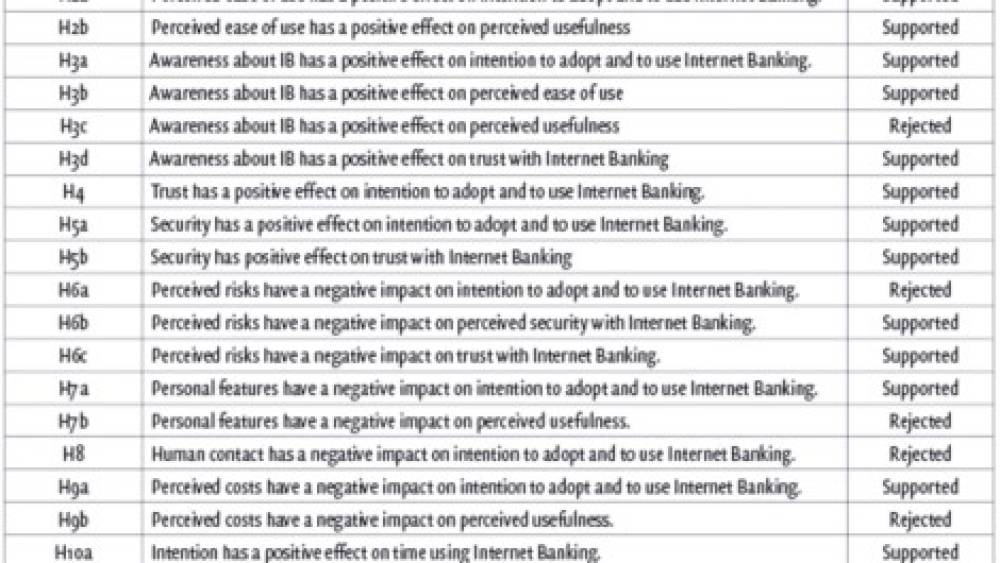
Based on the reliability analysis (Cronbach Alpha), eight factors are restrained from nine defined in the beginning (see Table 2). In fact, this analysis has eliminated the human contact factor. Thus, the hypothesis stipulating that human contact has a negative impact on the Tunisian’s intention to adopt and to use Internet banking is rejected.
On the other hand, this test confirms the reliability of the others factors which are: perceived ease of use, perceived usefulness, perceived costs, perceived risks, trust, security, awareness about Internet banking and personal features.
In order to check out the plausibility of the hypotheses, regression analyses are conducted and which results are showed in the next section.
3. Regression results
The results of regression between factors reveal that perceived ease of use has a positive effect on perceived usefulness which confirms the TAM’s thesis. Also, awareness about Internet banking has a positive impact on perceived ease of use and trust. In addition, security has a positive effect on trust which is conform to many studies’ results. Finally, perceived risks have a negative impact on trust and security which is very logic.
While, the results reject the hypothesis that awareness about Internet banking has a positive effect on perceived usefulness and the hypotheses that personal features and perceived costs have a negative impact on perceived usefulness.
The results of regression between factors and intention demonstrate that perceived ease of use, perceived usefulness, trust and security have a positive significant impact on intention to adopt and to use Internet banking.
Also, the results prove that perceived costs and personal features have a significant negative impact on intention to adopt and to use Internet banking. Whereas, regressions’ analysis show that awareness about Internet banking and perceived risks don’t have a significant impact on intention.
Hence, perceived ease of use, perceived usefulness, trust and security are motivators’ factors to adopt and to use Internet Banking by Tunisian consumer. Moreover, perceived costs and personal features are inhibitors’ factors to the adoption and the usage of Internet Banking by Tunisian consumer.
Therefore, as half of banks are offering freely Internet banking services, so Internet costs are the main obstacles to the adoption and usage of Internet banking by Tunisian consumers.
The results of regression between personal features and intention show that using e-banking services, other that are offering via Internet has the main effect. Also, data have showed that ATM is the most e-banking services used by our sample. As a result using ATM is the main barrier to the adoption and the usage of Internet banking by Tunisian consumers.
Thus, results conclude that Internet costs and ATM usage are the two main barriers to the adoption and the usage of Internet banking by Tunisian consumer.
The results of the research are exposed the conceptual framework in the figure 3 and the checking hypothesis are summarized in the Table 3.
4. Conclusion and future development
The results of average’s comparison between users and non users of Internet banking allow us to determine the user’s profile of Internet banking. An Internet banking user is a person who has considerable level of incomes, with significant Internet experience and who tends to use electronic commerce transactions.
Although the continuous increase of the number of Internet users and the development of the Internet Banking supply, the demand of Internet Banking in Tunisia is still until now very weak. The main reasons of this weakness are the ATM usage and internet costs.
Therefore, I suggest that all parties’ concern led to reduce internet costs in order to motivate consumers to use Internet banking services.
For further research, futures studies can investigate the intention of Tunisian enterprises regarding adoption and usage of Internet banking.