

The private equity industry faces many challenges, some new and others older, confirmed in their complexity. The global buyout dry powder is increasing each year reaching unprecedented amounts, the continuous increase in acquisition multiples, which significantly exceed historical levels, and the increasing competition between GPs are some descriptive elements of the current private equity landscape. Convinced of the attractiveness of the performance generated by top-quartile funds, institutional investors (LPs) are devoting an increasingly part of their allocation to this asset class. As a result, the balance of power between LPs and GPs has shifted in favor of PE funds managers, who impose more than ever their terms for more and more oversubscribed funds. Buyout funds, which typically have a lifespan of 10 to 12 years, actually take much longer to liquidate. It takes on average between 11 and 14 years for the funds to reach an RVPI of less than 0.05x (Cox D. et al. 2018). According to the latest Cambridge Associates report,
It is in this context of overheating that some GPs have started to launch new investment strategies. The appearance of long-term buyout funds (LTF) on behalf of third parties precisely intends to leave the beaten track of traditional buyout by proposing structures adapted for investment mandates authorizing periods of detention from 15 to 20 years. This trend began with the creation of the Canadian investing company Altas Partners, then a pioneer in this positioning. Few years later, other specialized players have joined the long-term cause, such as Castik Capital, Core Equity Holdings, and Cove Hill Partners. Followed in turn by other multi-strategy investing companies such as KKR, CVC, Carlyle, or Blackrock, the LTFs thus managed to raise nearly 33 billion dollars between 2015 and 2018 (Emmanuelle D. 2018). This trend is still marginal in the current private equity industry, but this trend quickly took root in the sphere of buyout capital since in 2019 nearly 59% of GPs had already raised an LTF or were considering to launch this strategy (Bolsinger M. et al. 2019).
This recent development has elicited many reactions from the private equity community. Certain LPs saw in this emergence an opportunity to reconcile their demands for profitability and their wish to see certain corrections of the traditional private equity model. Others, more critical, saw this development as a capitalistic strategy aimed at securing and accumulating management fees over the long term. The purpose of this study is to first analyze the rationale behind the development of these new funds and then the doubts they raise.
LTF rationale and investment thesis
An incremental investment strategy
These new funds, with a longer-term vision, are defined as an investment structure with the financial, legal, and operational capacity to remain in the capital of invested companies for a holding period exceeding 10 years. This innovation is accompanied by a specific and incremental investment strategy, inspired by structures traditionally oriented towards the long term such as evergreen funds and family offices. According to an INSEAD study
A claimed investment concentration
In practice, long-term funds target on average a portfolio of 5 to 7 companies per fund, for minimum investment amounts of 150 million to over 400 million dollars, supported by additional capital syndicated to LPs. These portfolios are intentionally concentrated (Zeisberger C. et al., 2017), but the inherent risk is lower due to the resilience of the few companies carefully selected for their positioning and performance. With an investment pace of 0 to 2 transactions per year, the investment decisions of these funds are highly opportunistic (Emmanuelle D. 2018). Sector diversification is, therefore, less monitored, on the one hand, because the underlying companies are selected to be more resilient, and on the other hand, because the funds can wait for a market rebound. This low number of portfolio companies is notably linked to the desire the GPs have to closely monitor their portfolio companies with particular attention paid to value creation.
An answer to requests coming from different stakeholders
Fewer friction costs
There is an upward trend in sponsor to sponsor buyout exit, leading to a second or even a third LBO. In 2019, sponsor-to-sponsor sales agreements represented 30% of the proceeds from the sale of private equity backed companies in Europe.
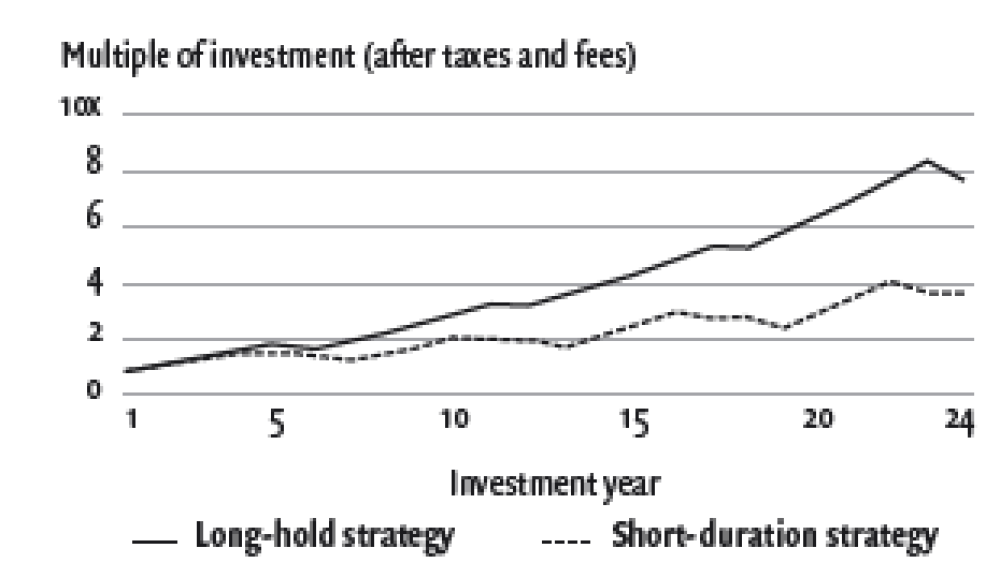
Long-term funds give GPs the wiggle room to satisfy investors by reducing the total costs of entering and exiting companies over the 15-20 years of its life as the fund will target fewer companies and keep them longer. This model (document 1), illustrate the impact that these successive LBOs have on the overall net performance by eliminating transaction costs, and by keeping the capital fully invested throughout the holding period, a LTF holding the company for 24 years offers a net outperformance of nearly twice (1.8x) the aggregate performance of conventional funds.
xxxgraph1xxx
Finally, with such longer holding and life periods, the LPs are likely to pay less often tax on capital gains. Their long-term horizon allows these funds to defer, and provision taxes related to capital gains and to reinvest it within their portfolio, thus increasing capital appreciation over the long term. Besides, these funds benefit from certain tax advantages thanks to the long and stable ownership of portfolio companies.
Towards an “Asset Managerization” of GPs
The advent of LTFs is in line with the growing investment vehicle offerings available in the private equity market. These new investment vehicles offer a wider range of holding periods, fee structures, and strategies, allowing LPs to choose a fund that best meets their preferences. Considered as a capitalistic strategy aiming to collect additional management fees over the long term, LTFs remain a natural and complementary extension of the preexistent PE funds offer, delivering a risk-return ratio that was not previously offered on such long horizons while limiting the risk of cannibalizing the performance of other buyout funds. These LTFs also allow their LPs to ensure a sustainable allocation and to secure a deployment of their capital in private equity over the long term. Decreasing the frequency of capital rotations from one fund to another allows LPs to save costs, time, and reduce the risk of reinvestment.
The possibility of attracting managers who are more reluctant to private equity
Through their longer-term characteristics, these funds can offer more flexible support to owners and business founders who are sometimes reluctant to "aggressive" traditional private equity funds. Founders and management teams often prefer a stable partner, to collaborate with for a decade or more, rather than going from GP to GP, changing their business plan and organizational model at each LBO (Gartner M. 2019).
Timing comfort for value creation projects
Being able to keep an investment in the portfolio longer makes it possible to implement value creation projects and to provide underlying management teams with the required tools to successfully undertake bottom or top line growth. In the traditional model, management teams typically have little time to implement operational changes before preparing the business for exit. Rather than only focusing on short-term capital gains, the management company can engage in more ambitious value creation projects (Lee K. et al. 2018). Thus, not only can LTFs undertake these long-term projects, but they can also implement more traditional operational improvements, worthy of traditional buyout funds, and reap the benefits over longer periods. As a result, LTFs are uniquely positioned to win auction processes. Indeed, LTFs are positioned between traditional and industrial financial investors, combining to a certain extent their respective expertise and financing capacities.
A resilient and counter-cyclical investment strategy
The long-term lens of these new funds is an advantage that allows portfolio companies to weather market cycles. Thus, LTFs are less constrained to invest their capital in the first few years of the fund and can therefore wait for a potential market correction to adopt an opportunistic investment policy and take advantage of a potential drop in acquisition multiples. On the other hand, LTFs have more time to divest portfolio companies. This timing comfort allows them to be able to wait for market expansion to sell their companies at an optimal multiple. Also, at the operational level, companies have sufficient oxygen and time to cope with a potential slowdown in macroeconomic conditions. This particularity makes them particularly well positioned to take full advantage of the subsequent rebound.
Uncertainties regarding LTFs
Lack of track record
The recent appearance of these funds causes some doubts amongst institutional investors. First, the lack of a track record for these relatively innovative investment vehicles works against them since LPs cannot benchmark with their portfolio funds or with market performance. The funds selection is even more difficult and uncertain, which explains the desire of certain LPs to wait for the maturation of the first vintages of LTFs to position themselves. However, past performance is not a reliable indicator of future results. Indeed, there is a significant volatility in performance by vintage, even when the different funds are managed by the same GP. This inter-vintage volatility has increased over the past three decades, with the performance of a given fund becoming less predictive of its successor’s performance. Thus, from the mid to late 1990s, a fund positioned in the top quartile had an average 40% chance of repeating the performance with its successor fund (Chang G. et al. A. 2020). In 2015, this share fell to 30%, while the probability of this same funds successor fund ending up in the bottom quartile quadrupled during the same period.
Conflicts of interest between strategies
LPs are also sensitive to potential conflicts of interest that could arise in allocating investments and resources between flagship and long-term funds of multi-strategy GPs. This concern applies to multi-strategy investment managers and when attractive investments with significant value creation potential are allocated to flagship funds to capture short-term value creation, thereby wasting the outperformance of holding the company over a longer term. This shortfall may be perceived as a failure from GPs that wish to secure a significant outperformance of their flagship buyout funds, at the expense of other funds and potential long-term performance. Indeed, the investment strategies explained above are large and overlap traditional buyout funds’one. The professionals interviewed said they competed with all biggest players in private equity today: family offices, other LBO funds, strategic investors, and other LPs investing directly in private equity. Although the investment strategy of LTFs is significantly differentiated by offering flexibility and a guarantee of long-term stability for companies, this does not protect investors from a cannibalization between traditional buyout funds and LTFs, which ultimately, exacerbates the rise in acquisition multiples.
Increased risk of zombies
In the traditional fund model, the annual management fee is usually set at 1.5-2% of the total commitments during the investment period, and then is reduced to a similar percentage on the net invested amounts of the companies sold and written-off for the remainder of the funds lifetime. Therefore, LPs bear the risk that GPs hold assets, in particular underperforming assets, until the end of a fund's life to keep receiving management fees on the unrealized amounts invested in the portfolio. The risk of this possible zombie policy is all the greater in long-term funds as its lifespan is longer (Zeisberger C. et al. 2017). The zombie metaphor can be used differently: since LTF GPs can hold companies for longer periods and have more flexibility on exit, some might forget the healthy pressure to create value as quickly as possible and postpone and/or delayed value creation plan.
Long-term use of carried interest to maintain the team
The delay in the crystallization of the carry is a subject which threatens the investment team retention. These funds can keep investments for fifteen to twenty years in portfolio, which further delays the carry payment, even in the case of deal-by-deal waterfall structures. On the other hand, investing in a blinded pool, the LPs therefore are basing their allocation on investment teams whose past performances and competences are proven. However, the race for skills and experience comes at a price: the age of the investment team. If a Partner is 55 or 60, she/he will be 75-80 when the fund is liquidated, rising concerns about the GP governance over key people and the perceived quality of their team. A 20-year lifespan lasts almost half a career, creating a greater risk that funds’ employees will pursue other professional opportunities or leave the team for other reasons. To mitigate these problems, adapted incentive structures have been installed within the LTFs to attract and retain talents within the investment team over such a long-time horizon (e.g. secondary market carry share, faster promotions etc.).
Recalibration of the LPs infrastructure
LPs wishing to invest in LTFs should be aware of the impact that such investment decision has and will have on their teams and their organizational structure to cope with these long-term horizons and the associated illiquidity. Team compensation, incentive structures, and measurement, monitoring processes and systems are some examples of core LPs activities that should be reviewed to enable teams and the organizational processes of long-term investing alongside GPs. Investors should modify their cash flow projection models to account for these funds and ensure that they will be able to meet and/or maintain their risk capital allocation goals over the medium and long term.
Macro and technological risks
The long horizon of these funds also increases the potential impact of macroeconomic and geopolitical trends on the performance of their portfolios. Indeed, technological disruptions and changes in industrial dynamics are likelier to occur and significantly impact a portfolio company that was acquired 10 years ago and therefore in a significantly different paradigm. These unknown risks are also reflected in regulatory policies, depending on government mandates and international alliances/treaties which will change and evolve throughout the holding period. These risks are not predictable but might have a potentially significant impact on the investment outlook and performance of an LTF. In this regard, LTFs have developed specific infrastructures allowing them to cover the multiple risks associated with long-term investment: specialized units and practices have been implemented to minimize the market and industry related risks.
Conclusion
Long-term funds appear to have emerged as a sub-segment of LBO funds by tailoring room for itself in the closed and traditional landscape of global private equity. The emergence of these funds corresponds to a market opportunity sailing on an abundance of capital flowing into alternative assets. If these funds have been so oversubscribed, it is because they address certain shortfalls of the traditional model by offering structures suitable for long-term investments. Indeed, the investment strategy flexibility on timing, the lower management fee structure, and a genuine focus on long-term operational development are traits that were more than well-received by the investor community. However, even if the investment strategies of these funds differ from those existing on the traditional market, they cause significant cannibalization between players in the buyout segment by intensifying competition between GPs. The recent appearance and quick development of this new strategy suggest that it will have a great future in store. Let’s see if the first vintage that will arrive to maturity in few years will prove the LPs community right.