
Dividends have been subject to extensive debate amongst financial theorists in the past decades. When a company starts to generate earnings, the decision of paying dividends to shareholders or reinvesting the surplus in the business becomes crucial. Indeed, for investors, this decision conveys information about a firm’s expected future performance in order to ascertain the true value of the firm and to mitigate agency costs.
Up until now, most studies on dividend distribution have concluded that a change in dividend policy results in a reaction from market participants in the form of a change in the expected firm’s value. Companies deciding to initiate or increase their dividend payout ratio will on average experience positive abnormal returns as opposed to firms deciding to omit or decrease their dividend payments, which experience on average negative abnormal returns (Pettit, 1972).
However, since it is not possible for investors and managers to accurately forecast their annual investment opportunities or earnings, a change in dividend policy may sometimes be necessary to respond to unexpected growth opportunities. As implied by the “Pecking Order theory" (Myers & Majluf, 1984), companies and investors are better off using internally generated cash to finance growth investment rather than relying on debt or stock issuance, they benefit from greater financial flexibility and potential long-term competitiveness. Thus, managers should cut dividends if the firm has access to truly profitable opportunities where the funds are to be invested. In practice, a dividend reduction is deemed as the most undesirable policy change, but careful communications and justification of this decision will increase the likelihood that investors will incorporate the underlying economic realities to their valuation of the firm.
Flexibility: A key determinant of dividend policy
Historically, dividends were a common way to redistribute earnings to a class of shareholders and constituted an important part of an investor's total return on their investments. Between 1945 and 1990, 50% of annualized total return of the S&P 500 Index came from dividends, but this figure has since plummeted to 23%. A similar trend can be seen when looking at the proportion of companies paying dividends. In 1991, 71% of companies were paying dividends compared to 61% in 2012, with large stocks tending to pay more dividends than small ones. One of the reasons for this global decline in dividends comes from the fact that firms have been substituting share repurchases for dividends because they are viewed as more flexible and can be used to time the equity market or to increase earnings per share. Flexibility is a key term in dividend policy decisions as it plays a critical role in the management of cash flow in order to pursue investment programs. As a result, financial managers are very careful in choosing the percentage of earnings to be distributed as this decision falls within a complex web of further investment, financing and liquidity matters. Thus, the firms must decide the form and timing of dividend payment, and pursue the common objective to maximise shareholder wealth in the long term.
Rethinking the traditional dividend interpretation
The interest of growth-induced dividend cuts lies in the potential long-term capital gain versus the short-term benefits of receiving dividends. According to the residual theory, dividends are paid if anything is left after providing for profitable investments (Weston & Birgham, 1979). The core of this theory is to fund profitable investments that maximise the firm's value and shareholders wealth. If there is no investment opportunity, earnings can be paid as dividends. As a result, companies decreasing dividends to invest in growth projects would, hypothetically, have more financial resources available to invest compared to their peers in their industries. In a world with asymmetric information, this would suggest that a dividend cut justified by investment motives would send a positive signal to the market about the company’s access to growth opportunities. In such a case, the long-term benefits from project cash inflows may be significantly higher than the short-term losses, leading to an appreciation in stock price, enhancement of a firm's value, and a maximisation of investors’ wealth.
Model
The model developed in this study postulates that growth-induced dividend cuts have a positive consequence on the firm's value and seems to meet specific strategic objectives. To take this element into account, an event study was conducted together with a qualitative approach. For the initial screening of companies cutting their dividends, public companies listed in the U.S. Stock exchanges were selected in a time period ranging between 2010 and 2018. Furthermore, because dividend policies vary widely among industries, the financial, utility firms, metals and mining companies were excluded. From this process, 194 companies announced a dividend decrease, cancellation or suspension during the seven years selected. Announcement dates of these proposed changes in dividends were collected from the Capital IQ database and Bloomberg was used to collect all distribution information and data concerning end-of-day prices of stocks. To identify instances where management attributes the decision to suspend or reduce dividends to finance investments, an examination of companies’ announcements in press releases was performed. There were 31 companies that met the criteria for this sample. Some examples of announcements that were included in the sample of growth-induced dividend cuts are as follows:
– On 8 July 2011, Apex Global Brands decided to “reduce the dividend from previous quarters in order to support its existing brands, as well as any newly acquired brands, and enable the company to execute on its growth strategy”;
– On 24 November 2012, Crexendo, Inc. announced a “suspension of its quarterly dividend program. With the company successfully redeploying assets to complete the transition to B2B operations which has essentially put the company in the position of being a 'start up,' the board determined this was the time to invest all available cash directly in the business”.
The same process was applied to constitute the sample of 34 companies where management attributes the decision to suspend or reduce dividends to poor financial performance. Finally, to evaluate the performance of the firms included in the samples before, during, and after the events, calculation of the cumulative average abnormal returns (CAAR) from a buy-and-hold strategy was performed.
Result
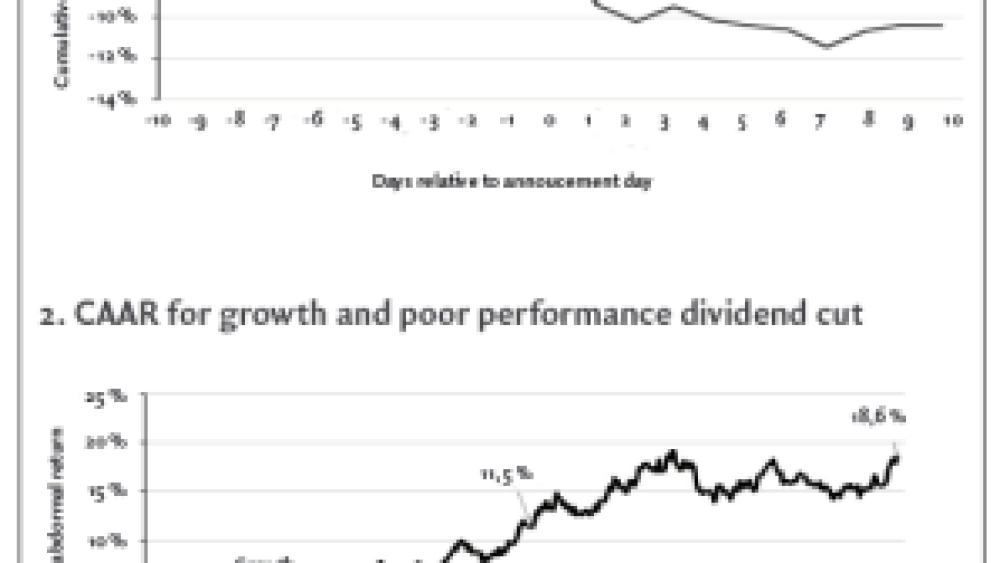
The results of this study indicate that investors suffer significant capital loss on announcement of dividend cuts, regardless of manager’s justification. Firms announcing dividend reduction motivated by investments in growth projects experience a price decline of -3,3% in the two-day (days 0 and 1) event-period, which is twice smaller than the two-day event-period loss in value of -7,5% posted by firms with poor performance-induced dividend cuts. Preparing the market by announcing the decision to cut dividends in press releases in order to gain financial slack appears to be relatively insignificant for market participants. Information asymmetry between shareholders and managers about the profitability of the investment opportunities is a potential explanation of the ineffectiveness of growth announcements as signals of future performance.
In the long run, firms cutting their dividend payments to invest in growth projects will on average underperform the S&P 500 for the first 100 trading days but will experience a higher abnormal return in the one year and two years following the change in policy. After 250 trading days (i.e., one year), the cumulative average abnormal return over the S&P 500 is 12,3% and up to 17,4% after 500 trading days. The underperformance for the first 90 trading days would imply the average investment period for the companies and the average time it takes before implementing or seeing the first result from the growth strategy. In stark contrast, companies cutting dividends as a result of poor performance have a continued capital loss of -8,1% and -9,7% in the one and two years following the announcement, respectively.
Overall, the results suggest that companies that announced and then pursued investment programs after a dividend cut generate higher value for their shareholders. It appears that shareholders may overreact to dividend cuts and do not fully consider the motives given by companies. As a result, managers should not be reluctant to cut dividends as it may sometimes be a necessary policy to support investment in growth opportunities. Foregoing investments to avoid a negative reaction from market participants can be viable in the short run, but a lack of investment in the future can be detrimental to the company to operate in the long run.
Upon further reflection, if dividend reduction is mostly perceived as a negative signal by investors, managers who willingly decide to cut dividends convey two crucial pieces of information. Firstly, managers are so confident in the long-term benefits of their investment project that they are willing to take the risk to have a short-term underperformance of their stock. Secondly, growth-induced dividend cuts are a very strong way to mitigate agency cost as managers can be dismissed if the project does not provide the expected increased cash inflows. This implies that a company in this situation will invest in profitable projects and do everything possible to bring the project to fruition in order to generate higher value for its shareholders.
Conclusion
The model developed in this thesis leads us to the conclusion that companies announcing growth-induced dividend cuts suffer from a capital loss in the short-term, independent of circumstances. However, this initial overreaction from the market is not justified in the long-term as these companies outperform the S&P 500 in the one to two years following the announcement as opposed to companies cutting dividends as a result of poor performance.
The results found in this study can contribute to the decision-making process concerning changes in dividend policy. Managers focusing on long term prospects rather than short term consideration should not fear of reducing dividends as good investment will generate positive abnormal returns for the company. Although this will translate in negative abnormal returns in the short run, there is a larger likelihood that firm’s targets can be met in the long run which will cause firm’s value to increase in the long run. Investors can use the results of this study for portfolio management purposes. In favourable economic conditions, when firms decrease dividends due to bad performance, investors should consider removing the shares of the company from their portfolio since these stocks do not, on average, recover in the long run. For growth-induced dividend cutting companies, an arbitrage strategy is available. Investors could short the shares of the companies after the announcement in order to benefit from the overreaction from other market participants. Once this reaction has eased, which corresponds to an average of twenty days following the proposed change in dividend policy, investors could buy back the shares and go long the stock to experience a positive long-term abnormal return afterwards.