


The development of digital tecnologies and innovations in healthcare are disrupting current medical practices and changing people’s lives. Indeed, there is a convergence of two phenomena. First, health professionals are taking over digital tools and services. Second, patients are seeking to take control of their health status as well as other areas. The COVID-19 pandemic has also strongly contributed to the disruption of major sectors worldwide even if the digital health segment has witnessed a positive boost amid the pandemic. The drastic health restrictions as the lockdown have led a real beam in digital application and in particular in the health sector.
Digital health sector can be defined as the confluence of healthcare and technology focusing on the provision and consumption of healthcare. It is primarily concerned with making medicine more personal, continuous, accurate, and data-driven, utilizing smart mobile applications, supported by advanced wearable and sensor technologies to empower patients by providing them with highly efficient and accessible health management tools. Using these tools, healthcare professionals together with the patients themselves can variously monitor, predict, diagnose, and treat a broad range of health conditions. Mobile health, telemedicine, health information systems, e-health are booming in the healthcare business space. Health analytics platforms, powered by AI and machine learning algorithms, are dramatically improving medical decisions and clinical workflow.
Digital technology is an answer to the challenge of the long-term transformation of our healthcare system, which must be supported by a powerful ecosystem of alliances. Too often disregarded and held back by both regulatory and cultural barriers, e-health is a key factor in empowering patients, providing access to personalized care and innovation, and improving prevention, thereby improving care and efficiency. This systemic transformation will involve the collection, sharing and use of health data within a sovereign and ethical framework, for better care and more precise and responsive management of our healthcare system. Moreover, digital health tools have great potential. They not only improve our ability to diagnose, but also to accurately treat disease and improve healthcare delivery for the individual
It is after few years that the digital and health worlds are joining forces to create an exciting new sector represented by the digital health. Although this new sector is becoming meaningfulness as the years go by, the best way to build a good investment team to identify and evaluate digital health startups is less obvious because this sector is still too young. Indeed, digital health is more than a mix of digital and healthcare sector. There are many new advantages linked to this alliance, but also new constraints to consider. For the digital world, the stakes that involve the end user are more important because it is the human being who is concerned. Indeed, it can be a question of helping human beings, sometimes even saving them. This is where the difference with the usual digital sector becomes clear. Developing a product that has such an important impact cannot be developed in 3 months as for a Software as a Services (SaaS) service for example. In most cases, precise scientific research is conducted through publications, sometimes even patents before the product takes shape. Digital health startups emerge from a highly regulated environment, which means that the project has demonstrated that its product is viable, innovative, and different from other existing projects. In the world of healthcare, it is the new and increasingly powerful analysis tools that are reshaping the healthcare economy. Digital technology has thus become necessary for healthcare because it allows it to respond to problems that were previously unresolved. Furthermore, the progress of digitization affects virtually all areas of health: hospital procedures, medical imaging, drug development, prediction of pandemics, cardiac surgery, and others. A major advantage of software development is that it is very fast and especially inexpensive. In general, life sciences tend to be long term and thus do not generate revenues, at least during the first years of their development.
Artificial Intelligence (AI) is now being used in all sectors of the economy, and particularly by healthcare professionals. While pandemic has given us a good wake-up call on the fragility of being human, AI is poised to be adopted to help address future pandemics, future health, and future healthcare. Human healthcare is being digitized in the areas of wearable computing, radiology, genetic sequencing, and more detailed blood testing. AI can be defined as the ability of a digital computer or computer-controlled robot to perform tasks commonly associated with intelligent beings. AI in health is an aid to diagnosis, decision making and the personalization of treatments. Diagnostic assistance, self-management of chronic diseases, personalization of care paths: the promises of AI in medicine are more and more ambitious. The challenge of these technological innovations is above all to combat disease while improving the quality of life of patients and the practice of healthcare professionals. AI relies on powerful algorithms capable of analyzing all health data related to patient: from age, gender weight, symptoms, personal and family history, physical activity, and previous treatments. Its use can be particularly effective in evaluating the pathology to be treated. It assists health professionals in the analysis and interpretation of the multitude of medical data at their disposal. This very detailed information refines the diagnosis and the treatment to be implemented. AI allows therefore medicine to enter a new cycle of innovation, notably by exploring the health data accumulated in recent years.
The increase in the elderly population in European countries as are all developed countries, the rising cases of obesity, huge prevalence of chronic diseases such as cardiovascular disorders (CVD), diabetes, and increasing need for remote patient monitoring services are the major factors driving the digital health market growth. Pollution, sedentary behaviour, lack of physical exercise, stress, unhealthy diets, alcohol, and tobacco consumption are all risk factors for these chronic diseases. The growing trend of preventive healthcare coupled with the increasing funding of various mobile Health (mHealth) startups for example is further driving the market growth. The adoption of mHealth services has saved Europe $126 billion in healthcare costs.
Digitalization of health is also driven by the following three reasons:
– First, it would alleviate the problem of medical deserts in countries but also in rural areas due to the decreasing number of doctors moving there and the closure of hospitals;
– Second, it would reverse the trend of decreasing ambulance services by hospitals;
– Finally, digitization would offer the possibility to mitigate the increase in healthcare expenses by giving more responsibility to the patient via digital solutions.
The global pandemic has had a major impact on the market. A particular appetite for low-cost, universally accessible, and innovative healthcare services has helped fuel the growth of this sector. Patients are therefore becoming more autonomous than before and are increasingly managing their health through digital solutions that allow them to monitor their illness and interact with the healthcare system (mobile applications, chatbots based on AI, online appointment booking, etc.). E-health thus enables greater involvement of patients, who become actors in their own health and learn to monitor their chronic disease or symptoms and better orient themselves in their care pathways.
European health care spending a lot of money in the order of trillions. This spending goes to pharma but also hospitals, physicians, and others. Almost all spending is indirect with insurance and tax. Therefore, consumers have limited influence on the contrary of governments and private providers. In Europe as well as in Israel, governments, private insurers, and regulators have significant power. They want to control costs with the coordination that is needed to get things done. This means that there is a significant time lag between when a technology is accepted by regulators, when it is adapted into the health care system and when innovators can generate revenue. In addition, governments and regulators are increasingly providing incentives to improve outcomes and reduce costs, which is a huge opportunity for technology companies.
For instance, in France, there are online diagnosis and treatment since 2018 and also cross-border treatment with EU doctors’ teleconsulting patients. KRY (Livi) and Doctolib markets are leaders in French telemedicine. Moreover, with the €7.5 billion Health Innovation 2030 plan announced on June 29 by the French President Emmanuel Macron at the Strategic Council for the Health Industries (CSIS), the ambition is to make France one of the leading innovative nations in health in Europe. The digital health acceleration strategy has been allocated €650 million, mainly from the Future Investment Program (PIA), for the development, validation and testing of digital tools for 5P medicine (personalized, preventive, predictive, participatory, and evidence-based).
The European digital Healthtech is an emerging and dynamic sector of activity. Between 2010 and 2020 it is more than 600 digital health startups that were created in Europe. Central and Eastern European (CEE) countries has a lot of untapped potential. In a macro analysis of the European digital health ecosystem by Speedinvest, it was found that the CEE region ranked second to last in Digital health VC funding. In addition, 92 digital health startups were founded between 2010 and 2021, receiving a total of approximately €234 million in venture capital funding. The region is well undercapitalized and with the median funding per startup of €500,000 the lowest in Europe. In the UK, the median funding per digital health startup is €12.3 million, compared to €9.4 million in France and €8.7 million for DACH. However, digital health in Europe has entered a huge period of growth. Much more activity in Central and Eastern Europe can be expected in the future. European Healthtech and digital health startups are now worth a combined $41B, up from $5B in 2015, to $25B in 2019 according to the “Digital healthcare Report” made by MTP, a PanEuropean growth investor focused on the Healthtech sector. It is obvious that Europe is starting to see big Healthtech, and digital health companies emerge. For example, in the telehealth sector there are Babylon or Kry, in the operations software there are companies such as Doctolib, Docplanner even in insurance with Wefox. Moreover, B2B has been growing faster, longer to unlock however represents a great opportunity. Bigger health companies are already emerging.
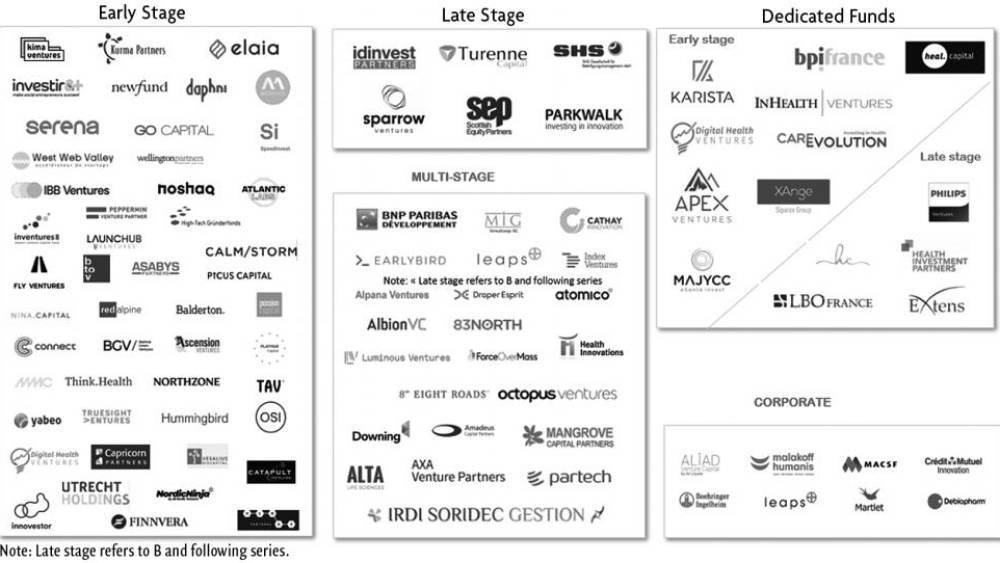
With the help of Internet, Prequin and Pitchbook softwares, a map of all funds based on public information in the digital health sector in Europe can be drawn (see Figure1).
A total of more than 100 European funds, including 15 dedicated funds are identified. The most active countries in the sector are France, followed by the United Kingdom and Germany. In fact, very few dedicated funds exist in Europe for the moment, with a total of 100 including 14 that are dedicated to digital health. This is mainly due to the still young maturity of this market, which is also growing rapidly as the healthcare sector is more than ever facing an acceleration of its digitalization.
Moreover, most of the funds invest in the start-up early phase and this is notably due to the maturity of European companies in the sector, which are mainly recent. The average fund size is therefore moderate. In addition, late-stage and multi-stage funds invest more in healthcare IT. In addition, American funds are coming on the European market. They are often based in London and consequently mainly approach the British market first. They are also active in France at a more advanced stage by co-investing with local funds. They are most often helped by dedicated funds such as the “Fonds Patient Autonome” within BPI France bank, impact funds, and funds associated with entities such as hospitals or business angel networks (e.g. Angel Santé).
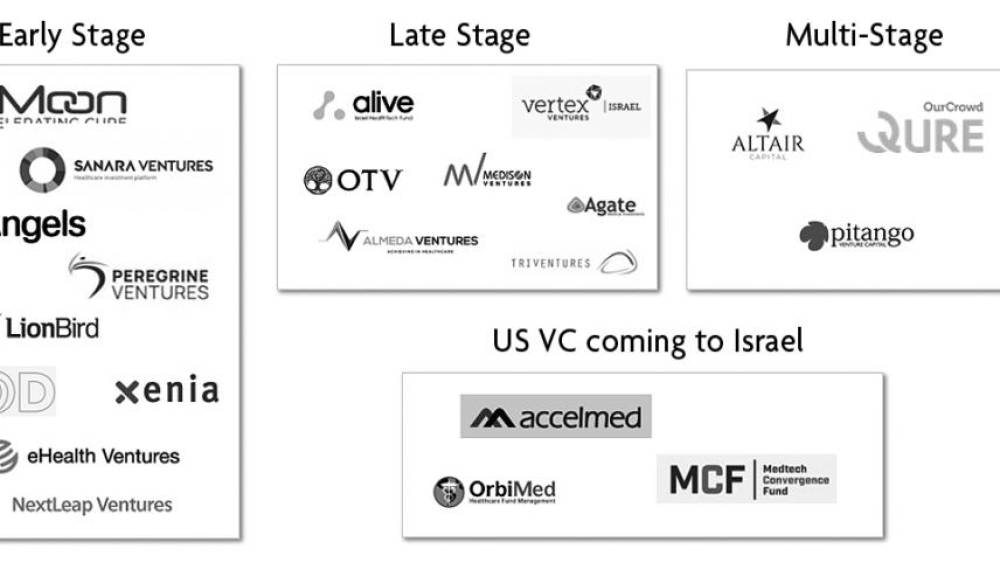
Israel’s digital health ecosystem has players that fully support the growth phase of a startup, from financing to market access strategies. Digital health is considered as a major growth driver for the Israeli economy. Comparing with the size of the country, there are many funds that are specialized in digital health and have expertise in this field. Indeed, in 2018, the Israeli government launched a national program to accelerate the growth of digital health industries and capitalize on Israel’s strengths. According to the document “Investing in Israel”, Israelian budget for the next 5 years is approximately $275 million. Therefore, in Europe, as in the UK and Israel, the digital health sector is attracting more and more investment funds (see Figure 2).
To answer the question: “What are the key success factors for venture capital funds to achieve performing investments in the sector of digital health in Europe (including UK and Israel)?” get to know more about the startups in the digital health sector is essential, by proceeding to an analysis of successful companies located in Europe, UK, and Israel which have undergone an IPO or an acquisition from 2018 to 2021.
As the number of startups is significant, a focus on 8 acquisitions and 5 exits by years from 2018 to 2021 in the digital health sector has been detailed. Therefore, a selection of 52 startups with significant acquisitions or IPOs matching with criteria chosen on Pitchbook has been performed.
Here is an example of the selection of the 13 most important acquisitions and IPOS in 2019 (see Figure 3).
Hence, different issues are raised:
– What are the companies which acquired the related startups?
– What is the average exit time?
– Are the projects more B2B or B2P? (P for Patient)
– Are there any similarities in the backgrounds of the people in the teams? What are the backgrounds, the studies, the schools?
– Are they mostly juniors of seniors?
– What is the percentage of men and women?
The 40 acquirers detected are (see Figure 4) : 21 digital health players and MedTech companies, 8 Healthcare distributor, 4 miscellaneous and 5 others including software companies, publishing, or financial investors. As a result, digital health companies are the largest acquirers of digital health companies and account for more than 50% of exits, followed by Healthcare/Pharmaceuticals distributors and a mix of other strategic players. Healthcare distributors, whether wholesale or retail, are making strategic acquisitions in order to expand distribution channels and/or extend value chains to users.
Between 2018 and 2021, the average exit is therefore 9.5 years. Commonly in the business, the startup investment community is a 7-to-9-year horizon. Exits from digital health, whether through Mergers and Acquisitions (M&A) or Initial Public Offering (IPOs), remain higher than the averages found, which is not surprising given that IPOs in the healthcare sector are often longer than in other sectors.
Projects are well distributed in B2B and B2P with almost 50 percent for both sides. Most often, either the project is an aid to the patient that represents the consumer here, and more specifically an application that targets a specific aid to the patient such as Selfdiagnostics. The company is a developer of a molecular self-diagnostic technology designed to pace up the process treatment and it offers self-diagnostic home medical test kits, specially designed to fight against SARS Covid. Therefore, it helps users to understand more about their condition and obtain a better cure much faster. As well as SkinVision that is a developer of a medical application designed to access skin spots and moles for the most common types of skin cancer. The company’s app uses an algorithm that analyses skin spots or moles and helps understand melanoma risk factors with early detection. This allows users to perform regular self-checks with their phones. Otherwise, the company is focused on products for hospitals or helping doctor to improve the habits. For instance, Touch Surgery is a developer of cloud-based data analysis systems. It was designed to codify surgical procedures and thereby improve global surgical care. The company’s cloud-based data analytics systems use cognitive mapping techniques, AI, and 3D rendering technology.
According to the analyses, the members, and founders of startups come from well-known engineering or business schools in 80% of cases. In the digital health sector, 97% of the startups include at least one engineer or doctor in the team, which is not very surprising. Also, in the “Other” category il it often people coming from finance mainly, software industry, marketing. A question can be raised about what the entrepreneurs did before entering this new sector.
Startups led by juniors (young graduate - up to 5 years of experience) constitute 37% of the whole. However, this percentage is closely followed by teams that are mixed (team composed of seniors and juniors, or people that have between 5 and 10 years of experience) representing 34% of the whole. Finally, around 29% of the startups are mainly composed of seniors (more than 15 years of experience).
According to the data:
– In 2018, there were 92,16% of men and 7,84% of women;
– In 2019, 93,33% of men and 6,67% of women have been noted;
– In 2020, there were 84% of men and 16% of women;
– In 2021, 88,89% of men and 11,11% of women were identified. Women are therefore in a very strong minority, but it tends to increase.
The analysis has demonstrated that the buyers most interested in the digital health sector first come from the healthcare world, especially digital health payers. Digital health startup exit times are longer than the median, as projects are often longer than in digital health and more regulated. Moreover, the fact that a digital health team must have at least one engineer or doctor on the team to succeed but this is not a fundamental condition. It should be noted that there is at least one scientist represented by a doctor or an engineer. This condition increases the chance of success, especially at the beginning when startups want to raise funds. Indeed, the team is a key driver for investors. Having complementary profiles, scientific but not only is a real asset that is not negligible, it is a real strength. Moreover, the nature in terms of experience of the team is quite heterogenous. Any type of profile can succeed but if the people are young, they still have experience in most cases in entrepreneurship. In addition, a criterion that is often considered by funds is the business model. The business model is very important, and the repayment for example is key in digital health sector. Therefore, a startup that assures that its product will be reimbursed when it is commercialized has a much better chance of obtaining financing than others. Of course, this is relative to the country in which it develops. For instance, in France since March 10, 2020, the conditions for reimbursing teleconsultations have been expanded thanks to decree no. 2020-227. Previously, it was necessary to respect the care pathway to be reimbursed, to consult one’s attending physician in person, or to have in any case consulted a physician in the last twelve months. The reimbursement rate is then the same as for physical consultations. Furthermore, the obtention of CE marking can be clue for investors as well as the Food of Drug Administration (FDA). CE marking has been in force since 1993 and is the main indicator of a product’s conformity to EU legislation, thus allowing free circulation within the European market. The FDA organization is responsible for authorizing the marketing of drugs in the United States. This aspect can illustrate the implementation of the product at the international level.
Therefore, as the digital transformation continues, it results the rise of new technologies that will influence the entire healthcare system for both patients and healthcare professionals. Europe is lagging the US and China in digital health technologies, but this study has shown that an increasing number of startups in digital health are developing with the support of investments funds. The future of digital health in Europe, UK and Israel is promising provided that the related ecosystem and the regulations are appropriate for their development. n
Name of the startup Deal Size Financing Status Deal Date Geography
Soma Analytics Undisclosed Formerly VC-Backed 01/29/2019 UK
Sensimed Undisclosed Formerly VC-Backed 12/24/2019 Switzerland
MentalApps Undisclosed Formerly VC-Backed 10/14/2019 France
Sealantis 30.00 Formerly VC-Backed 01/29/2019 Israel
Icare 60.00 Formerly VC-Backed 12/24/2019 Finland
LloydsDirect Undisclosed Formerly VC-Backed 06/19/2019 UK
Cytena 30.25 Formerly VC-Backed 08/05/2019 Germany
Aurora Undisclosed Formerly VC-Backed 10/01/2019 Germany
Marinomed Biotech (WBO:MARI) 19.50 Formerly VC-Backed 02/01/2019 Austria
Diaceutics (LON:DXRX) 24.12 Formerly VC-Backed 03/21/2019 UK
Farmae (MIL:FAR) 67.24 Corporation 07/29/2019 Italy
Infoscan (WAR:IST) 2sd IPO Undisclosed Corporation 11/04/2019 Poland
Optomed (HEL:OPTOMED) 27.66 Formerly VC Backed 12/05/2019 Finland
Be’ery G., Eger Z., Fryd N., Tamir A. & Schory I. (2020), “Digital Health: The Israeli Promise”.
Faltin F. (2020), “Digital Health in Europe: Analysis of 600+ Startups from the Last Decade”, Speedinvest.
Frentz A., Jerusalmy S., Lescure F., Loiseau S. & Mesnard L., (2021), “Digital Life Sciences ≠ Digital + Life Sciences and at Ealia, we love it!”.
Austin Hackett & al. (2020), “The Promise of Digital Therapeutics”, McKinsey & Company.