
The Internet of Things (IoT) has received enormous attention from academia and various industries over the past decade. As a burgeoning sector, there is not a commonly accepted definition on IoT. This paper defines it as “a distributed network connecting physical objects that are capable of sensing or acting on their environment and able to communicate with each other, other machines or computers, without any human interaction”. The term Internet of Things came into existence in 1999 when Ashton coined the term to describe the “globally emerging Internet-based information service architecture”. Ashton conceived that, if all objects in daily life were equipped with identifiers and wireless connectivity, these objects could communicate with each other and be managed by computers, without human oversight. These everyday objects include not only electronic devices and technologically advanced products, such as equipment and gadgets, but also “things” that are not normally thought of as electronic at all. It covers any real-world objects, such as clothing, furniture, materials, parts and equipment, merchandise and specialized items, monuments, and all the miscellany of commerce, culture and sophistication.
The data these devices report can be collected and analysed in order to reveal insights and suggest actions that will produce cost savings, increase efficiency or improve products and services. By ’connecting the unconnected’, cities, transportation, supply chains, homes, and industries like health care, retail, and entertainment are becoming smarter, more efficient, and more resilient.
Since 2014, consumers got familiar with this IoT concept as companies introduced numerous IoT-based products and services, and a number of IoT-related acquisitions have been making the headlines, including, e.g., the prominent takeover of Nest by Google for $3.2 billion and the acquisition SmartThings by Samsung for $200 million. The valuation of the IoT companies is an important aspect for companies, entrepreneurs and investors, willing to seize business opportunities. The literature related to the valuation of (specifically) IoT companies is very limited. The goal of this thesis is to assess the use of different valuation techniques for IoT firms in the real world.
Valuation techniques
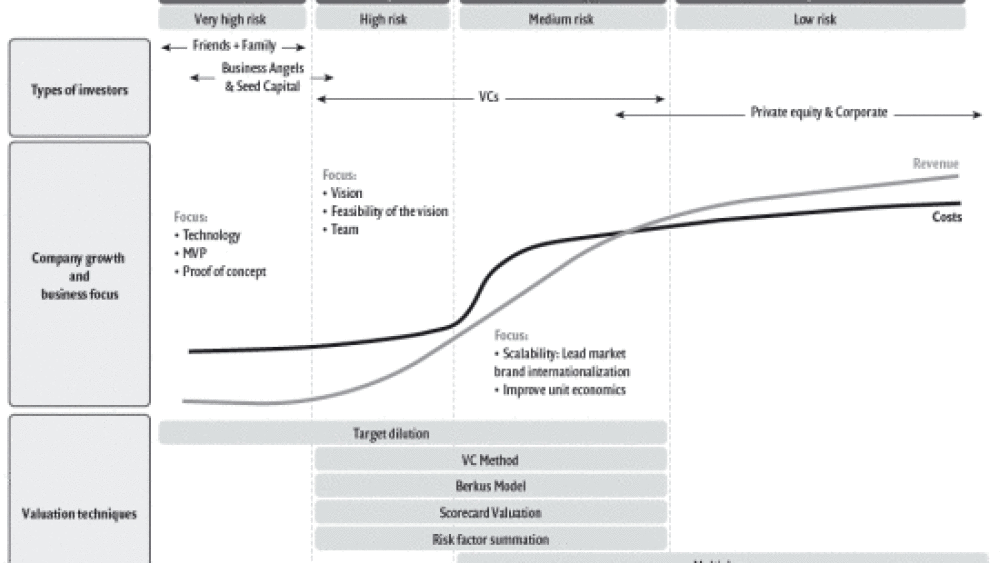
There are several valuation techniques theoretically used by investors for Tech companies. The choice of the technique depends mainly on the maturity of the company and the market.
According to literature, there are five methods specifically used for start-ups: a/ Target dilution, b/ Berkus methods, c/ Scorecard Valuation Method, d/ Risk factor Summation, and e/ Venture Capital Methods. On top of these methods, three methods are used to value tech companies with more maturity: a/ Multiples, b/ Discounted cash flow (a.k.a. “DCF”), and c/ Real options. Each valuation method is presented below (Figure 1).
The methodology used to assess the use of these valuation methods in the real world is based on qualitative (interviews) and quantitative (database/broker note) fundamentals. More specifically, this research is based on the reading of more than 200 documents (of which 80 were used to develop this thesis), the analysis of financial metrics of more than 300 companies, and the completion of four interviews with leading European Tech investors and financial advisors.
Research findings
Many surprising aspects emerged from interviews and databases. The outputs are grouped into three main themes: a/ market analysis (1.),valuation techniques (2.), and human/social & legal aspects (3.).
1. Market analysis
IoT is a young market where most of the companies are not profitable. The type of investors are thus Venture Capital funds, willing to generate high returns on investments. However, although the IoT trend appeared many years ago, the boom of IoT has not occurred yet, and investors are becoming frustrated. This slow development is due to many uncertainties related to the market and the technology:
- Companies have recently invested a lot of money in this industry (e.g. GoPro and Fitbit) but the success is limited. Investors are not convinced by B2C’s market readiness, and expect B2B to grow faster in the coming years;
- Market competition is also a source of uncertainties, as it’s hard to both distinguish between companies (i.e. young companies with limited differentiating value propositions) and assess their ability to enter new markets;
- There are some uncertainties related to the technology. For instance, the market does not know which connectivity protocol will become the standard for the industry (e.g. Sigfox, Lora, etc.).
- There is a supply of capital from Limited Partners that is superabundant compared to the demand from companies. Therefore, investment funds get bigger and need to deploy a higher amount of money per deal. This pushes prices up;
- The increasing exit prices (e.g. IPO, M&A, secondary funds) attracts more Limited Partners, willing to invest in successful funds. This leads to a vicious circles with bigger funds and bigger returns;
- The most successful funds try to position themselves in similar deals. Generally, investors want to invest in software (and less in hardware) companies because it offers higher margins (i.e. almost no operating costs), less capital expenditures, higher capacity to create value, and more exit opportunities and growth (e.g. more companies are likely to buy the company, and lower integration cost).
2. Valuation techniques
The valuation techniques used by investors are limited, and there is a big gap between theory and practice. The price paid by corporates and funds is based on supply and demand ; the valuation is a small part of the deal. According to the interviewed investors, there are three relevant valuation techniques: a/Target dilution, b/VC method, and c/Multiples. In practice, investors never use Berkus model, Scorecard Valuation Method, Risk factor summations, and Real options. They rarely use Discounted Cash Flow model, because it is based on too many assumptions (but some financial advisors like to have it as an additional tool for the negotiation).
Regarding Target dilution, the general dilution is between 20-35% of the companies. The owners accept to sell a stake of their company at given price (generally between €1m and €4m). Thus investors make a reverse calculation to calculate the value for 100% of the firm, and decide to invest or not at this valuation.
Regarding VC methods, they are generally used by funds, which expect an IRR of at least 35% (which represents 4x the initial value in 5 years).
Multiples are used by investors and financial advisors – essentially EV/Sales because companies are not profitable. There are few elements to take into account:
- There is a difference between financial (minority) and strategic (acquisitions) operations. Minority operations is generally executed by financial investors such as VCs, and majority operations are acquisitions from larger companies seeking strategic integration. The multiple is not applicable for acquisition, because there is no pattern from historical transactions and the amount of data is limited (i.e. no transparency). There is more pattern for minority investments, e.g. from trading comparable of listed companies, capital raise from private companies, or acquisition of minority stakes in private companies;
- There is no multiple for the whole IoT industry. We can find patterns by different business models (e.g. Hardware, platform with monthly subscriptions and low capex, connectivity solutions offering annual subscriptions and requiring the development of the infrastructure, etc.);
- In terms of valuation, the goal of investors is to get a high return of investment (e.g. x30 their initial amount) and to participate in an exciting business adventure. Therefore, the difference between x27 and x32 is not important. There are other aspects that are, according to the interviewed investors, more crucial for an operation: the human/social & legal aspects.
First, EV/sales in indeed the most applied multiple. Other multiples such as PER, EV/EBITDA and EV/EBIT are not relevant because many companies are not profitable yet). Second, Price to Book Ratio is the second best ratio ; the standard deviation is generally a bit higher for Price to Book vs. EV/Sales, in each business category. Finally, the trading companies helped us determine EV/ Full Year 2019e Sales multiples for each categories:
- For Sensors, the multiple is c. 3x;
- For Hardware (incl. semiconductors and processors), the multiple is between 1x and 3x;
- For Connectivity and Infrastructure (incl. transceivers and antennas), the multiple is c. 1x;
- For Platform, the multiple is between 7x and 10x;
- For Applications and Automations, the multiple is c. 3x;
- For Data analysis and Consulting, the multiple is between 2x and 3x;
- For companies with a mix of Software and Hardware, the multiple is c. 5x.
Broker notes from listed companies also support the findings: equity researchers generally use EV/Sales multiples, with a different average multiples for each business model. However, equity researchers also use additional methods, including P/E ratios, EV/EBITDA, EV/FCFF, and DCF with sensitivity tables. These techniques are applicable because Earning, EBITDA, and FCFF of these companies are generally positive. However, this does not reflect the situation of the IoT market, where most of the 4,000+ companies are not profitable. Therefore, the multiple method based on EV/Sales appears to be the “one valuation method fits all” in the IoT market.
Finally, Real options and DCF are respectively never and rarely used by investors:
- Investors are not familiar with the concept of Real options. Even if some investors do, they struggle to explain the assumptions to third parties and prefer not to use it;
- Investors rarely use DCF because it implies too many assumptions: the IoT market is very young and the forecasts in the models are generally highly questionable. Thus the use of DCF is generally limited to the few large IoT companies.
3. Human/social & legal aspects
At this stage of the IoT industry, the human and legal aspects are more important than the valuation. According to investors, the three most important aspects for investors are: the team, the vision, and the feasibility of the vision. The team is the number one criteria because funds invest mainly in someone’s ability to create value. The level of trust must be very high, and the founding team generally needs to show positive track records. Investors have mainly a background in entrepreneurship or consulting, less in finance, and the financial evaluation is not a priority.
The investor’s reputation and ability to help the company is also an essential element. For example, having Google Venture as investor is exciting for founders, and this can bring future opportunities in terms of tech expertise and network/partnerships. This gives Google a strong bargaining power for negotiations.
The last aspect (and potentially the most important aspect) is the legal discussions of the term sheet that will impact the valuation of IoT companies: Some terms will impact the valuation of the company, such as the SAFE (Simple Agreement for Future Equity), Pre-emptive provisions, Drag and Tag along rights, Tranches and milestones, Liquidation preference (a.k.a. waterfall), and Anti-dilution protection.
Conclusion
The pricing of IoT companies entails a mixture of both science and art. Valuation techniques only provide an order-of-magnitude estimate, based on a combination of several techniques, mainly Target dilution, VC method and Multiples. In terms of multiples, trading multiples – particularly EV/Sales – are a good way of valuing companies. Each business models has a specific range of multiples, and software companies generally have a higher multiple than hardware companies. For instance, IoT platform companies have a multiple of c. 9x, while IoT Sensor companies have c. 3x EV/2019e Sales. These financial figures are easily applicable to minority/financial investments (generally operated by VC funds), but not to strategic investments (e.g. acquisitions from companies seeking the integration of the start-up). Figures from historical transaction do not allow to identify a pattern regarding transaction multiples for all types of IoT business activities. The price of IoT companies also results from an adjustment of the financial value due to external factors, notably social and legal aspects. The expertise of the investor (in order to make the company grow) and, more importantly, the terms of the contract (including the preference shares and liquidation preferences impacting the investors’ return on investment) influence the price paid by investors during the deal. “Tell me the price and I’ll tell you the terms,” is a common axiom among early-stage investors. Researchers should try to conceptualise it.