

Challenges of attracting institutional investment
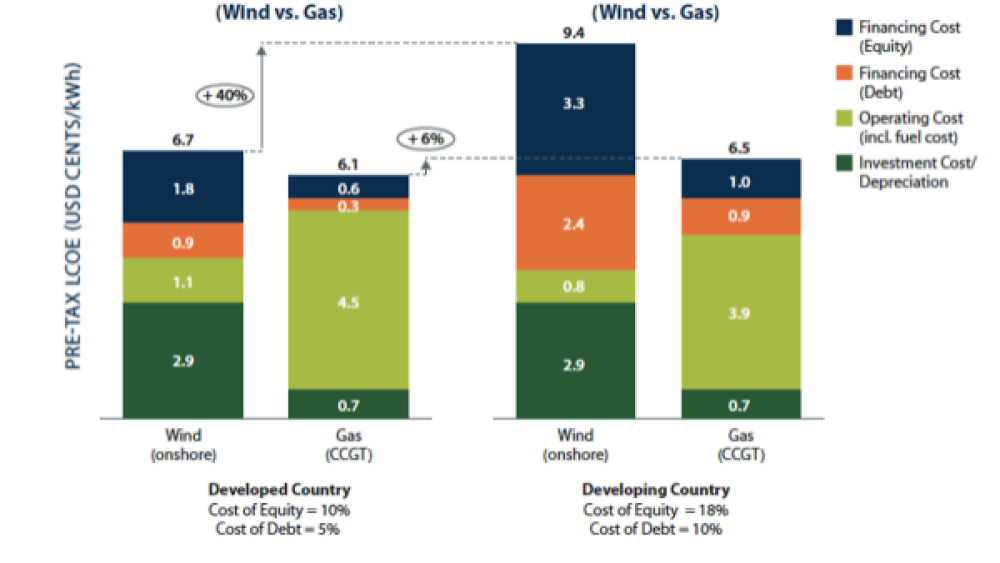
Standing in the way of an increased involvement from institutional investors are risks related to renewable energy (RE) and other reflecting challenges from investing in emerging countries. One of the specificities of RE projects compared to their conventional energy peers is the large upfront investment costs. While investment costs account for approximately 80 % of the total technology costs for wind energy, they only amount to 15 % in the case of gas.
On the graph 1, the pre-tax levelized cost of electricity (LCOE) for onshore wind and combined cycle gas is decomposed for developing and developed countries in 2012. LCOE for wind energy in the developing countries is 40 % higher than in the developed countries. Whereas the difference in LCOE for gas is far lower, with a mere 6 % increase on the costs in the developing countries. This loss of competitiveness of wind energy with regards to gas in developing countries can be imputed to the capital intensity of the renewable assets, which increases the rate of return required by debt and equity holders.
Moreover, banks in developing countries often have a lack of experience with renewables and project financing structures. They agree to provide financing but only for reduced maturity term loans and require greater portion of equity in the capital structure of projects, which ultimately deteriorates the economics of the project. Wiser and Pickle (1998) proved, using a DCF valuation method, that the maturity of the debt in a RE project severely influences the LCOE. They showed that improving the maturity of term loans from 12 to 20 years decrease the LCOE for solar PV and wind energy by 17 % and 12 % respectively.
Green bonds
To persuade investors, the investment will have to be structured via a class of financing instrument that they are knowledgeable about and familiar with. According to the Climate Bonds Initiative (CBI), as of 2013, 50 % of the total assets managed by institutional investors were in the form of bonds. Bonds increase the overall amount of credit pooled by allowing a wide range of investors to participate in the financing. The existence of a secondary market for bonds enables investors to adjust their investment horizon and payback period.
Investors’ enthusiasm for green bonds has grown rapidly since 2013. They have started to acknowledge that climate change poses a threat to the financial sector and needs to be considered as a new investment return variable. The literature shows that the green label comes at a price premium, which represents the willingness of investors to accept a lower yield for a green emission compared to a regular one. A study from Barclays (2015) using regression analysis between green and conventional bonds quantified the spread at 17 basis points.
Green project bonds
Project bonds are bonds issued by a project company for which proceeds are tied to the underlying assets of the project. With the current economic context, interest rates have reached a historical low. Strong demand for sovereign debt market instruments has lowered down yields and offered the opportunity for institutional investors to use project bonds as a higher-yield alternative instrument. While Hutchison and al. (2016) estimated that project bonds have a risk premium of between 150 and 300 basis points over the comparable government bond, project bonds are still a competitive product for RE developers because the cost of financing remains typically lower than bank loans.
Moreover, project bonds commonly provide longer debt maturities compared to bank loans, and since RE projects in developing countries usually struggle to secure long-term financing, bonds offer the possibility to lengthen the payback period and ameliorate the economics of the projects.
When the bond is issued prior to commercial operation date, bondholders have to bear a completion risk. Traditionally, institutional investors have been reluctant to get exposure to construction risk. To mitigate this risk, the market has integrated solutions that include cost overrun undertakings, completion guarantees and sponsor equity support agreements. For instance, the Credit Guarantee and Investment Facility (CGIF) and the European Investment Bank (EIB) have dedicated support programs in place that aim at providing infrastructure developers with credit enhancements on their project bonds issuance.
Pirapora Solar: an example of a successful green project bond issuance
Located in Minas Gerais State (Brazil), the Pirapora solar park is the largest operating solar PV facility in Latin America. Pirapora Solar Holding issued in August 2018 a BRL 220 million green project bond to finance a portion of the construction of the 400MW solar farms. The instrument was oversubscribed two times and received historical low pricing for a 16-year green bond issued in Brazil.
The Pirapora complex benefits from a fully contracted revenue structure. The whole amount of energy generated by the solar farms is sold under a 20-year PPA with an average fixed price of BRL 298/MWh. The shareholders of the Pirapora Solar Holding are EDF and Canadian Solar, two solid investment-grade issuers with strong expertise in the RE sector and green bond market. What was pivotal to the success of the Pirapora green project bond issuance was the credit guarantee provided by the Inter-American Development Bank (IDB). According to Fitch, the guarantee increased the energy production breakeven by 30 %, and allowed the bond to secure an investment-grade rating.
Green hybrid bonds
Mezzanine instruments allow developers to secure financing at a lower cost compared to regular bonds while offering investors the possibility to receive a higher return on investment since they can benefit from a performance-based option on top of interest income.
The challenge of optimizing the capital structure of RE projects lies in finding the appropriate combination of equity, debt and mezzanine capital. In their study, Yoo and al. (2018) analyzed the feasibility of using an option-based mezzanine financing for a power-utility project to attenuate the high interest rate of project finance. By using multiple Monte Carlo Simulations to achieve project volatility and Net Present Value (NPV), and applying the Black Scholes model to convert these values into adjusted interest rates, they estimated that the NPV was maximized when the mezzanine financing represented 20 % of the total investment cost.
Green ABS
The process of securitization enables to issue distinct and marketable securities out of the SPV and separates the assets to be securitized from the issuers’ balance sheet. Because the credit rating of the securitized instrument is solely based on the creditworthiness of the selected assets, securitization can allow non-investment grade issuers to secure financing at a much lower cost. Moreover, by pooling several projects in the same security, green ABS reduce the size risk of small projects not having the scale to secure financing alone.
With the objective to optimize the capital structure of the bond instrument, portfolio management techniques can be applied. Portfolio management techniques can be described as finding the appropriate proportions of the different projects to be included in the bond instrument. This concept, taken from the portfolio theory of Markowitz, does apply for RE as an asset class because the diversification effect can be achieved by combining different technologies of renewables within the same portfolio. Lee and Zhong (2015) analyzed the potential of issuing a bond that pools together separate RE projects. The given instrument securitizes future cash flows from the projects and redistributes it in the form of interest payments to investors. In their experiment, three solar projects and two wind power plants were pooled into the instrument. By using a System Advisor Model and Monte Carlo simulations to project future cash flows, they found that the green instrument had a lower standard deviation compared to each of the standard deviation of individual projects.
Chinese Leasing & Co: an example of a successful green ABS issuance
China Resources Leasing & Co. is a financial leasing company created by the China Resources Group, which is a state-owned conglomerate. The leasing subsidiary issued CNY 1.3 billion of green ABS in May 2018. The bond, rated AA by Dagong Credit rating, has an average life of 10 years. This green ABS was issued in four different tranches. These tranches are backed by account receivables from 76 leasing contracts effective for services rendered in five distinct sectors, ranging from solar, hospital, built environment to ships. Even though the collaterals are not entirely low carbon infrastructure assets, the use of proceeds from this issuance will be fully directed to finance 27 solar farms and one onshore wind farm across China.
The instrument managed to secure an investment-grade rating of AA partly because of the implicit Chinese government guarantee. According to the IMF, the implicit Chinese government guarantees reduce the borrowing cost of state-owned-enterprises from 100 to 200 basis points and upgrade their credit rating by 4 to 5 investment notches.
Yieldcos
The yieldco is a new type of financial instrument that has emerged in 2014 in the US. It is an investment vehicle that is spun-off by a parent entity to own its operating assets. The yieldco groups together RE operating assets, securitizes future cash flows associated with these assets and redistributes the vast majority of it in the form of dividend payments. The risks perceived by investors are reduced because the securitized cash flows of projects come from already operating assets for which long-term contracts have been secured.
The amount of capital raised via the initial public offering can be used to reimburse part of the debt or to directly finance new projects at lower rates. To fuel its growth, the yieldco purchases assets directly from its sponsor parent company or from third parties, typically through right-of-first offer (ROFO) agreements.
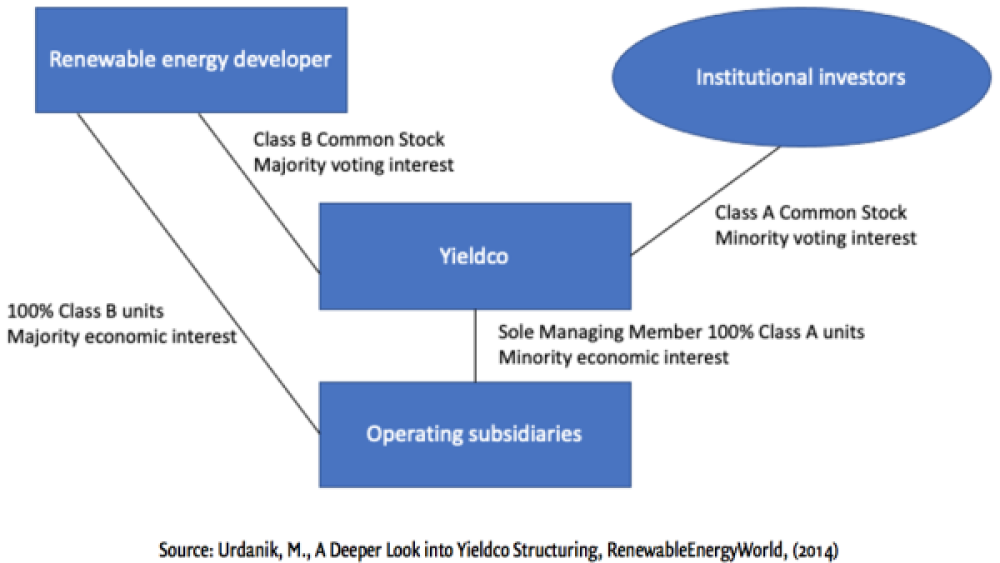
As presented on the graph 2, the yieldco’s corporate governance is usually structured to allow the parent entity to retain a majority stake in the investment vehicle while maximizing the amount of capital raised. This can be achieved by creating two different classes of shares: class A and class B. The distinction allows the parent company to keep voting interest with its class B shares while selling 100 % or less of the economic interest through class A shares.
TerraForm: an example of a successful Yieldo listing
SunEdison, founded in 2003, expanded rapidly to become one of the largest RE developers in the world in 2015. It set up in July 2015 a yieldco named TerraForm Global. TerraForm Global was spun off to own and operate contracted RE assets in high growth emerging markets. The initial portfolio of projects consisted in 987 MW of capacity. Assets located in the emerging countries accounted for 100 % of the installed capacity.
The strategy of development of TerraForm Global was to grow the initial portfolio of projects not only via call rights signed with its sponsor SunEdison but also via right-of-first-offer agreements (ROFO) with respect to projects developed by Renova, the largest RE developer in Brazil. TerraForm Global managed to attract the interest of a large number of institutional investors. The average participation of institutional investors during the life of the yieldco, before it became privatized in 2017, amounted to approximately 60 % of the total shares held.
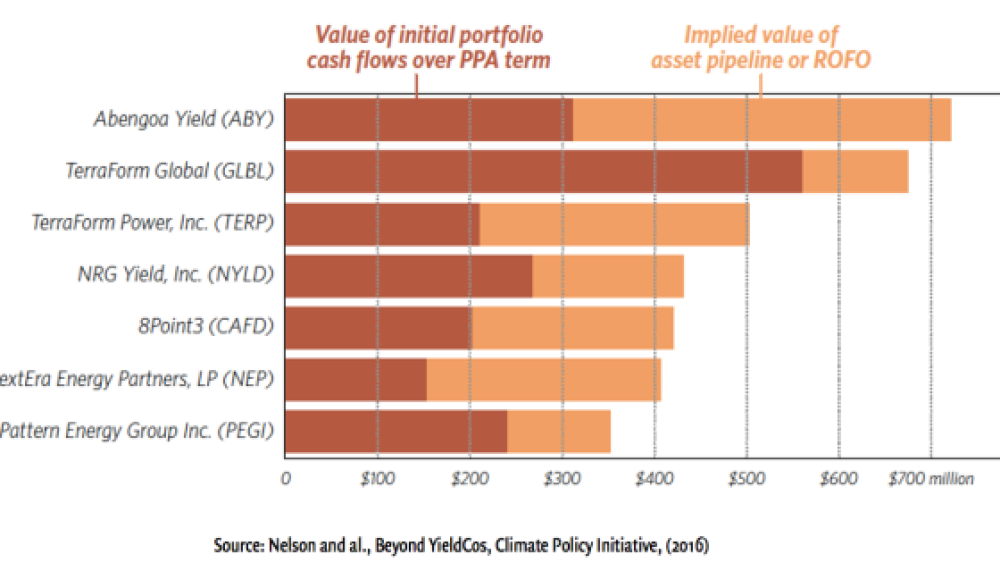
While at first yieldcos succeeded in their listings, the yieldco market collapsed in mid 2015 and shares prices plummeted. The first seven yieldcos to be created lost more than 50 % of their market capitalization from the end of July 2015 until the beginning of February 2016. One of the main factors responsible for that decline is the bankruptcy of SunEdison. Because SunEdison had a strong correlation not only with its own two yieldcos, TerraForm Global and TerraForm Power, but with the other five yieldcos, its bankruptcy started to raise concerns about the validity of the yieldco model. The second main reason is the implied growth rate assumed by these investment vehicles. For instance, TerraForm Global targeted a 3-year dividend per share CAGR of 20 % at IPO. This amount of growth is only achievable if the yieldco manages to acquire sufficient accretive projects in their portfolio, or profit from the leverage effect (Nelson and al., 2016). As shown on the graph 3, Nelson and al. estimated that at IPO date, an average of 45 % of the valuation of the yieldcos was based on the growth prospects associated with future projects.
Their analysis shows that a lack of confidence on the pipeline of projects can lead to a 25 % share price decrease. Because almost all the yieldcos missed their DPS targets for year-end 2015, their valuations plummeted.
Following this collapse, the yieldco market was restructured and several acquisitions took place. The market has now stabilized and yieldcos have since then outperformed the S&P 500 Index. More modest growth rates have been targeted and valuations have been less influenced by the growth prospect of the pipeline of projects.
Innovative capital market instruments have therefore emerged and opened up new investment channels to support greater institutional investor participation in renewable energy financing. Nevertheless, it needs to be pointed out that credit enhancement mechanisms are instrumental for issuers to secure a higher credit rating on their offering and enter the scope of investment options of institutional investors.