
The 2007 financial crisis resulting in both the disorderly liquidation of a “too big to fail” institution, namely Lehman Brothers, and the huge use of tax-payer resources required to stabilize the worldwide financial system raised two questions for the regulators. First, how to prevent the tax-payer to bear the cost of credit institutions recapitalization ? Second, how to clear credit institutions capital instrument’s pricing from any bail-out prospects ?
A new resolution framework introducing a new “bail-in eligible” instruments
To answer these challenges, a new European resolution framework has been set up with the implementation of the CRDIV package (including the CID – Credit Institutions Directive - and the CRR- Capital Requirement Regulation) and later the BRRD (Banking Recovery and Resolution Directive). It requires credit institutions to hold several buffers of easily “bail-in-able” own funds instruments. It has also given a large range of resolution tools for the regulator to restructure a failing or likely to fail institution and ensure the continuity of its critical
The French government implemented the BRRD framework through the Sapin 2 law (12.09.2016), enabling French credit institutions to issue a new type of senior bond, namely Senior Non-Preferred (SNP). These securities are not subordinated, i.e. they are senior to Tier 2
A resolution framework in Law but few application cases
Few cases of bail-in decision have occurred since the implementation of this framework. These cases gave investors first views on how the resolution authorities will apply resolution to credit institution in the future. Banco Popular Español S.A. was for example placed in resolution in June 2017 after high credit losses and liquidity shortage. Its shares, AT1 (Additional Tier
However, these cases were triggered by idiosyncratic problems and resolution tools have never been employed and assessed in a systemwide crisis situation.
The need for resolution actions simulation in pandemic crisis to understand the additional risk bore by these instruments against senior preferred instruments
Since inaugural issuances, the SNP market prices showed wide volatility, highlighting the investors’ difficulty to price the risk of these instruments. How to derive a theorical valuation for these bonds, considering their bail-in-able feature versus Senior Preferred instruments? This is possible by observing default cases in a resolution framework, calculating their Default probability (PD) and Loss Given Default (LGD) parameters. Given the scarcity of resolution cases, historical observation couldn’t be implemented as an observation method.
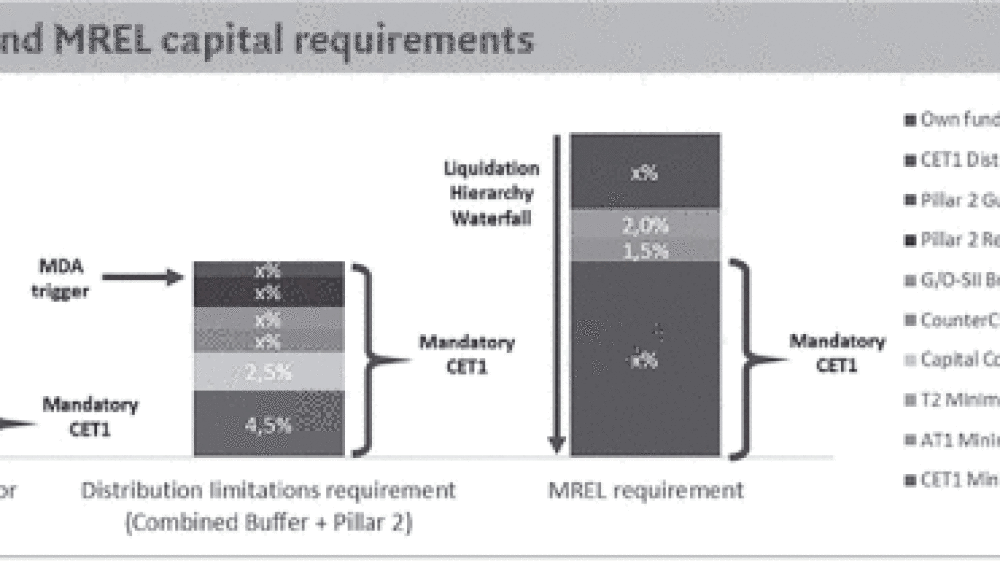
Our work aimed at building a model able to simulate resolution situations in order to derive LGD parameter according to liabilities’ regulatory priority waterfall. Given the model structure, we were also able to derive similar prices for AT1 and T2 bonds. The model perimeter integrates the 5 biggest credit institutions in the French Banking system, namely BNP Paribas, Credit Agricole, BPCE, Société Générale and Credit Mutuel Alliance Fédérale. A bank enters into resolution when its CET1 (Common Equity Tier 1, the highest loss absorbing type of capital) ratio falls below the regulatory requirement of 4.5% of total RWAs. We then observe the amount of capital necessary to reach back an adequate level. This CET1 recovery level was set as the individual institutions’ CET1 ratio combined buffer requirement, i.e. 4.5% plus 2.5% CCB, 0% CCyB and the entity-specific G/O-SII buffer (cf. graph 1).
In case of default, the necessary amount of AT1, T2 and SNP instruments is thus converted into CET1 capital. We used in our model the waterfall as defined in the BRRD framework. When a bank defaults, given a specific CET1 shortfall (cf. graph 1), we simulated weather or not a specific instrument class was subject to conversion (what constitutes an occurrence of default for the instrument) and at which level (what constitutes LGD parameter).
The combination of a stochastic simulation to derive balance sheets dynamics and interbank funding crisis contagion to simulate CET1 ratio long term evolution
To properly estimate the occurrence of resolution situations and CET1 shortfall at resolution, we chose to use a stochastic approach. A new stress testing concept proposal released by the Banque de
We considered a 10 years observation period divided into 120 months sub-periods. For each period, three different asset returns were randomly generated, from a normal distribution with the corresponding asset historical returns mean and volatility. An asset price pattern was generated for Equity securities, Fixed Income securities and Loan portfolio over the 120 periods. CET1 capital is in our model calculated as the difference between assets and liabilities. The value of each bank’s assets being continuously impacted by market price volatility, the CET1 is growing when market prices rise, and decrease when they fall. When CET1 becomes too low compared to Risk Weighted Assets, the bank is placed into resolution.
For Equity and Fixed Income securities, the model used historical mean and volatility of Market Indexes returns, respectively MSCI World Index and FTSE Euro Broad Investment-Grade Bond Index (EuroBIG).
As the Loan portfolio is valued at amortized cost (i.e. the net book value is the gross outstanding loan amount reduced by loan loss provisions) it is not market valued. Reproducing its evolution over the observation periods thus required a different approach than the market proxies used for Equity and FI securities. Customers’ loans are not as liquid apart even packaged into securitization, and thus no market prices are available.
To reproduce the normal activity of a bank in a “Business as Usual” environment and its normative profits generated from the Loan portfolio, the following reasoning has been applied: banks earn interest revenues from the portfolio and bear the Cost of Risk. The first one is fundamentally greater than the second, increasing the shareholder’s equity. This margin is thus considered as the proxy for Loan portfolio average return. It is estimated with Monthly Average Returns on Assets of the observed credit institutions sample.
In periods of crisis, the Loan portfolio impacts bank’s capital by generating higher additional Cost of Risk. We thus derived Loan portfolio returns volatility using the concept of Abnormal Loan Loss
In the model, CET1 capital increases or decreases at each period, reflecting the asset prices variation. But asset prices variation also triggers margin calls on interbank lending exposures. When market prices fall, margin calls are triggered to maintain the rate of overcollateralization of the interbank financing. This is reflected in our model as a cash movement between two banks: the interbank debtor repays a part of the financing and the debtor receives such margin call. In case the interbank debtor does not hold enough cash to pay for the margin call, fire sales are simulated by selling assets below current market prices. The model impacts the CET1 capital with the resulting loss.
Given the historic market prices volatility, balance sheets structures and solvability levels, French banks bail-in eligible instruments represent attractive/undervalued investments for investors
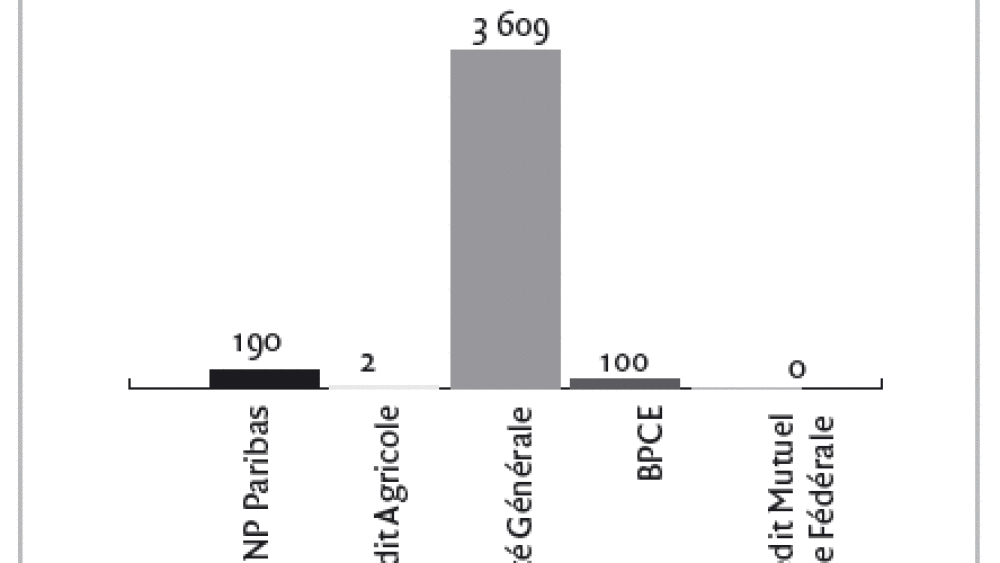
Using a Monte Carlo approach running 25,000 experiences of 10 years periods, we found 3.901 resolution cases, representing an average 10Y resolution probability of 3.12%. Since the resolution of an institution triggers automatically AT1 conversion (as the first layer of loss-absorbing liability), the AT1 PD equals the institution PD. More interestingly, average LGD of AT1 bonds is 100%, which means that in every resolution case, AT1 bonds were fully converted. This also implies that the average 10Y PD for T2 instruments also equaled resolution probability. However, T2 average LGD was below 100%, at 88.3%. Average 10Y PD for SNP reached 0.89% and LGD was 20.2% on average. This shows that the risk bore by SNP instruments largely differs from other bail-in-able instruments risk.
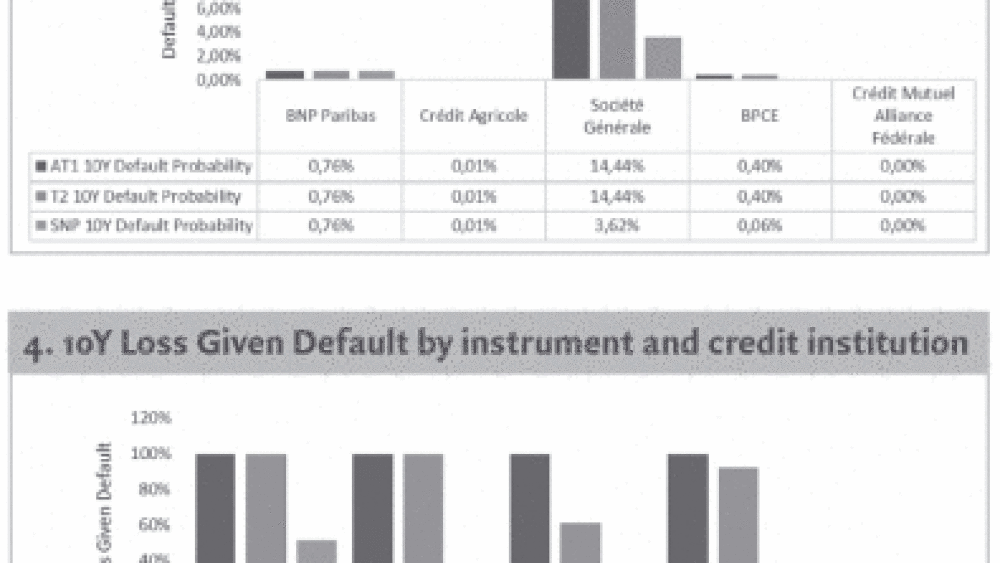
Individual results are highly interesting. As shown in the figure 3, 10Y resolution probability greatly diverged among banks, ranging from 14.44% for Société Générale to 0% for Crédit Mutuel Alliance Fédérale. Société Générale in fact concentrated 93% of resolution cases. Oppositely, Crédit Mutuel Alliance Fédérale did not record any resolution case during the 120 periods of each of the 25,000 experiences. 10Y PD were 0.76% for BNP Paribas, 0.40% for BPCE and 0.01% for Crédit Agricole. These are unexpected results, which, apart from Société Générale, highlight the strong solvency of French banks.
Société Générale’s PD is identical for both AT1 and T2 instruments and reaches a relatively high level (14.4%). Reasoning on the simulation start balance sheet, it is obvious that Société Générale suffered from the higher share of its assets invested in Equity securities, the higher share of its balance sheet invested in FV asset classes, i.e. FI and Equity securities and of course its lower CET1 ratio at start point. Société Générale had indeed the lowest fully loaded CET1 ratio as of 31.12.2017, at 11.4%, vs. 14.0% on average. However, Société Générale Tier 2 instruments LGD is relatively low compared to peers. At 61% vs. 88% on average in the sample, this low LGD is the result of a high starting point AT1 buffer (2.5% as of 31.12.2017 vs. 0.94% on average in the sample).
The extremely favorable results for Crédit Mutuel Alliance Fédérale are mostly due to initial CET1 ratio (16.5% as of 31.12.2017), but also to small Equity and FI securities portfolios. The experience also demonstrated the strength of Crédit Agricole, with quasi-null PD.
The main finding of our study is the very low LGD for systemwide Senior Non Preferred instruments. We observed a sharp fall in PD between AT1/T2 instruments and SNP (14.44% to 3.62% for Société Générale). Our model and its realistic parameters support the idea that French banks Senior Non Preferred bonds are very interesting assets for investors as their returns are higher than those of Senior Preferred bonds, while their risk is relatively low, given the low DP and LGD levels. Additionally, banks must continue to increase their Eligible Liabilities buffer regarding MREL requirements full implementation. An increased buffer will further mechanically decrease the LGD of these liabilities. Issuances of Senior Non Preferred instruments to refinance Tier 2 bonds would however worsen the LGD on these bonds.
A theoretical 10Y zero coupon bond pricing was conducted with PD and LGD parameters as
We thus could conclude that, according to the network stochastic simulation model described above, model parameters and current balance sheets structure data of French 5 largest credit institutions, the spread between Tier 2 instrument and SNP instrument risk premiums is 20 times the spread between SNP instrument and benchmark, while AT1 instrument must bear a risk premium 1.71 times higher than the one of Tier 2 instruments. This extreme multiple between SNP and T2 bonds’ spread highlights the low risk of SNP bonds as well as the absence of other premiums included in valuation method.
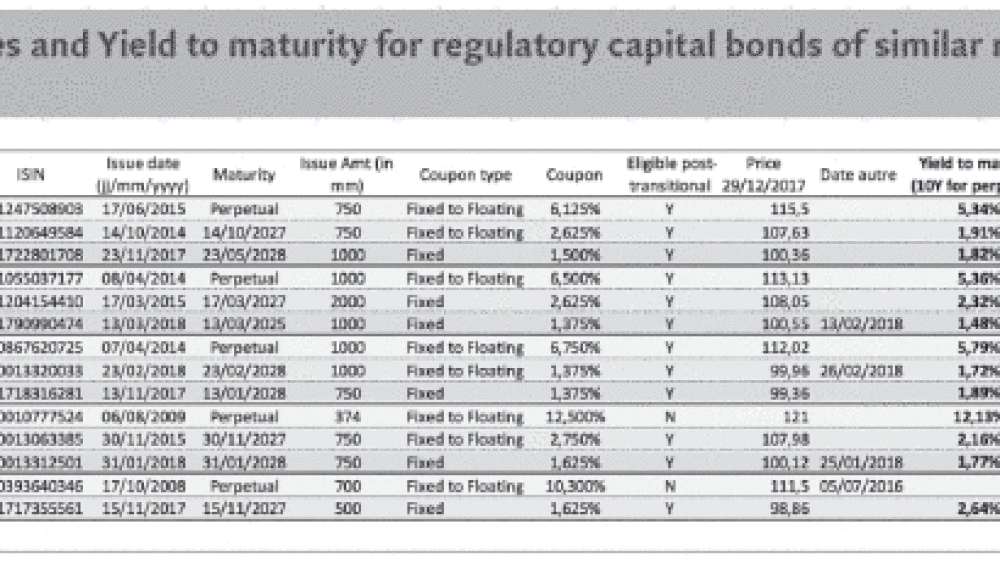
As shown in the table below, model-deducted yield to maturity are tighter than those derived from market prices. This supports the conclusion that markets are mispricing these instruments, i.e. they are undervalued by market participants and could represent interesting investment opportunities.