
OTC derivatives played a role in the financial crisis that erupted in 2008. The European Commission criticised the opacity of the market and the lack of adequate
As a result of the crisis, on 25 September 2009, the G20 Leaders agreed on a set of measures to improve the functioning of the OTC derivatives markets by increasing their transparency and risk management and protection against market abuse.
The measures agreed were:
- Trading of all standardised OTC derivatives contracts on exchanges or electronic trading platforms;
- Clearing of all standardised OTC derivatives contracts through CCPs;
- Reporting of all standardised OTC derivatives contracts to trade repositories;
- Adoption of higher capital requirements for non-centrally cleared contracts.
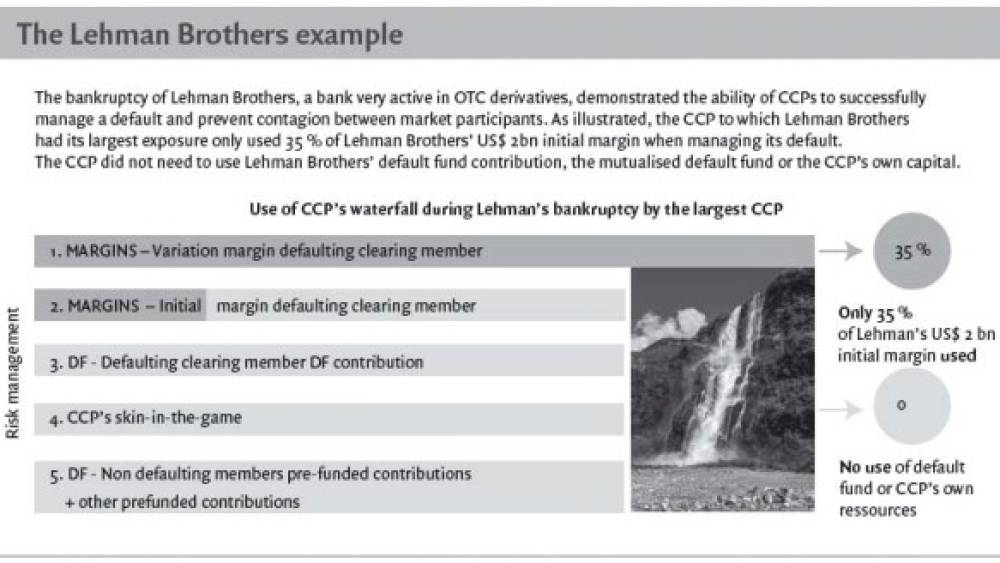
Although CCPs have performed extremely well during the recent financial crisis as exemplified in the Lehman Brothers case (see below), global authorities want to ensure that an adequate recovery and resolution regime is in place that focuses on the provision of the CCPs' critical services in times of utmost stress without having recourse to public funds. To this end, CPMI-IOSCO and FSB respectively published the reports 'Recovery of financial market
In accordance with both reports, it can be stated that the core objective of CCP recovery and resolution planning is to ensure that control and an orderly decision-making process based on facts and that effective action is taken if a market crisis requires it.
The role of CCPs shaped by legislation
CCPs are resilient institutions thanks to an adequate legislative framework and a robust risk management design. It should be noted that the recovery and resolution framework envisaged in the international guidance would be applied to a very extreme scenario, far worse than that experienced at the height of the financial crisis in 2008.
The CPMI-IOSCO 'Principles for Financial Market Infrastructures (
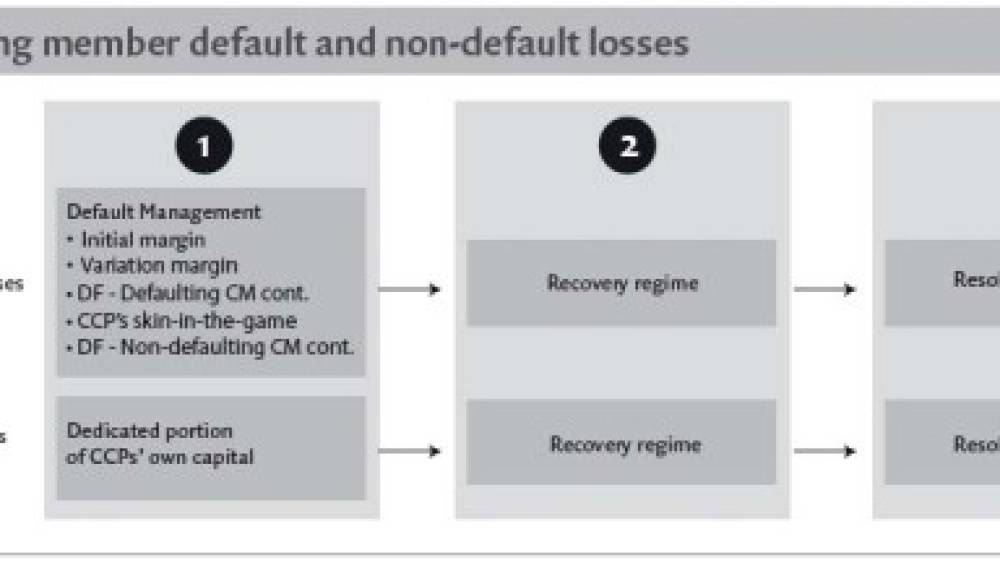
CCPs are by design a risk management and mutualisation system. In the event of a credit loss occurring from one or several member defaults, CCPs should implement their Default Management Processes (DMP) before entering into recovery or resolution. During the DMP, CCPs use the pre-funded resources in their default waterfall (the defaulting member's initial margins and default fund contribution, a dedicated proportion of the CCP's own capital ['skin in the game']), and the balance of the mutualised default fund to cover any losses incurred when liquidating or transferring the defaulter's positions.
One of the reasons why CCPs have been so stable even during extreme market moves is this incentive/disincentive structure, and it is critical that the recovery and resolution framework does not diminish but rather increase the market discipline that central risk management creates.
The CPMI-IOSCO report rightly highlights this as a characteristic of recovery tools, and stresses that those should be carefully judged on the basis of their support for an orderly Default Management Process so as to avoid triggering recovery or resolution.
But in case of an recovery event efficient processes should be in place.
Recovery of CCPs
An effective recovery framework should be based on the following key principles:
- Continuity of critical services: The policy objective of recovery plans should be to ensure that CCPs continue to provide critical services under extreme stress scenarios;
- Structure: CCPs should be allowed to implement their recovery plans before resolution authorities intervene, unless there is evidence that the recovery plan is likely to fail or to compromise financial stability;
- Transparency: Recovery tools should be agreed ex ante, transparent and predictable for the benefit of stakeholders;
- Flexibility: CCPs should retain the flexibility to implement tools that are more appropriate to the products they clear;
- Fairness: CCPs should be able to allocate losses in an equitable manner to all participants.
In principle, CCPs should enter recovery once all the pre-funded resources in the default waterfall have been depleted without the default having been fully resolved (i.e. CCP has not achieved a matched book), but not
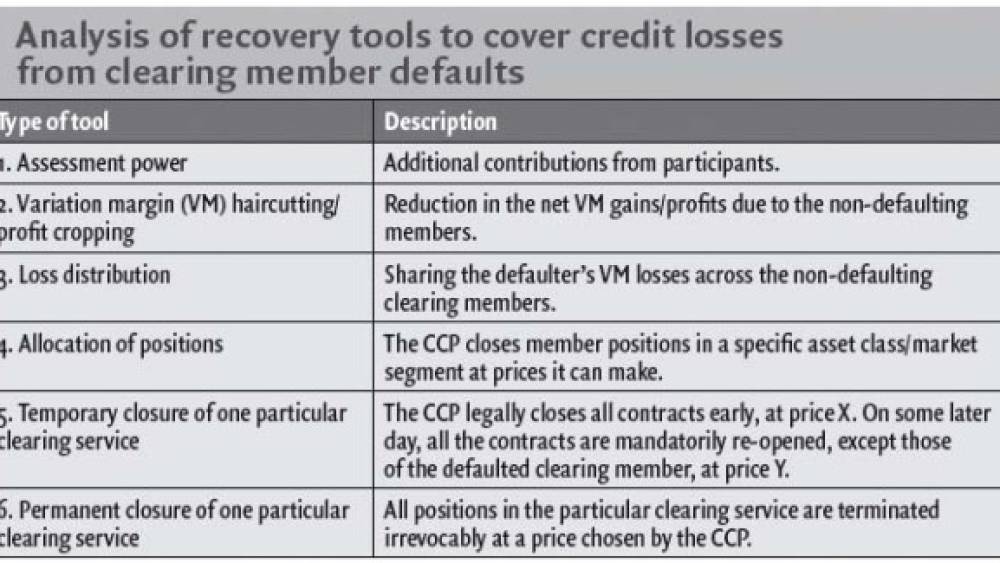
There are various recovery tools suggested by policy makers to allocate losses that arise from a clearing member default. They are not mutually exclusive and CCPs may use a combination of them. In addition, some of the recovery tools may also be appropriate in a resolution scenario.
In addition some CCPs may decide to use other ad hoc tools such as voluntary member commitments, asset sales, private/public loans or insurance contracts, mainly for losses of a smaller scale and in consultation with their competent authority as need be.
Resolution of CCPs
CCPs should describe the steps they would take if all recovery measures fail, with resolution authorities reserving the right but not the obligation to intervene. A resolution authority will face the choice of attempting continuity or conducting a wind-down of the CCP. The former is expected to be the preferred choice, but the latter must always remain a possibility as there is always a limit to the value of a market.
Should a resolution authority intervene once the CCP and market attempts at recovery have failed, it should decide on the best course of action for financial stability. It can enact this for instance by reapplying or extending any recovery tools and potential additional resolution tools.
The resolution regime designed for banks in the Eurozone, which is based on a single resolution authority and a single resolution fund, is not adequate for CCPs because there are substantial differences between banks and CCPs. These include their supervisory architecture, the parties that would be affected by their failure and their lines of defence.
The resolution of a CCP is most likely to be effective if the CCPs respective resolution authority leads the process because it will be most familiar with the CCP's operations and will thus be able to act decisively. However, the lead resolution authority should cooperate closely with the resolution authorities of other jurisdictions that have a legitimate interest in the resolution of a CCP in question. Finally, the efficient resolution of a cross-border CCP will be facilitated if the relevant jurisdictions have taken a consistent approach to CCPs' recovery and resolution regimes.
The way forward
The international guidance provided by the CPMI-IOSCO and FSB reports should immediately be taken into account by the European Commission to make a legislative proposal on this subject. At the time of writing this article, the exact scope of the proposal as well as the date of publication remain unclear. It is however expected sometime in 2015.
Once the proposal is published, its general framework should be discussed and agreed by the European Council and the European Parliament. After this process is finalised, the European Securities Markets Authority (ESMA) and the European Commission should work on any eventual technical standards, which should in turn be adopted by the European Council and European Parliament.
Given that CCPs may operate cross-border and clear products that are traded globally, public authorities must ensure a consistent application of the recovery and resolution framework at an international level in order to provide an efficient solution to support the stability of the financial markets.