
There has been a lot of interest in the performance of corporations with regard to its ownership structure. Especially the influence that families exert on their business has kept many researchers busy. Numerous studies have been conducted so far, often leading to controversial conclusions, which are the result of differences in defining family firms or differences in how the studies have been conducted. Jaskiewicz and Klein (2005) examined several studies with the topic of family firm performance and concluded that only in approximately 40% of these studies, family firms were found to perform better than non-family firms.
Family firms, followed by state-owned firms, dominate corporate ownership in the world (La Porta et al., 1999). This is also true for Latin America, where family firms are the major form of corporate ownership as they represent approximately 85% of the private sector economic activity (EY, 2014). The Latin American region covers 6% of the 250 largest family firms in the world. Their importance can’t be neglected as they generate 60% of Latin America’s GDP and employ 70% of workforce in the region, including the Caribbean. The majority (47%) of these family firms are managed by the first generation and to a lesser extent by the second generation (29%). In addition, many new family businesses have been established thanks to the strong growth of the region during the past ten years. The major family firms in Latin America are Odebrecht, Klabin, Cementos Argos, America Movil and some of these have been around for more than a century, such as Chilean department stores’ chain Falabella who celebrated its 125 years in 2014 (EY, 2014).
The goal of this research article is to investigate whether the ‘superior performance of family firms’-hypothesis can be confirmed for the Latin American region. The academic literature related to family firm performance in Latin America remains scarce. Some studies examined how family businesses influence firm performance in countries such as Mexico and Chile. A recent study by Galve-Gorriz & Hernandez-Trasobares (2015) studied the institutional framework and concentration of ownership in eight Latin American countries and compared the results to Spain. This research paper is the first one to investigate family firm performance across the Latin American region, instead of analysing this in one country only.
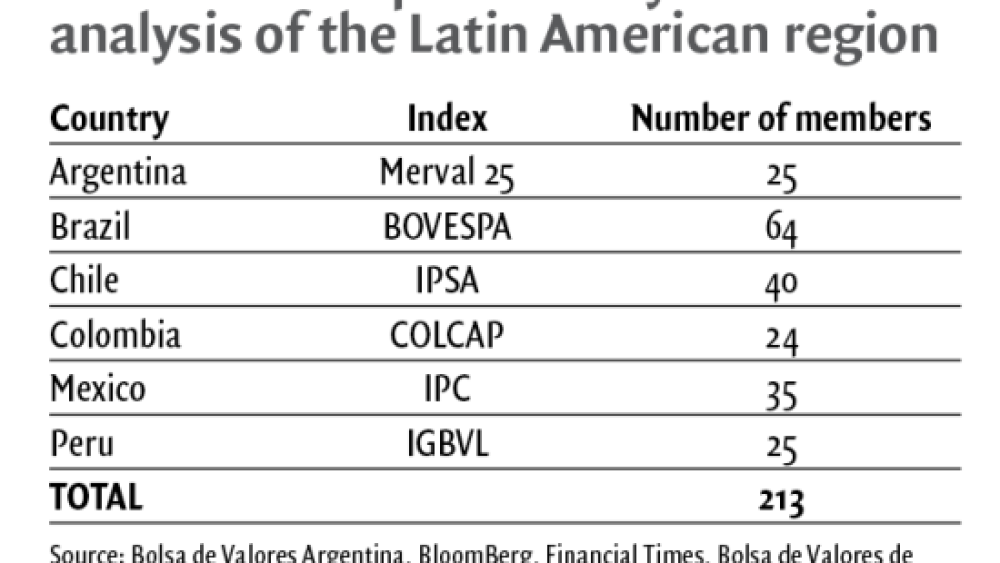
The analysis will examine the performance of listed family and non-family firms in the major economies of Latin America in terms of GDP, i.e. Argentina, Brazil, Chile, Colombia, Mexico and Peru (World Bank, 2015). The sample is based on the major index of each country’s stock exchange.
Review of Academic Literature
As mentioned earlier, family firms are the dominant form of corporate ownership in the world. La Porta et al. (1999) estimated that 60-70% of all companies are family controlled ones. Family firms focus on the long-term going concern of business and aim to maintain control of the company (Stein, 1988). Therefore, ownership tends to be concentrated over time (Galve-Gorriz & Hernandez-Trasobares, 2015), even in times of crisis (Andres, 2008). The concentration of ownership, however, is less present in countries in which the institutional framework is more developed or strong (Anderson & Reeb, 2003). Often, families have invested a considerable amount of their personal wealth in their company. Therefore, families are more encouraged to be closely involved with the management of the company and to guarantee the survival of the company (Andres, 2008; Dyer, 2006). Research revealed that family firms are underrepresented in certain sectors such as utilities (Andres, 2008), metal industries, waterworks and supply and communication (Martinez et al., 2007) as these are very capital intensive and regulated industry sectors.
According to some researchers, family firms outperform other types of ownership structure. Moreover, their superior performance is at its highest level if the founder is active as CEO (Andres, 2008; Anderson & Reeb, 2003; Villalonga & Amit, 2006). Anderson & Reeb (2003) believe that founder-led family firms are the only ones that are valued higher by the market and that have better operational performance. Galve-Gorriz and Hernandez-Trasobares’ study (2015) also confirms the “founder-effect”, i.e. that the first generation leading the company can generate higher returns than the generations that inherit the company. Potential reasons for this superior performance are that families pass on knowledge and experience from generation to generation and build more easily long-term relationships with the company’s stakeholders (Andres, 2008).
Not everyone shares the belief that family firms have a superior performance. Some authors believe that there is no connection between the ownership structure of a firm and its performance (Demsetz & Lehn, 1985). Others think that aspects such as survival and private benefits provided by the firm could influence the decisions that family firms make (Schleifer & Vishny, 1997). Also, family firms might not always hire the most talented persons for key positions within the firm, thereby potentially favouring family members (Dyer, 2006).
La Porta (1999) discovered that weak legal protection of minority shareholders results in concentrated ownership. Countries based on the common law system such as UK, USA and Japan often have a widely held ownership structure because professional managers are often used once the founder retires and because minority shareholders tend to be better protected by this system. Countries based on the civil law, such as Continental Europe, have the civil law system and offer poor legal protection of minority shareholders. Therefore, ownership is more concentrated. Also, countries with underdeveloped regulation and institutional framework face a higher presence of corruption (La Porta et al., 1999; Galve-Gorriz & Hernandez-Trasobares, 2015).
Family firms in Latin America
Most studies that investigate whether family firms have a superior performance compared to other firms were primarily conducted in Western countries. This research aims to find out whether the same results can be found for Latin American countries and therefore, it is essential to understand the Latin American context. Martinez et al. (2007) studied the performance of 175 listed firms in Chile and came to the conclusion that family firms have a superior value creation and performance when compared to non-family firms. Nevertheless, family firms are less valued in the market because it believes that family firms are vulnerable to minority shareholders’ expropriation. As a result, the market applies a discount to the value of their shares. Aguiló & Aguiló (2012) examined the performance of family businesses in Mexico by using a sample of 101 public listed companies. They found that family firms have a superior performance compared to non-family firms. Ownership concentration has a positive impact on performance. A plausible reason for this could be that concentrated ownership increases the ability to monitor business activities more closely. Just like other countries in the Latin American region, Mexico offers weak legal protection to minority shareholders. This could explain why concentrated ownership is the dominant form of corporate ownership.
Latin American countries are based on civil law and thus offer poor investor protection (CIA, 2015). Consequently, it is no surprise that concentrated ownership is very present in the region. Regulations, in particular, are hard to imply in this region because of the family structures and high ownership concentration (ECLAC, 2015). Transparency and accountability are blocked by these ownership patterns. According to Lopez-de-Silanes (2009), the lack of transparency is also due to the high levels of corruption in the region. When using the Corruption Perceptions Index of Transparency International (2015), it can be concluded that Chile is the least corrupt country in the region, while Argentina is the most corrupt country, closely followed by Mexico.
Since the 1990s, there is more M&A activity in the Latin American region. This is closely linked with the large-scale privatisation wave that was introduced by the Washington
Hypothesis formulation, data and methodology
The goal of this research article is to investigate whether the following hypotheses can be confirmed:
- H1: Family firms perform better than non-family firms;
- H2: Family firms perform better than state-owned firms;
- H3: Family firms perform better than widely held firms;
- H4: There is a significant difference in the performance of family firms across the countries of the Latin American region.
As can be seen from Table 1, our dataset is composed of 213 companies, located in the six major economies of Latin America. The financial sector has the strongest presence (22%), followed by the materials (15%) and utilities (15%) sector. Companies active in the financial sector are excluded from the sample as they have a different valuation method. There have also been some adjustments for companies with dual share classes that have different voting rights. Therefore, our final dataset consists of 163 companies.
We define firms as family firms if one or more individuals are the ultimate owners of a company, owning the largest block of shares. The owners aren’t necessarily descendants of the founder(s) or involved with the management of the business (Blondel, Rowell & Van der Heyden, 2002). Since information about which generation is managing the family firm is often not detailed enough, even for publicly listed companies in Latin America, this article identifies family firms regardless of which generation is currently managing the business. A cut-off of min. 10% of company shares, held directly or indirectly, is applied (Maury, 2006). We will classify each company in one of the following shareholder types, which follows the definition used by La Porta et al. (1999):
- Family or individual;
- State or government;
- Widely held firms (corporation or financial
institution) ;[2] -
Miscellaneous .[3]
A wider range of sectors
The family firms of our dataset are mainly active in the materials (22%), consumer staples (21%), industrials (20%) and consumer discretionary (13%) sector. It is worth mentioning that capital-intensive industries such as utilities are rather underrepresented, confirming what Andres (2008) discovered in their study. Compared to state-owned and widely held firms, family firms are active in a wider range of sectors. Not surprisingly, state-owned firms are strongly present in the utilities (62%) and energy sector (24%), which can be related to the regulatory nature of these industries.
The dataset is screened using three performance measures to determine whether family firms perform better than non-family firms:
- Return on assets (ROA) calculated as: EBIT/total assets;
- Return on equity (ROE) calculated as: net income/equity;
- Tobin’s Q calculated as: (market capitalization +total debt)/total assets.
- Firm size (natural log of total assets);
- Firm debt (estimated as net debt divided by EBITDA);
- Company age (natural log of years since foundation);
- Corruption Perception’s Index score as a measure of corruption level.
Results
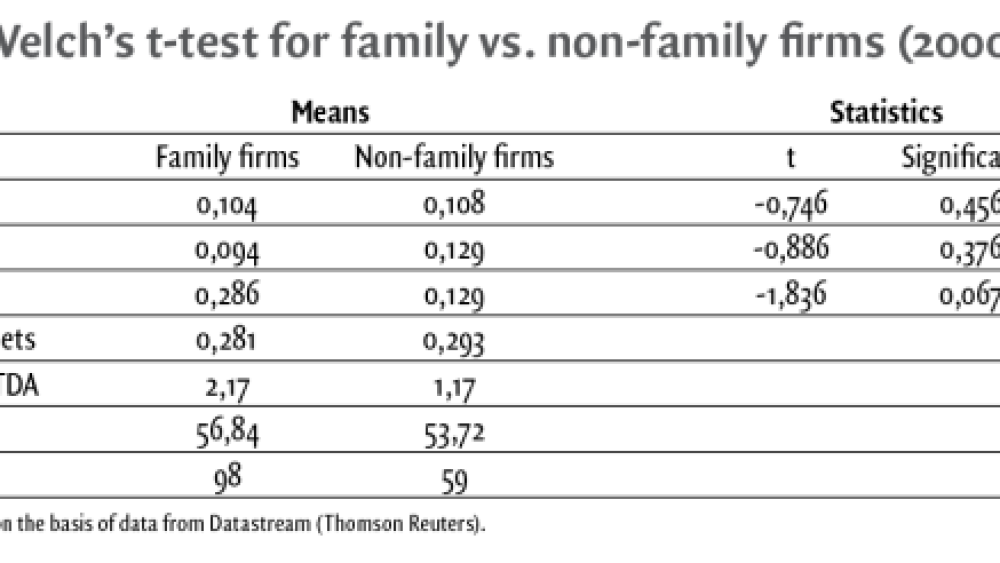
The first hypothesis tests whether family firms perform better than non-family firms, using the performance measures we defined earlier. The test revealed that none of the performance measures were significant at a 0.05 level (Table 2). The H0, stating that family firms have a similar performance as non-family firms, couldn’t be rejected. Consequently, hypothesis 1 can’t be confirmed. Family firms’ debt level is slightly lower than that of non-family firms. This is rather unexpected since families might have a preference for debt over equity to finance their activities as it avoids losing ownership control. Casanova (2009) and Bebczuk (2000), however, argue that family firms in Latin America favour auto-financing instead of debt. This could explain the slightly lower debt level. The leverage ratio, measured by net debt over EBITDA, illustrates that on average it takes family firms longer than non-family firms to repay their debt (keeping net debt and EBITDA constant). This might result in a higher cost of debt for family firms and might explain why family firms have lower levels of debt than non-family firms. Further, family firms are on average older than non-family firms.
A closer look into the non-family group was necessary to see whether the performance of family firms is better than any subgroup of non-family firms.
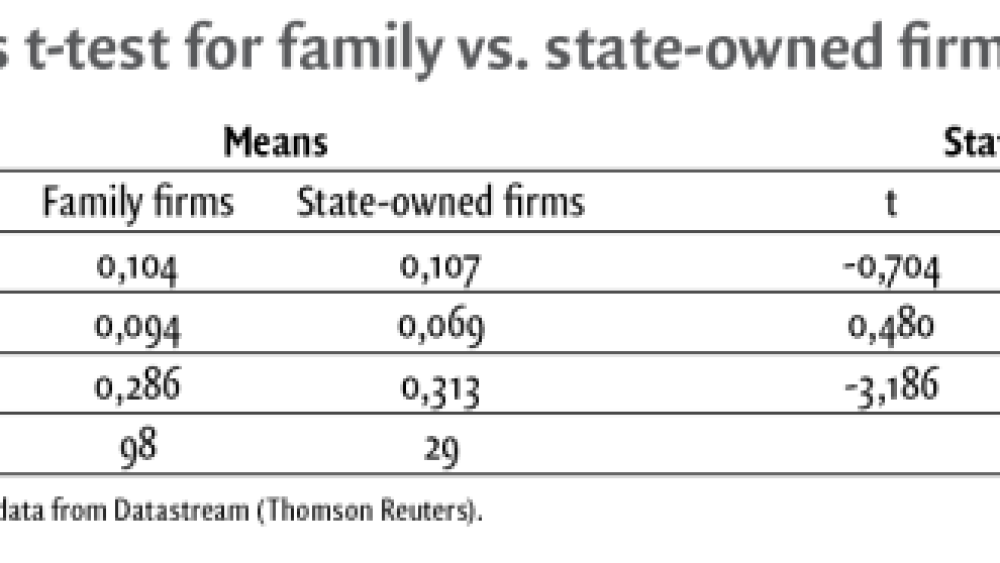
It is clear that family firms aren’t performing better than state-owned firms in accounting terms (Table 3). There is only a significant difference in performance regarding Tobin’s Q. Tobin’s Q is lower than one for both family and state-owned firms and this indicates that the market value of all companies in our sample is less than their average replacement value. Nevertheless, the Tobin’s Q of family firms is significantly lower than the Tobin’s Q of state-owned firms. So the market undervalues family firms significantly more than state-owned firms. As a result, hypothesis 2 can’t be confirmed either.
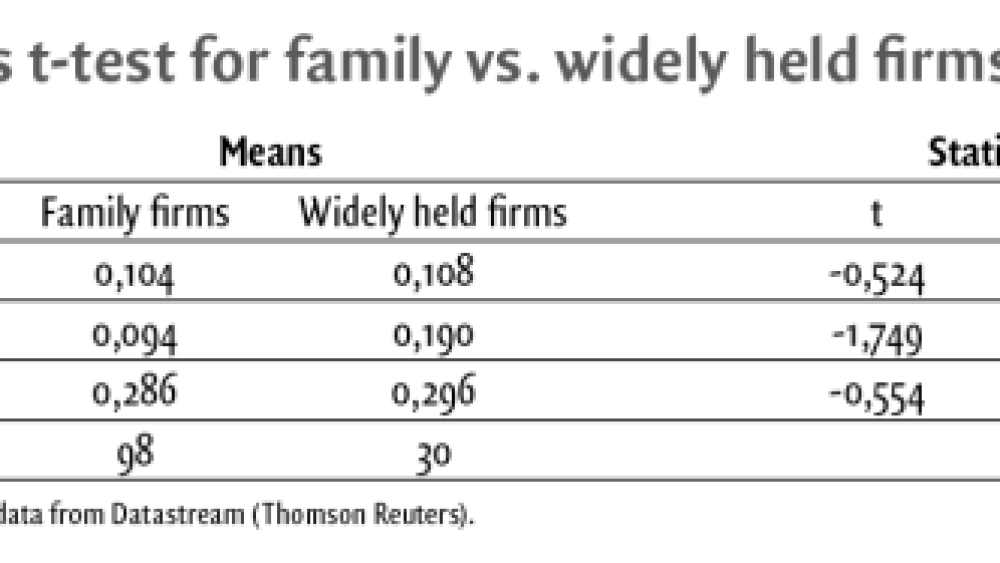
Next, the hypothesis that the performance of family firms is superior to the performance of widely held firms was investigated (hypothesis 3). Table 4 shows that none of the performance measures (ROA, ROE, Tobin’s Q) is significantly different. There is no difference in performance between two types of ownership structure. Therefore, hypothesis 3 can’t be confirmed.
It was also investigated whether the most recent financial crisis (2007-2009) had any influence on the difference in performance between family and non-family firms in the Latin American region. Therefore, the sample will be analysed for three periods: a sub-sample before the financial crisis (2000-2006), one during the financial crisis (2007-2009) and one post-financial crisis (2010-2014). There is only a significant difference in Tobin’s Q before the crisis. Non-family firms have a higher Tobin’s Q on average and this means that the market value in comparison to the replacement value of the assets of non-family firms is slightly better than the one of family firms. However, both family and non-family companies remain undervalued by the market as their Tobin’s Q is lower than one. During the crisis, the ROA of both groups also differs significantly too. The mean of ROA of non-family businesses is higher than the one of family firms, meaning that non-family firms performed better during the crisis. The management successfully used its assets more efficiently to generate earnings. In the post-crisis period, there is no significant difference between two groups at all.
Across the Latin American region
Furthermore, it was investigated whether there is a significant difference in the performance of family firms across the Latin American region (hypothesis 4).
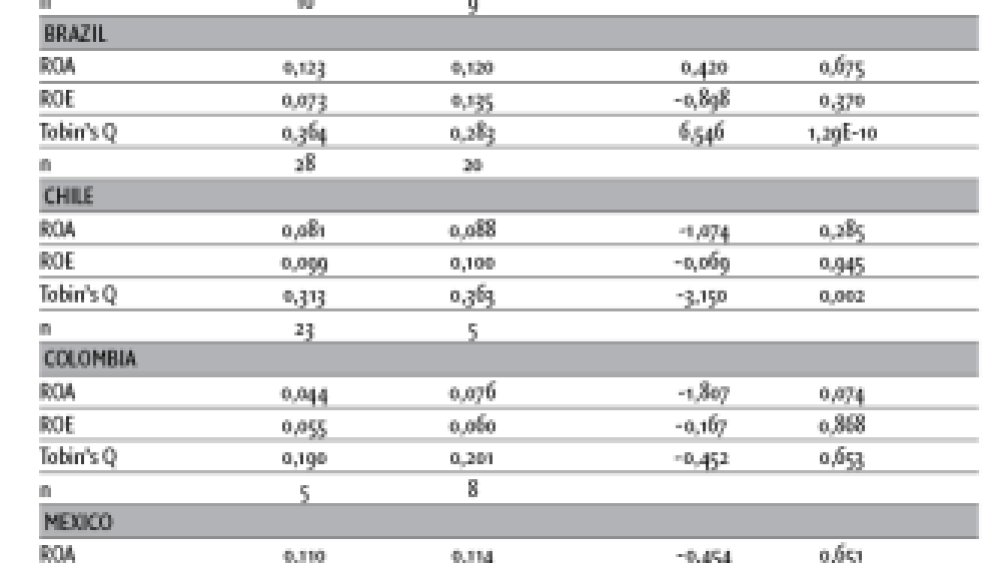
The results in Table 5 show that in Argentina, only Tobin’s Q is slightly significant. Non-family firms have a higher Tobin’s Q than family firms. Once again, the market values non-family firms higher than family firms. In contrast, both ROA and ROE aren’t significant in Argentina. In Brazil, the difference in Tobin’s Q between the two groups is much more significant than in Argentina. Family firms have a higher Tobin’s Q than non-family firms. Brazil seems to be the exception where family firms have a better market value than non-family firms. Both groups’ market value remains lower than the replacement value of their assets though. ROA and ROE, on the other hand, are not significant. Chile follows the same trend as Argentina by having a Tobin’s Q that is slightly significant. In this case, family firms’ Tobin’s Q is lower than the one of non-family firms. Martinez et al. (2007) also found a lower Tobin’s Q for family firms. Colombia doesn’t have any significant performance measure at all, even if Tobin’s Q is only slightly not significant. Just like Argentina and Chile, the Tobin’s Q of Mexico is slightly significant. Again, the average Tobin’s Q for family firms is lower in comparison to non-family firms. Both ROA and ROE aren’t significant. Peru is the only country where all performance measures are significant at a 0.05 level. Especially Tobin’s Q is very significant. On average, the three performance measures tend to be lower for family firms.
Undervalued by the market
The overall trend for the Latin American region is that accounting performance measures such as ROA and ROE aren’t significant, except for Peru. In general we can conclude that family firms aren’t more efficient in using their assets to generate profits. Also, the return investors get for their investment isn’t better in family firms than in non-family firms. Only in Peru, non-family firms are better at generating returns for their shareholders and better in using their assets in an efficient manner to generate profits. In Argentina, Chile, Mexico and Peru, non-family firms have a higher Tobin’s Q on average. Therefore, family firms seem to be slightly more undervalued by the market than non-family firms. A possible explanation might be that the market discounts the family’s shares more because they fear more minority shareholder expropriation. Therefore, the market capitalisation of family firms is often lower than for non-family firms (Martinez et al., 2007). These findings are not similar to the findings of Martinez et al. (2007) for the IPSA index in Chile. They discovered that Tobin’s Q is higher for family firms. This dissimilarity of results might be explained by the different criteria that Martinez et al. (2007) have applied to determine family control. However, when taking the whole sample (175 listed firms in Chile) that Martinez et al. (2007) investigated into account, Tobin’s Q is found to be significantly lower for family firms. Given that Martinez et al. (2007) studied the IPSA index a few years ago, the composition of this index might have changed too. If that were true, it might explain the differences in the findings.
In conclusion, hypothesis 4 can be confirmed: there are very significant differences in the performance of family firms and non-family firms across countries, notably in Brazil and Peru. The outcomes, however, can’t confirm superior performance of family firms in comparison to non-family firms.
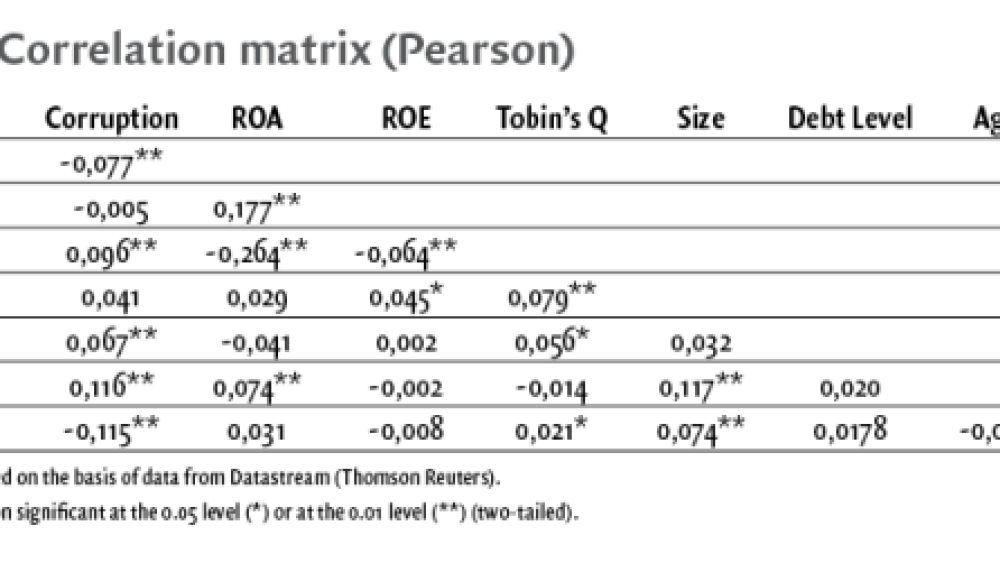
In this research article, the way variables correlate with each other was investigated as well. In order to make a correlation matrix, family and non-family firms were ranked because they are non-numerical. Family firms were assigned number 1 and non-family firms were assigned number 2. They are listed as FamNum in the correlation matrix below. Sector variables couldn’t be included because they are non-numerical (categories). Sometimes no real values were available for the data (these appeared as NA) and therefore, they were removed from the dataset. Table 6 shows a Pearson correlation matrix, except for the correlation coefficients with FamNum because it is based on rank (1, 2). In that case, a Spearman correlation matrix was used.
In general, none of the variables seem to have a very strong correlation (coefficient>0.7) with each other. The strongest correlation can be found between ROA and Tobin’s Q. This is a very significant negative correlation, meaning that if Tobin’s Q is high, ROA will be low and vice versa. ROA and ROE also have a small, but significant, positive correlation coefficient. This is not very surprising since both ROE and ROA were not significant in the Welch’s tests we did before. The similarity between both profitability ratios might explain why they often point out the same results. Further, the positive significant correlation between size and age is very evident since successful businesses tend to expand in time. FamNum has a very significant negative correlation with the corruption variable. This represents that family firms are slightly less corrupt than non-family firms. The positive correlation between corruption and age means that older firms tend to be a little less corrupt. Recall from table 2 that family firms are on average three years older than non-family firms. Thus, family firms, especially when they are older, tend to be less corrupt.
Conclusion
The goal of this research paper was to investigate whether family firms have a superior performance when compared to non-family firms. Countless studies have been produced without leading to any consensus. Surprisingly enough, the academic literature that discusses family performance related to the Latin American region remains rather scarce. This research article discussed the results of previous studies about family performance and offered a deeper insight into Latin American context. The main stock exchanges of six countries, being Argentina, Brazil, Chile, Colombia, Mexico and Peru, were used to compose a sample. 60% of all companies in this sample were defined as family firms. These firms are mostly active in the materials, consumer staples and industrials sector. Three performance measures were used to judge on the performance of family and non-family firms: ROA, ROE and Tobin’s Q. The results suggest that family firms aren’t significantly performing better than non-family firms. Rather, they can perform significantly worse regarding market and accounting performance. Brazil is the only country where family firms are valued slightly higher by the market than non-family firms. Finally, when looking at the correlation between variables, it can be concluded that family firms and older firms tend to be less corrupt.