

“But there are hostile takeovers!” This is the first reaction I usually encountered when leading my research. One would then quote a few famous examples of past operations, such as Louis Vuitton on Moët Henessy or Mittal over Arcelor. But their frequency is much lower than one could expect. Indeed, hostile takeover is a strong academic topic and offers sensationalism due to its particular process, hence a strong presence in specialized and unspecialized media. It is also taught in business schools very early on, along with several defense mechanisms. However, this strong presence hints towards frequent occurrences of such hostile public offers, while the market does not reflect such a frequent phenomenon at all. Contrariwise, hostile public offers appear extremely seldom globally.
Indeed, between 1976 and 1990, 35,000 M&A deals have been identified globally, out of which 364 can be described as hostile; this represents roughly 1% of the takeovers (Meier & Schier, 2016). In particular, in France, there has been a decline in the frequency of hostile takeovers: only 37 have been through since 1985 (IMAA institute), and only four unsolicited bids have been launched between 2014 and 2017. However, Olivier Meier (2016) accordingly points out that even though only 14% of American firms have been subject to a hostile takeover, almost 50% of the firms have been threaten, directly or indirectly, by such an operation. Hence a strong presence in the financial landscape and in investors’ minds, but this remains unjustified by the real volume of these operations.
There are defense mechanisms on both financial and legal side, along with some “bad press” effect that companies do not want to deal with, fearing it will negatively impact both their revenues standalone and their future potential success, if they do pursue with the integration of a hostilely acquired firm.
Mergers and acquisitions constitute long processes, and a hostile offer adds difficulty to what can already appear painful and exhausting. The poor likelihood of reaching a successful end of this process can explain why firms do not bother pursuing an offer that’s ill-received from its beginning. Why then, knowing the hardships ahead do some actually decide to suffer through this whole process?
From its very beginning, such a process triggers immediate effects for both the potential acquirer and the target. Therefore, the bidder would not engage in it unless he believes this operation can be (a) successfully achieved, requiring a significant amount of work upstream to analyze the defense mechanisms and potential loopholes, and (b) that the target represents a financially interesting investment. Whether it is its leveraging possibilities or whether it presents important synergy opportunities with the bidder, the target is most likely not chosen at random but selected thoroughly, thus justifying an interest from the bidder so important that the bidder will take the risks associated with a hostile takeover process.
Pursuing a hostile takeover, another kind of obstacle race
Are hostile bids too risky to be tried? In order to evaluate how professionals envisioned the credibility of the major obstacles usually considered to prevent hostile bids, I realized a quantitative questionnaire, which more than 50 investments bankers answered to and interviewed different experts: Maître Emmanuel Brochier, Partner and Founder at Darrois Villey Maillot Brochier ; François Kayat, Managing Director at Lazard, Paris ; Éric Toulemonde, Founding Partner at EKA Partners.
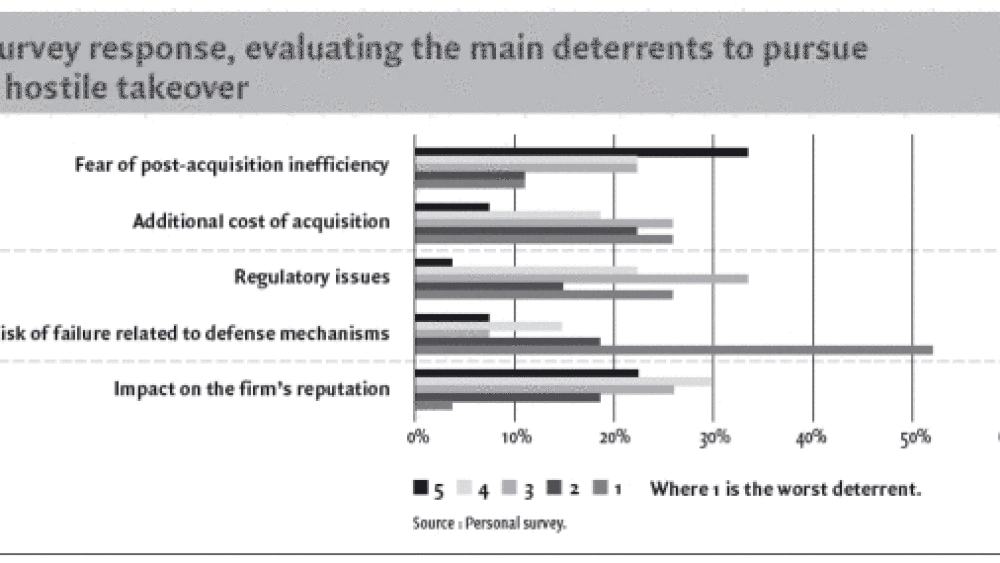
The graph 1 gives an estimation of what investment bankers consider the main deterrents of hostile takeovers. It appears that the principal fear is related to the failure of the operation per se, rather than to the risks associated to the post-merger integration phase. Indeed, only 11% of respondents evaluated the fear of post-acquisition inefficiency as the main factor stopping a firm from pursuing a hostile operation, whereas Antitakeover provisions and Regulation are considered as the worst deterrent by 52% and 26% of respondents, respectively. The only factor that distinguishes as seeming the most significant deterrent is the risk of failure related to the defense mechanisms. This perception of antitakeover provisions as the major deterrent shows that the possibility to succeed in spite of these measures is either extremely low, or extremely complicated.
The defense of the target is surely the first direct obstacle that the bidder meets. However, the efficiency of such a defense appears questionable. Although a targeted firm can surely wave its will to defend itself, the threat is not always realistic. This is the case with “white knights” defense for instance: its efficiency is unquestionable once it comes into the acquisition battle, but what is the feasibility of getting one in the first place? Only extremely wealthy individuals or firms could play this role, and firms are quite reluctant to assume it as this rushed merger could negatively impact its future wealth.
Moreover, the inefficiency of defense mechanisms as well as the reasons behind their use have been quite controversial, making even the most famous ones appear like myths rather than realistic threats. Some antitakeover provisions are controversial as they might result in target’s shareholders being potentially worse off than if the acquisition took place. For instance, golden parachutes are often viewed as “rewards for failures”, especially when they reach extreme levels.
“Not afraid”: a series of unconvincing threats
As for reputation, only 4% of respondents considered it a major deterrent. This probably results from the communication that is closely managed and monitored by the bidder. Eric Toulemonde indicated that “trying to impact the bidder’s reputation via communication is not a mean frequently used”, whereas Maître Brochier emphasized the importance of communication. In fact, he called up that one type of operation can be refereed to differently: “hostile, non solicited, unfriendly: these are different words to describe one legal reality, but that act differently in terms of communication”. The firm’s reputation can be negatively impacted before the offer is submitted. Kayat observed that “Technip’s future bid was published in the papers [over CGG, in 2014,ndlr] its shares decreased by 20%! Technip never formalized its offer”.
Finally, the interviews conduced were convergent in undermining the impact of government pressures and regulation. First, the increasing complexity of financial instruments lessens the efficiency of supervision authorities. Toulemonde stated that “regulators lag behind in handling different financial instruments; hence, the regulatory response to different instruments is put into place at a later date”. Maître Brochier agreed, as he gave the example of LVMH’s tentative takeover over Hermès: “LVMH had bought some shares derivatives; back then, regulation didn’t’ state an obligation to declare anything about derivatives”. The 1989 law on transparency in the
In addition, the protection of sensitive sectors is not always sufficient to prevent hostile takeovers. For instance, media is protected and some conglomerate have acquired one but this is not what prevents a hostile bid on the group. Indeed, according to François Kayat “we do not try a hostile takeover on LVMH because of the shareholder structure and the personal role of Bernard Arnault, not because LVMH includes Les Echos”. “The agreement with the government could be easily made by saying they will ensure the freedom of the said-media, or even that they will sell it right away, even to the original shareholders”, he added. Although government pressures constitute a reality and can be risky to go against, they do not always constitute a credible threat. Eric Toulemonde declared: “In France, the culture is stronger, in the sense that the establishment and government interventionism are taken into account. Thierry Breton qualified this as “la grammaire des affaires” (business grammar) in 2006, qualifying the strong opposition that Mittal met when buying Arcelor”. Despite this public opposition, the threat did not appear credible as it had no strong legal grounds, and Mittal pursued its takeover nonetheless.
“Si vis victoriam para bellum”
The difficulties, both regulatory and regarding defense mechanisms, can also be overcome by being anticipated: the obstacles are well-known from intermediaries, both investment bankers and lawyers, and in practice the help they provide to a willing acquirer throughout the process and especially before the offer is launched is key for the success of the transaction.
Besides determining the strategic interest of the acquisition, a thorough preparation comprises elements such as analyzing the capital structure of the target, and anticipating the response of the target. An offer can start off as hostile, or result from a previous failure of friendly negotiations. However, when the bidder estimates that the management will reject its offer, it is more likely to fend off obstacles beforehand, as timing appears essential. In fact, in France, the Financial Markets Authority fixes public offers’ timeline. As the timespan can appear quite short, by anticipating the response, via collecting the funds needed for instance, the bidder limits the opportunity for the target to react, and as well as the opportunity for other firms to enter the auction. When the bidder analyzes the firm thoroughly beforehand it can also find loopholes in its capital structure that allows it to neutralize some or all of the usual antitakeover provisions.
While antitakeover provisions still appeared as a major deterrent to survey respondents, the investment bankers’ interviews dismissed mitigated their efficiency. In fact, François Kayat indicated that the white knight defense is efficient but difficult to put in place due to timing, and that the poison pill “does not really exist”. In his view, the first defense mechanism is thus to win some time, which can be achieved by engaging into some litigation, as Club Med did for instance. Also, for him the only credible defense for a target is to convince the shareholders not to sell. This can prove efficient if it is credible to the shareholders that their wealth will increase. He mentioned Ubisoft, which successfully prevented its shareholders to sell to Vivendi. Vivendi ended up stepping back, while Ubisoft saw its value double.
Moreover, if the bidder has a prior ownership in its target, it can enter a litigation in order to remove some of the antitakeover provisions. French lawyer Maître Brochier pointed out the Nestlé-Perrier (1992). In that case, Nestlé’s goal was to limit the voting rights. When a certain threshold is exceeded, there’s an obligation to declare it; if a legal threshold isn’t declared, it is possible to ask the president of the Commercial Court to sanction. The sanction results in blocking some voting rights: from what’s over the undeclared threshold (automatic sanction: 2 years) to all of them (judicial sanction: 5 years with no limit)! This limitation of the voting rights automatically reduces the influence of the concerned shareholder.
Although all interviewees agreed on the need of a thorough preparation before going hostile, the approach to the hostile takeover is not agreed upon: Maître Brochier stated that it was quite frequent to initiate a lawsuit in order to lead the takeover while overcoming some issues such as the Board’s opposition. However, Kayat contested, saying it is quite seldom, and a firm would not go through that hassle. 67% of respondents to the survey who have taken part to a hostile takeover indicated the operation started off as hostile, emphasizing the importance of both preparation and timing to overcome usual defense mechanism. The aforementioned examples of bypassing defense mechanisms can explain why a significant share of experienced respondents (25%) considered this risk as a small deterrent rating it a 4 or a 5.
Therefore, hostile bids do not appear impossible to overcome, as each of the difference risk impacting the success of the operation per se seem to be manageable, provided they are thoroughly prepared. However, “possible” does not mean “easy”, and the preparation and risks taken for such a bid require both a solid opportunity and the bidder’s significant motivation.
Successful deal: strong strategic motivations required
While friendly takeovers are usually thought of as strategic, synergetic ones, hostile takeovers seem to be triggered by further motives, resulting from circumstances and opportunities. Besides the strategic interest that the target might constitute for the bidder, the identity of the shareholders, the managers, and thus the capital structure are elements that motivates the bidder, and it can identify more easily if it already has an extended knowledge of the company thanks to its prior ownership.
The primary motivation could be resulting from an offensive strategy, triggered by a simple opportunity identified by the bidder. Such an opportunity can be detected by a prior shareholder. Indeed, “in ex-post hostile deals, bidders have toeholds in half of the cases and the toeholds are large, as if the bidder expects resistance in those cases and prepares for a fight” (Bretton and Eckbo, 2000). The notion of toehold described by Bretton and Eckbo refers to a bidder who has some prior stake in its target. This toehold thus provides the willing acquirer with a competitive advantage and a greater chance to win the target. Having a toehold allows the bidder to evaluate whether the capital is open enough and whether the anti-takeover provisions are weak enough for the operation to succeed. Finally, it allows it to evaluate from the inside whether the premium would be adapted to future gains, as it has an extended access to information. In this case, the rationale behind the takeover does not appear to require some specific strategic elements. An opportunity could be identified by an insider, a “toeholder”, when the managers simply appear weak enough at a certain point. The disciplinary takeover would thus target the management team itself, not the company per se.
The identity of shareholders and managers also matter as it can both create or prevent takeover opportunities and as sometimes the individuals are the ones directly targeted by such operations. First, the identity of shareholders constitutes a major element in allowing a hostile takeover. The capital structure creates takeover opportunities: a company with a poorly locked capital, such as a significant free float, will be easier to bid on. The capital structure, and a change in the capital structure, thus constitutes an opportunity effect for a bidder.
Finally, in takeovers, the economic rationale can also be dampened by less rational, critical thinking: in fact, a takeover could even be triggered by some ego fights, such as in the Vivendi/Gameloft case, which opposes Vincent Bolloré to Michel Guillemot. Meier (2016) describes this operation as one that mixes honor, determination, pride, changing a stock-exchange battle into a personal combat.
We observe that takeovers, hostile or friendly, often come in a wave, and follow the same pattern. This indicates that the pursued objective might be the same. In fact, hostile takeover waves usually begin towards the end of a friendly takeover cycle. It thus appears that hostile takeovers are pursued as a last resort measure, considering their high failure risk. Indeed, “several studies published since the late-1960s have shown that at least 60% of such attempts
Profiling the typical hostile takeover target: “Is there a suitor for my hostile deal?”
Olivier Meier and Guillaume Schier (2016) observe some common characteristics of hostile takeover targets. According to them, the typical target profile presents the following characteristics: usually, targets are older than the average firm, they present a Tobin’s
This profile comprises both financial and non-financial elements. First, it seems to indicate that targets present a good economic health, but that their performance is poorer than what it could be. A low debt-ratio and strong payback capacities appear as necessary conditions for a hostile takeover, as most of these transactions are achieved by an LBO (Leverage Buy Out). Hence, the injection of new debt into the group requires a prior good financial health. This standard profile seems to confirm the thesis of market control: these operations would be a way to “discipline” the market and sanction the managers who seem to not be performing enough, as suggested by Shier and Meier’s analysis of Tobin’ Q, and who don’t seem to hold a strong strategic vision, partly due to the routine they may have developed over the years.
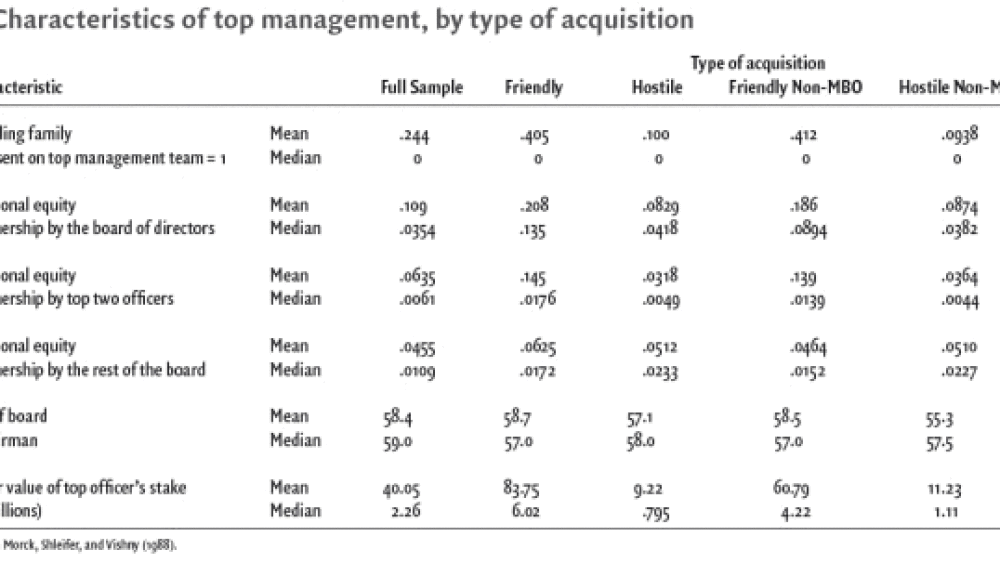
Besides financial and economic performance elements, common characteristics of targets refer to the identity of managers and shareholders. In their article “Characteristics of targets of hostile and friendly takeovers”, Randall Morck, Andrei Shleifer and Robert W. Vishny study the differences in Fortune 500 companies which have undergone an acquisition or a manager buy-out between 1981 and 1985. Among the difference between friendly and hostile operations, they have studied the difference in board ownership as well as the age of the Chairman. Indeed, according to them, “personal characteristics of board members might influence their attitude toward the firm’s being acquired independent of their ownership stake”. They have thus observed that hostile targets show a lower board ownership than friendly targets; the difference is even greater when observing the ownership by the top officers. Additionally, they have also shown that a hostile target is “much less likely to be run by a founder or a member of the founder’s family”.
As shown in the table 2, the likelihood of a friendly acquisition is positively correlated with management ownership. Over the sample considered, the board of friendly targets owned over 20% of the company on average, versus 8.3% for hostile targets. The difference appears even greater when there were incidences of members of the founding family on the top management team: 40% of friendly targets had such individuals among their management team, whereas only 10% of hostile targets had one. Morck and al. raise two rationales to explain this correlation. They point out that the role top officers, and in particular members of the founding family, hold in the company is a special one, “either because they command the loyalty of shareholders and employees or because their attachment to the company is more than just financial”. This consideration is important as hostile takeovers most often result in ousting the management team.
Another non-financial characteristic could be the age of the Chairman of the Board. The author’s hypothesis is that he might be conflicted: his recommendation could be biased by the impact the sale of the company would have on his retirement plans. However, the empirical research exhibited in the previous table (Fig. 2) shows a minor difference between friendly and hostile targets, dismissing this as an important characteristic in the typical target profile.
These studies have drawn the portrait of the target of a hostile takeover as a healthy but poor performer, with a management team that is typically not a major shareholder. As Meier (2016) points out, the capital structure matters as it is easier to form a hostile bid against a firm which presents a “capital […] mal verrouillé” meaning a poorly locked capital, confirming Morck, Shleifer and Vishny’s observations.
Looking for firms that fit the typical target profile
The preparation of a takeover, leaded by the firm and its councils, especially an investment bank and a law firm, can comprise two elements. While the lawyers will evaluate the legal feasibility – and the likelihood of success – of some offensive measure, the investment bank acts in particular to present their client, the bidder, with potential targets. The analysis of their profile, what gains would such a transaction provide the bidder, and what might affect the transaction, in terms of price evolution and difficulties ahead.
Some of the difficulties that arise from regulation and antitakeover provisions are possible to overcome, especially with a thorough legal preparation. But what complicates the occurrence of a hostile takeover is the lack of firms that fit the profile of a possible target. Indeed, the importance of the identity of shareholders and managers reveals the difficulty in finding a firm that has a shareholder structure that makes it possible to initiate a hostile bid on, besides meeting both the bidder’s offensive and defensive strategy.
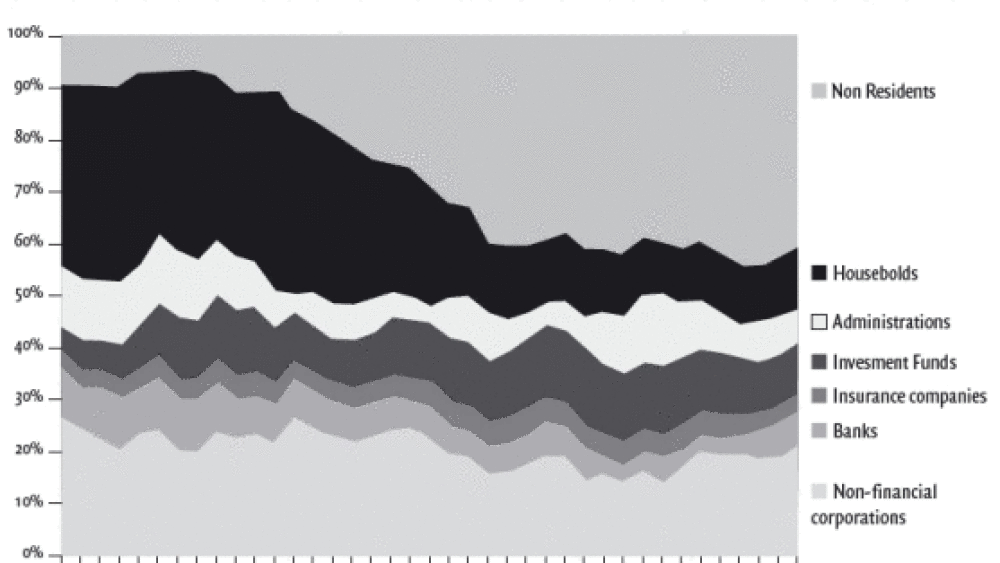
In fact, nowadays in France as in many other European countries, the shareholder structure has undergone some significant changes since the 1980s. In fact, a study by the Observatoire de l’Epargne Européenne (OEE) has pointed out that the main changes in listed company holdings reside in an increased participation of non-residents, to the detriment of households. The graph below (Fig. 3) shows that households held about 35% of shares in 1977, whereas in 2015 they only held about 10% of shares. The decrease in the presence of households in the shareholder structure suggests that the accessible free-float of French listed companies is significantly lower. As households usually constitute very small minority shareholders, they tend to be the easiest target in the case of a hostile takeover. Therefore, this change in the shareholder structure indicates an increased difficulty for hostile bidders, as the capital of listed firms seems less moveable.
Many respondents to the survey indicated that the major factor preventing hostile offers was the lack of suitable targets. Indeed, Eric Toulemonde indicated that a hostile offer resulted from the union of three factors: “Some targets are “nice to have” while other are “must have” […]. When the bidder needs to acquire its target to survive and it is motivated by what this transaction will bring it, the offer is both offensive and defensive. If in addition if there is a “lock” that initially prevents the takeover from taking place, then the motivation turns hostile”. The simultaneous occurrence of these three factors makes a hostile offer statistically unlikely. Similarly, François Kayat emphasized the underlying strong strategic motivations for an offer to be made: “an offer is made when a firm wants to do it and can do it. It is the meeting of an opportunity and a strategy; but the takeover is always the result of a long reflection on the firm’s strategy, he bidder has a precise idea of what it wants to do”.
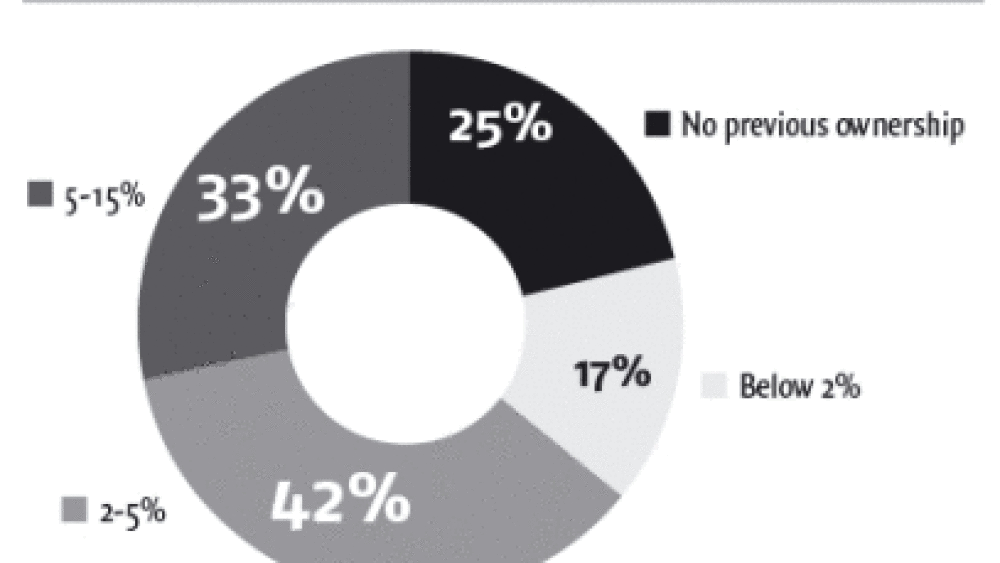
The identification of both the opportunity and the strategic interests could be facilitated by a previous toehold in the company. Indeed, 58% of respondents indicated that the takeover had resulted from an opportunity effect; in all of these cases, the bidder had a prior ownership in the company (v. Fig. 4).
Finding suitable targets appears uneasy also because of today’s shareholder structure. More than 20% of respondents mentioned the low free-float and the presence of a reference shareholder as a major additional obstacle. One summarized it as follows: “A hostile takeover is justified on a large float, a value that has been haircut, and a company that is poorly protected; less than 3% of listed companies have this profile today.”
Hostile bids are dead, long live hostile bids?
Hostile takeovers happen when healthy but underperforming publically traded companies have a capital sufficiently dispersed, and appear undervalued. This condition for a successful hostile takeover appears as an additional obstacle to the risks inherent to the transaction per se and its aftermath. Indeed, we have studied different deterrents, in particular a range of antitakeover provisions and a stricter control of the State, both through regulations and government pressures. But we saw that there are several leverages that a bidder can action in order to bypass some of these obstacles, especially through a thorough preparation. Therefore, although these deterrents still appear strong in the professionals’ opinion, they do not necessarily constitute a credible threat. A hostile takeover could therefore be achieved successfully, overpassing these common obstacles.
However, we saw that there are different motivations that justify going hostile, and we concluded that a hostile operation could only occur if it responded both to an offensive and a defensive strategy. Finding a suitable target that answer both those conditions and whose profile suits the required one, both in regards to its financial situation and shareholder structure proves difficult. Therefore, it appears that however strong the bidder’s motivation and thorough its preparation may be, the shareholder structure and the cultural environment appear much harder obstacles to bypass to successfully pursue a hostile takeover nowadays in France. The shareholder structure has shifted towards a lower household participation, and hence a lower free float, whereas investment bankers have witnessed an increase in the presence of reference shareholders and solid blocks that make the target “un-biddable” upon.
While in France culture, economic patriotism and shareholder structure are new tenacious obstacles to hostile takeovers, it would seem easier for a bidder to go hostile abroad. Indeed, Anglo-Saxon culture exhibits a more liberal approach, leaving the decision up to the market. Therefore, while it is hard to imagine an increase in hostile offers in France, the rebound in global takeover activity a few years ago could hint toward a future hostile takeover wave in these countries.