
The first perpetual bond in history was issued in 1648 by a Dutch water board to finance the construction of a dike system, and the bond is currently held by Yale University in the United States and still pays interests. Nowadays, perpetual bonds have become an alternative and often used capital raising instrument by companies. They are notably frequently associated with banks or financial institutions willing to improve their capital ratios but are also issued by corporates looking for non constraining funds. Thus, as of January 7, 2017, Bloomberg was recording a total outstanding perpetual bond market of EUR 802 billion.
Many questions remain floating around these perpetual bonds. A preliminary draft of definition would be a fixed income security with no maturity date, technically non-redeemable and implying, a perpetual interest payment at a specified frequency. As such, these products present very similar features to preferred shares with guaranteed dividend. Eventually, these two products appear to differ on several points including notably, accounting, tax and/or regulatory features. Many forms and features of perpetual bonds can be observed in the market, strongly differing regarding the redemption, the remuneration, or even the classification.
The underlying questions lie in the understanding of the rationales motivating banks and corporates to issue these products, the determinants of the choice between debt and equity, and those leading to issue long-term debt, and even perpetual maturity debt.
Complex and diversified debt instruments…
Perpetual bonds are hybrid securities between debt and equity. In the substance, they are debt contracts including a contractual remuneration (generally coupons) but giving neither claim on the control of the company nor on the profit generated. However, they present several characteristics that make them closer to equity than debt such as perpetual maturity and therefore being irredeemable, deeply junior subordination to all other debt layers or some skip mechanisms of remuneration payments. The main characteristics of perpetual bond are the following:
Maturity: Perpetual bonds have no maturity date and are irredeemable.
Subordination rank: Perpetual bonds are senior to equity but are subordinated to all other debts and have a low recovery rate in case of bankruptcy.
Call option: Perpetual bonds are irredeemable but are generally callable at the option of the issuer. They can usually be called after protection period of 5 to 10 years after issuance, at periodic dates, generally coupon dates.
Coupon skip mechanism: coupons deferability can be (i) Optional, id est at the discretion of the issuer who can defer payments without being in default, (ii) Mandatory, so that the bond includes covenants to avoid over-indebtedness or any other financial distress situation triggering a mandatory deferral of coupon payments, (iii) Cumulative, so that deferred coupons accrue and bear interest, and are paid in the future, and finally (iv) Non cumulative, meaning that deferred coupon are just cancelled and not paid.
Coupon step-up: Some perpetual bonds can present redemption incentive such as coupon rate step-ups at call dates.
Dividend pusher/stopper: Coupon can come along with (i) a Dividend pusher clause implying the company to pay all cumulative deferred coupons if ever it pays dividends to its shareholders, or conversely (ii) a Dividend stopper clause a company not paying coupon would not be able to pay dividends or buyback shares.
Equity credit: Equity credit is the percentage of equity attributed to the perpetual bond by rating agencies.
…that can either be classified as Debt or Equity…
The classification of these products does not answer to a unique rule and differs regarding accounting, tax, rating and regulatory standpoints.
Accounting treatment: On an accounting standpoint (International Accounting Standards 32, paragraph 16), a financial instrument can be classified as an equity instrument only if it simultaneously (i) has no fixed maturity date, (ii) gives “a residual interest in the assets of the company” after all debt have been repaid, and (iii) has no contractual obligation to deliver cash or any other financial asset or liability. Perpetual bonds both have no fixed maturity, as technically irredeemable, and do provide a claim on the assets of the company in case of liquidation, after all other more senior debt has been repaid. Finally, the third criterion is determinant, and, as substance prevails over form (paragraph AG26), perpetual bonds are classified under IAS/IFRS as equity if coupon payments are cumulative or non cumulative deferrable, and as debt if coupon payments are mandatory.
Tax treatment: Although there is no harmonization of tax rules at the international level, debt interest payments are commonly tax deductible. This tax deductibility of coupons might depend on local laws but regarding tax a perpetual bond might be a debt instrument.
Rating treatment: Each rating agencies have different criteria when attributing equity credit to perpetual bonds. However, four key features remain common to all main agencies which are (i) the coupon skip mechanism (Mandatory, Optional), (ii) the coupon settlement (Cumulative, Non Cumulative), (iii) the subordination rank (Subordinated, Preferred, Equity), and (iv) the maturity (The longer the maturity the higher the equity credit, and equity treatment).
Regulation treatment: The Bank of International Settlement, founded in 1930, has been defining and shaping the global banking supervision framework through Basel agreements (I, II, now III). It distinguishes two main categories, Tier 1 capital, serving as loss absorber on a going-concern basis, id est capital that can absorb losses to avoid bank’s insolvency or liquidation, and Tier 2 capital, absorbing losses on a gone-concern basis, meaning that can absorb losses, after all Tier 1 capital is consumed, to prevent depositors from losing money. Finally, a perpetual bond can either be classified as AT1 or T2 capital depending on (i) its subordination rank, (ii) whether coupons are cumulative (T2) or non-cumulative (AT1), and (iii) whether the instrument provides loss absorption on a going-concern (AT1) or on a gone-concern basis (T2).
…and present some intuitive advantages
Eventually, the complexity of these products and the classification opportunities it presents can have a significant impact on companies’ financial situation, cost of resources, financial flexibility and shareholding structure.
Financial situation enhancement: First of all, companies can possibly benefit from a credit rating strengthening due to equity credit percentages attributed by rating agencies to hybrid securities. Secondly, perpetual bonds can be considered as either as AT1 or T2 regulatory capital, by banks which are, thus, incentivized to issue such securities to strengthen their capital ratio and meet Basel III regulatory guidance.
Cheaper alternative than equity: Perpetual debt is junior to all other debts and therefore might bear more credit risk. However, it benefits from the tax deductibility of interests. On the other hand, equity does not benefit from any tax shield and shareholders bear more risks on their investment and therefore ask for a higher return on stocks. Thus perpetual debt appears to be a less expensive alternative than equity.
Financial flexibility: First, remuneration features can vary and so coupons might be cumulative or non cumulative deferrable. Therefore, the real cost of this debt might be different year over year depending on the coupon skip mechanism. The payments can be subject to dividend pusher or bring dividend stopper clause enhancing the flexibility of the issuer. Secondly, these bonds might be callable at the option of the issuer. Indeed, most perpetual bonds come along with a call option, sometimes accompanied by margin rate step up at call dates to incentivize companies to call.
No dilutive effect: Indeed, equity provides interest and control in the company while perpetual debt only gives right to the holder to perpetual coupon payments. Being irredeemable, perpetual bonds are close to equity but they enable their issuer to monitor the dilution of control.
From an optimal capital structure to the determinants of long-term debt issuance
Papers on optimal capital structure and financing decisions for corporates are numerous in the existing literature. Indeed, financing a company has a cost and can impact the firm value, and the reduction of this cost has been at the heart of corporate finance until today.
Capital structure theories
The traditional approach of the firm capital structure considers the cost of resources as a weighted average (Weighted average cost of capital or WACC): see Equation 1
where E is the market value of equity, D the market value of debt, k is the cost of equity, i the interest rate on debt and τ the tax rate. Thus, when increasing leverage, the cost of capital should linearly decrease and so the value of the firm increase. However, when the gearing of the company (debt to equity ratio) increases, shareholders suppose an increase of the risk, and will ask for a higher required rate of return on their shares. Likewise, lenders will increase the cost of debt when gearing increases, as their recovery rate would be strongly reduced in case of default. Finally, the traditional view of capital structure defines the WACC as a convex function of leverage, with an optimal gearing giving the lowest WACC, maximizing the market value of the firm. Thus, the market value of the firm would be a concave function of leverage.
However, various theories are opposing on capital structure choice. The capital structure theories are mainly derived from Modigliani & Miller (M&M). Indeed, assuming perfect market with no asymmetric information, no tax, no transaction, bankruptcy or agency costs, and the possibility to raise risk-free debt, they demonstrated that neither the value of a company nor its weighted average cost of capital (WACC) are affected by the capital structure choice (1958). In a later paper (1963), relaxing the corporate tax assumption, they showed that as debt is tax deductible whereas dividends are not, the company can reduce its WACC and increase the value of the company by increasing its gearing. However, it also tended to demonstrate that companies should only be financed with debt in order to benefit from the tax advantage of debt, supposing that the firm value would be a linear function of the firm indebtedness. M&M acknowledged that debt also implies other costs and constraints that might balance the obvious tax shield.
Three main theories emerged from the Modigliani and Miller researches: the Trade-Off theory, the Pecking Order theory, and in a least measure the Market Timing theory.
The trade-off theory directly flows in the wake of M&M’s researches acknowledging the various advantages and costs of indebtedness, stating that the capital structure and then the firm market value can be optimized by a “trade-off” between the net present value of tax benefits and additional costs of debt. These costs notably are bankruptcy costs, agency costs, personal taxation and non-debt tax shields.
The pecking order theory is a more risk-averse doctrine stating that firms first use internal funds available such as retained earnings, then short-term debt, then long-term debt and finally equity.
Finally, the market timing theory relies on the idea that companies tend to issue equity rather than debt in periods of increasing stock prices and strong equity market performances. Moreover, firm’s financial structure would have less impact on financing decisions than historical performance of the company’s stock and overall market conditions.
Determinants of long-term debt issuance
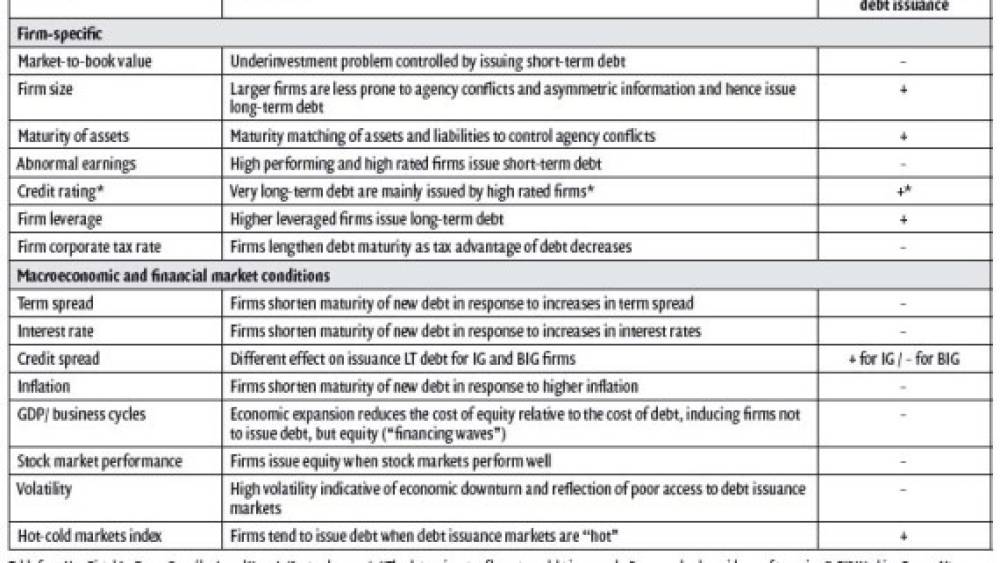
Correlatively to the previous theories, long-term debt issuances answer to specific determinants. These determinants are of two kinds, firm-specific and macroeconomic (Chart 1). It appears that long term-debt issuances are mainly driven by firm-specific determinants. As such firms with, large size, id est significant total assets and market value, and/or assets with long maturities (to match long maturities of debt), and/or high credit rating, and/or significant level of leverage (id est debt to total capital ratio here) will tend to issue long-term debt.
Conversely, the risks of increase in term spreads, interest rates, credit spreads, or inflation, or in presence of strong economic momentum and increasing GDP, high stock market performance or volatility tend to have a negative impact on the decision to issue long-term debt. Still when debt markets are “Hot”, companies will tend to follow the trend and issue debt, which can notably be the case in long periods of low interest rates.
The perpetual maturity of debt as an answer to optimal capital structure
Following M&M who based their research on the firm value and the irrelevance of the capital structure assuming a riskless and infinite-life debt, several research papers intended to put light on the benefits of infinite maturity of debt.
Infinite maturity of debt, optimal capital structure, term structure of credit spread, tax benefits and firm value
It is notably the case of Leland (1994), who demonstrated that a company financed with long-term debt will not automatically bear the risk to go bankrupt should its firm value decrease to the value of debt principal, as the company can raise additional capital to bailout. Second, Leland evidenced that, for long-term debt, there is a positive relation between higher risk-free rate and optimal debt level, as higher interest rates imply greater tax benefits and therefore incite the company to raise more debt. Conversely, he found that bankruptcy risk is negatively related to optimal leverage, as higher bankruptcy costs incite a company to reduce its amount of debt, and therefore the risk. He also evidenced that agency risks lead firms to reduce debt maturity to avoid asset substitution problems. Nevertheless, it appears that financing through long-term debt present real advantages for firms as it implies a higher optimal leverage, lower yield spread and higher tax benefits.
In a later paper, Leland and Toft (1996), completed Leland (1994) findings by integrating different maturities of debt in their model, and demonstrated that there is a positive relation between greater firm value and longer maturities of debt. However, it still has to be balanced with higher agency costs and asset substitution, resulting from issuing longer term debt. Moreover, they confirmed Leland (1994) study of the term structure of credit spreads and evidenced that while spreads increase with leverage, they decrease when lengthening debt maturity. Finally, firms with high bankruptcy costs tend to issue long-term debt, so that tax benefits offset bankruptcy costs. On the other hand, firms with high growth potential and low cash flows would not benefit from as high tax benefits and therefore tend to issue short-term debt. Eventually they find that spreads and probability of default, and so firm’s rating, are “functions of traditional financial ratios”.
Integration of a call option and redemption incentive: reconciliation of all agents and risk mitigation
Mjos and Persson (2008) further investigated the benefits of perpetual debt by integrating a call option in a closed form model based on callable risky perpetual debt with protection period. Their paper showed that in the presence of a call option, the coupon rate, id est, the cost of debt, increases, to compensate for the embedded option that could avoid investors to benefit from the perpetual rent they paid for. However, this increase of the coupon rate has a positive impact on the bankruptcy risk of the company. Indeed, the increased coupon incites the company to call its debt after the protection period is over to avoid paying very high perpetual interests. As such, they evidenced that, even if an increase in the coupon rate increases the long-term bankruptcy asset level of the issuer, the call option inversely affects bankruptcy decision and reduces the value of assets at which level it is optimal to liquidate the company. In other words, the presence of a call option mitigates the probability of default and has a positive impact on the rating of the perpetual securities.
Perpetual bond as an instrument of banking supervision
Asymmetry of information and market transparency have always been at the heart of banking supervision and regulation. Indeed, strengthening the market discipline of banks is one of the main pillars of the Basel Committee. However, banks’ disclosures were not sufficient to ensure market discipline. Indeed, a study of Bigus and Prigge (2001) demonstrated that an issuer standing is positively related to its bond prices and yields, which provide strong signalling and monitoring functions. However, these functions are typical of the secondary market of debt, and while liquidity of a debt security often comes along with either volumes or frequency of issues, they explained that it is not possible to choose to vary one of these features without deteriorating the quality of either the primary or the secondary markets, resulting in an “either-or-choice”. They demonstrated that issuing a single perpetual subordinated bond for a certain minimum outstanding volume, “either permanently or at certain dates”, would strengthen the quality of information and make the market more liquid and transparent as technically substituting the primary market by a unique secondary market.
Outstanding perpetual bond market analysis
Hypotheses surrounding perpetual bonds
The previous information enables to draw several hypotheses on perpetual bonds, starting by the profile of issuers. Perpetual bonds seem to convene more to highly rated companies, which should mainly be rated investment grade (Badoer and James, 2016), as these products are implying significant issues in terms of liquidity and risk, to which investors are sensitive. Secondly, there is a positive relation between high firm leverage and long-term maturity of debt (Leland and Toft, 1996). Finally, following the growing regulation of Basel agreements, accounting, rating and tax treatment, these hybrid bonds are mainly associated with banks.
Moreover, the literature evidenced the importance of firm’s leverage and rating as determinants of long-term debt issuances. Interpreting Leland and Toft (1996) who evidenced that spreads and probability of default might be functions of traditional financial ratios, we can derive that both the rating and the yield of a perpetual bond, might also be a function of the leverage and the long-term rating of the issuer.
Outstanding corporate perpetual bond market
As of January 7, 2017, Bloomberg was displaying information about 2,531 outstanding corporate perpetual bonds, representing 1,293 issuers (which is not the number of firms, as one same firm can have issued different perpetual bonds through different entities).
The total value of the outstanding perpetual bond market was reaching EUR 802bn of which 74.9% from financial institutions (EUR 601 billions). Geographically, top five issuing countries, which represent altogether 64% of the total amount outstanding, are China (EUR 172 billions, 21.4% of total amount outstanding), France (EUR 110 billions, 13.8%), Great Britain (EUR 89 billions, 11.1%), United States of America (EUR 81 billions, 10.2%) and Netherlands (EUR 60 billions, 7.5%).
Test sample: descriptive statistics
The sample to be tested has been reduced regarding available and treatable data to have complete information on (i) both issuer’s long-term rating and the perpetual bond rating from Moody’s (S&P and Fitch Ratings data were not sufficiently furnished and has been excluded from the sample), (ii) the coupon rate which is the contractual remuneration of the bond, (iii) the current yield which corresponds to the pricing of the bond, and (iv) the firm leverage level (ratio of total debt to total capital here). It resulted in a sample of 672 bonds, which should be significant as there were only 770 rated bonds out of the 2,531 bonds. The statistical analysis of the sample showed the following results:
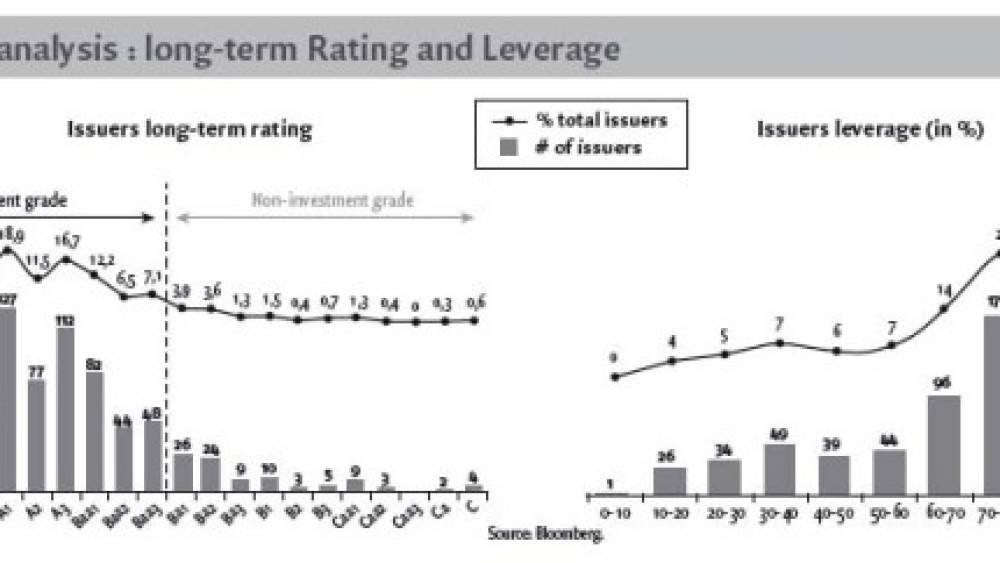
1. The average rating of issuers of perpetual bonds is A3/A- and the median rating is also A3/A-. Concretely, 85.9% of issuers of perpetual bonds are rated investment grade, and even 43.3% are rated A2/A or above, which confirms the strong quality of perpetual bond issuers (Figure 1).
2. The average leverage is 66.2% (median 71.7). Moreover, 78% of issuers are levered at 50% of their total capital or higher, reaching even 57% levered at 70% or more (Figure 1). It appears that issuers of perpetual bonds highly levered.
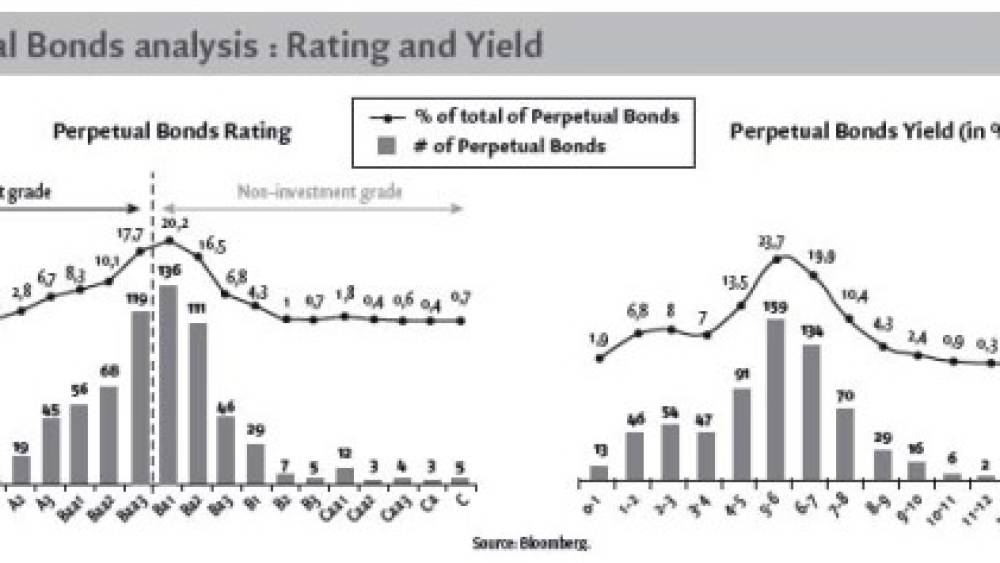
3. The average rating of perpetual bonds is around Ba1/BB+ and the median rating is also Ba1/BB+. Whereas it is not a perfect science, rating agencies tend to consider that hybrid securities such as perpetual bonds are rated 2 to 3 notches below their issuer long term rating. Here we can see that there is still 46.3% of perpetual bonds who appear to be rated investment grade. However, ratings are rather concentrated around the frontier between investment and speculative grades with almost 80% bonds rated between Baa1/BBB+ and Ba3/BB- (Figure 2).
4. The average yield is 5.4% (median 5.65%). It appears that 76.2% of bonds have a yield higher than 4%, and even almost 63% above 5%. In a more global way, yields are concentrated at almost 68% between 4 and 8%, which is very significant for a financial instrument of this kind issued by so highly rated issuers. (Figure 2).
Determinants of perpetual bonds: an empirical study
The existence of a standard profile of issuer
The statistical analysis of this reduced sample confirmed some trends such as the strong credit quality of issuers and their high leverage. Furthermore, financial institutions are the most represented issuers. In order to identify the standard profile of issuer, several filters have been applied to the issuer profile, using criteria defined supra as determinant for long-term debt issuances: Investment grade rating, high leverage (at least 50% here). The aim is to see if these criteria are met within the case of infinite maturity debts.
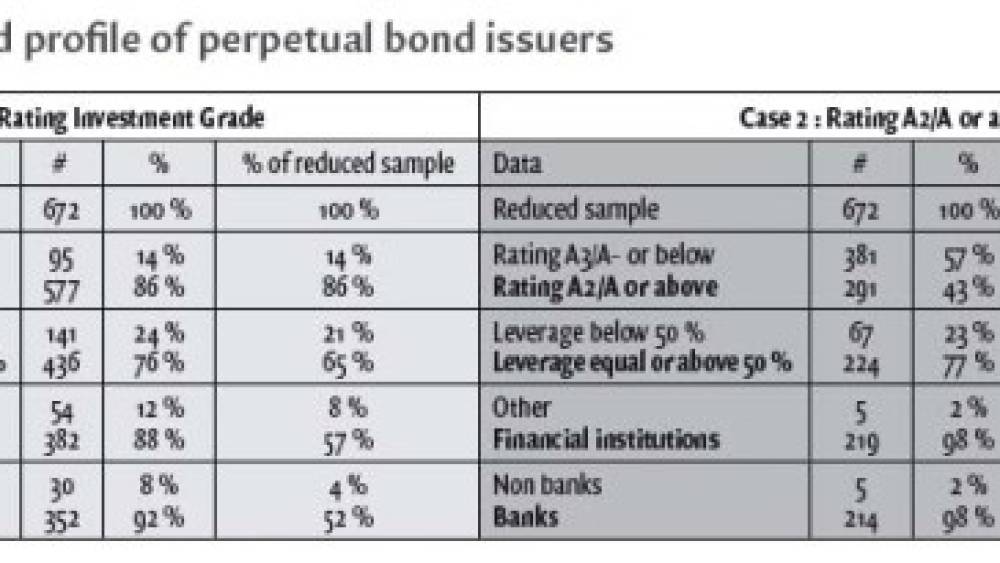
First of all, by looking at the results of these successive filters (chart 2, Case 1), we can validate that fundamental determinants of long-term debt issuances, the issuer’s leverage and rating, are also determinants of perpetual bonds issuances. Indeed, 65% of the sample correspond to companies rated investment grade and levered at 50%.
Moreover, this test (chart 2, Case 1) evidenced that out of these 672 perpetual bonds, 86% of issuers are investment Grade, of which 76% present a leverage equal or above 50%, of which 88% are financial institutions, the latter being mainly banks at 92%. Eventually, banks rated investment grade, levered at 50% or more represent 52% of all 672 perpetual bonds. Therefore, we can conclude that there seem to exist a standard profile of issuer and these issuers are mainly banks rated investment grade, with a leverage 50% or more of their total capital.
Finally, repeating the same exercise taking issuers rated A2/A or above (chart 2, case 2) evidenced that eventually, 32% of the sample of bonds correspond to Banks, highly levered, rated A2/A or above, which confirms the strong significance of this standard profile presented and that these debt instruments are principally issued by banks, highly levered and highly rated.
The rating and the yield of a perpetual bond are functions of the indebtedness and the rating of the issuer
Taking the experience further, it would be thoughtful to test the significance of these two determinants in explaining the variance of the rating and the yield of the perpetual bond.
see Equation 2
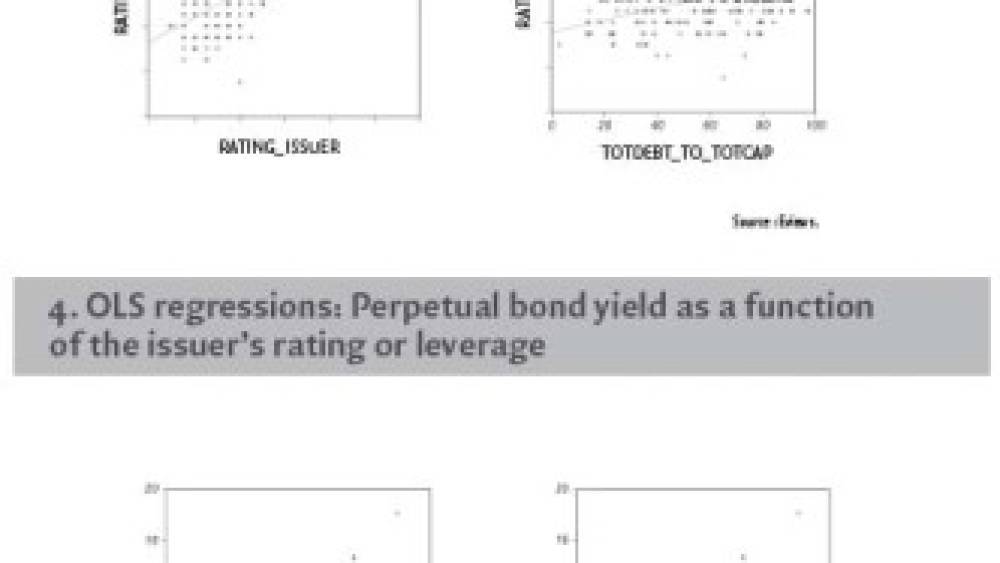
The graphical lecture of scatter plots of the rating (the yield) of perpetual bonds in function of issuer’s leverage and long-term rating, in figure 3 (figure 4) show that these 2 variables are clearly positively related to these determinants.
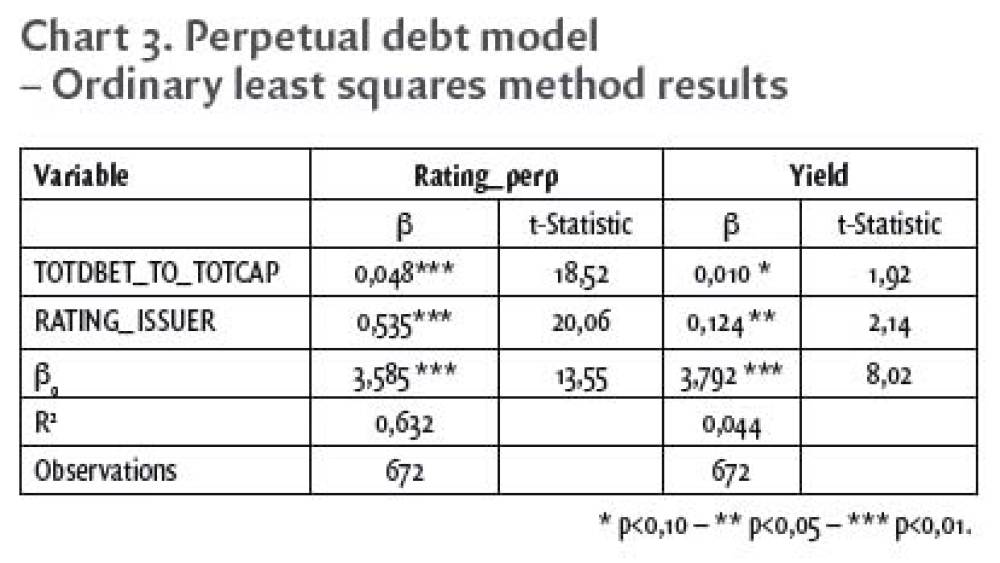
After applying Ordinary Least Squares regressions, corrected from heteroskedasticity and autocorrelation of residuals, it resulted as shown in chart 3.
All variables of the model are significant and explain the variance of the yield and the rating of a perpetual bond, however the explanatory powers are not even:
Rating: (i) the model is significant at 99% (p < 0.01) and (ii) the explanatory power is very strong at 63% (R2 of 0.63)
Yield: (i) the model is significant at 90% (p < 0.1 for the leverage and p < 0.05 for the rating), but (ii) the explanatory power remains very limited (R2 of 0.044).
Finally, the model based on these two determinants is very significant in explaining the rating, however the equation of the yield might also depend on other determinant variables.
Conclusion
Eventually, the whole context surrounding these products, concerning accounting, tax, rating, or regulation has progressively been favouring the issuances of perpetual bonds, as enabling issuers to strengthen their financial situation, retain flexibility, control and still have access to cheaper and less constraining funds than equity.
Since Modigliani and Miller (1958) many researches have intended to characterise the optimal capital structure, the determinants of issuing debt rather than equity and, even further, the reasons for choosing long-term debt maturities.
Through this paper we have evidenced the existence of a standard profile of issuers. Out of a sample of 672 bonds, we found that perpetual bonds issuers are mainly rated investment grade, are highly levered at more than 50% of their total capital, and are principally banks.
Furthermore, it is now evidence that both the yield and the rating of these infinite bonds are functions of some important firm-specific determinants of long-term debt issuance which are the issuer’s leverage and long-term credit rating.
However, the strength of the model remains limited. If there is effectively a strong relation between the rating of a perpetual bond and its issuer’s leverage and long-term rating, there is only little evidence for the yield. Indeed, the model only includes two firm specific determinants while the yield remains a market driven element, and might rather depend on many macroeconomic determinants such as interest rates, credit spreads or overall market conditions.
Finally, it would be thoughtful to test all other firm-specific and macroeconomic determinants of long-term debt issuances on perpetual debt. Moreover, the sample tested only includes perpetual bonds rated by Moody’s and it might be interesting to extend the study to some other rating agencies such as S&P and Fitch Ratings. Finally, this study only considers spot data and might be extended to integrate historical values to have a dynamic vision of the evolution of ratings, yields, issuers’ leverage, interest rates, or even spreads.
The issuance of perpetual debt has strongly increased over the recent years and is not anymore anecdotic, so further research on this little explored subject might definitely prove to be thoughtful in understanding and reshaping the existing dogmas of optimal capital structure, debt-equity choice, and debt maturity choice.