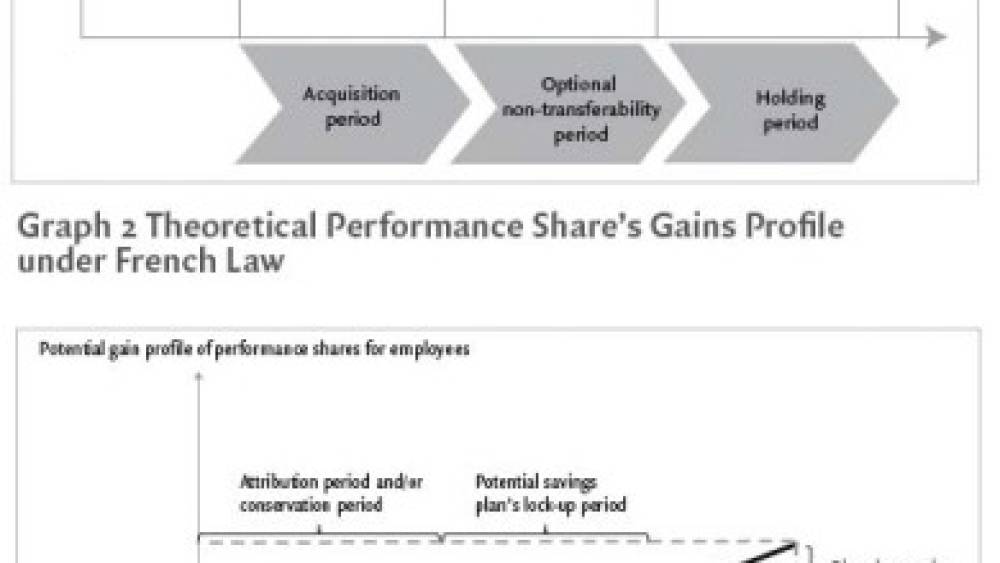

Performance shares are shares granted to employees by corporates on a free basis and including performance conditions or not. This financial tool belongs to the employee shareholding tools and is at the cross-road of employee shareholding and savings plans. In France, this tool can also refer to “AGA” standing for “Attribution d’Actions Gratuites” (“free shares” in the UK or in the USA). The term “actions de performance” also exists in France and refers to shares that are granted to employees on a free basis but which will be acquired solely if embedded performance conditions are met. In France, “AGA” thus refers to performance shares without performance conditions whereas “performance shares” include embedded performance conditions.
Long-term origins of employee shareholding tools in France and implementation of “performance shares” in 2005
Employee shareholding first appeared in France under Charles de Gaulle’s Presidency, who set the bases for employee savings plans by implementing “participation” mechanisms and creating PEE (“Plan d’Epargne Entreprise”). Then, employee shareholding spread with the wave of privatizations that took place in the 1980s (Saint-Gobain, Paribas, Suez, etc.). Employees’ sources of remunerations have evolved substantially in the last century since they do not only earn their salaries anymore, but also complementary sources of income as “intéressement” and “participation” (cash mechanisms) or stock options (stocks mechanisms). Before 2005, stock-options were largely used in France in the frame of employee shareholding plans. Performance shares plans only appeared in 2005 in France and companies unequally started to implement this new financial product in the remuneration package of their employees. Moreover, performance shares products have been ruled by multiple tax regimes that significantly impacted their attractiveness over the time. For instance, the plus-value realized at the acquisition date was not the same before 09/27/2012, after the 09/28/2012, between 08/08/2015 and 12/31/2016, and from the 01/01/2017. Performance shares are indeed financial products subject to the fluctuation of French fiscal laws regarding the tax on acquisition gain, social contribution rates and salary contribution. Rules on performance shares have also evolved together with employee savings rules, which enable employees to allocate performance shares on “PEE” since 2006 with a maximum amount.
A complex employee shareholding tool enabling companies to better address governance issues in the frame of their global strategy
In accordance with French law, performance shares plans are mechanisms implemented by an entity through its Extraordinary General Assembly (“AGE”) to attribute shares to employees on a free basis and at a fixed date, with or without embedded performance conditions. The authorization given by the Extraordinary General Assembly cannot exceed 38 months. Existing shares are first attributed to employees and are then definitively allocated if performance conditions defined in the plan are met.
Performance shares plans are thus a way for employees to become shareholders of their own company without having to pay for it. To be considered as performance shares, the shares have to bear a risk on capital and not to require a financial counterpart in accordance with IFRS rules. Also, performance shares enable employees to realize an ensured gain at the divestiture date, which is not the case of other paying share tools such as stock options for instance.
Two types of performance shares plans have to be distinguished:
- The first type is called “democratic” and concerns all the employees of a company or at least a large majority of them. In other words, performance shares plans are “democratic” when all or a major part of employees belonging to the same company or group are offered the possibility to subscribe to this plan.
- The second type is a “restricted” plan, only concerning a limited number of employees. In this configuration, one or a limited number of categories of employees is/are concerned by performance shares plans.
Existing impacts of employee shareholding tools on the corporate and its performances
The theoretical impacts of performance shares can first be glimpsed through the impacts of employee shareholding on corporate’s performances. First, employee shareholding tools have an impact on the corporate globally by (i) reducing agency conflicts and related costs (Jensen & Meckling, 1976), (ii) enabling employees to obtain complementary revenues and savings through the redistribution of profits (Hollandts & Guedry, 2008), (iii) enhancing the level of identification, commitment and satisfaction of employees globally (Hollandts & Guedry, 2008) as well as loyalty and devotion (Klein, 2007), (iv) stabilizing a portion of corporate’s equity due to the long-term investment profile of employees (Hollandts & Guedry, 2008) and (vi) prevent from potential hostile takeovers (Chang & Mayers, 2002). Secondly, employee shareholding have an impact on corporate performances through (i) the increase of employees’ productivity at an individual level (Kato, 1995) and then spreading to the whole corporate ( Frohlich, 1998). Wilson & Peel concluded that a decrease of employees’ turnover would result in a higher organizational performance (Wilson & Pell, 1991) which would also contribute to enhance corporate’s performances. In addition, Segupta and al. concluded that companies’ best performance came both from a lower workforce turnover and a higher productivity. Employees’ turnover thus seems to be a key variable but it should not have to be too low neither. The turnover of a company also reveals its ability to attract and hire new talents to strengthen its position and know-how on the market and also to demonstrate a certain level of flexibility to potential investors. Moreover, the idea that employee shareholding would result in a decrease of employees’ absenteeism at work was raised by Brown and Fakhfakh later in 1999 (Brown & Fakhfakh, 1999). Thirdly, the implementation of employee shareholding tools modifies stakeholders’ risks by (i) increasing the level of risk employees are ready to bear since they are in a position to expect higher revenues (Benhamou, 2010). In this frame, Benhamon also states that the sensitivity of employees’ revenues towards the economic situation, corporate strategic choices and management quality increases (Benhamou, 2010). Being both a shareholder and an employee of its own company enables to align stakeholders’ interests but it can however cause significant issues. If employees hold a too large stake of their own company, investors could consider that there could be a liquidity “hair-cut” to be applied to the valuation of the company. The free float is negatively impacted by the percentage held by employees who are considered as long-term investors. In addition, performance shares plans can target all the employees of a group or select a restricted number amongst them. This phenomenon of “restriction” indirectly generated by the nature of this financial product could be a reason to deter employees from enhancing their commitment towards the company and negatively impact the performance of the corporate. Eventually, employee shareholding tools could be used as an additional and less expensive source of financing as well as a protection against potential hostile takeovers. In spite of their potential limited scope and the inclusion of conditions that could prevent their acquisition by employees, employee shareholding tools thus seem to have an impact on corporate’s performance. As performance shares belong to employee shareholding tools, they may also have an impact on corporate’s performance.
Performance shares also impact the corporate and its performances since they belong to employee shareholding tools
The defended thesis is that performance shares plans have a positive impact on corporate’s performances. Econometrical tests were conducted on a sample of four CAC 40 industrial companies, Alstom, Safran, Legrand and Schneider Electric, between 2005 and 2016. They are first comparable in terms of sector of activity. Then, their average market capitalization in 2016 was above €5.0 billion, they all realize more than €5.0 billion in terms of revenue in 2016 and had a total number of employees above 32,000 in 2016. They thus are comparable in terms of size. Eventually, as international companies with a global footprint, their operations are lead worldwide which made them comparable in terms of geography. The data of the sample were collected from annual reports and extracted from Thomson Eikon. The two main outcomes of these tests are (i) performance shares have a positive impact on corporate’s performances overall and (ii) acquired performance shares have a positive impact on corporate’s performance shares. The incentive for employees created by the implementation of performance shares plans induces a higher motivation and commitment of employees towards the company. Employees’ efficiency at work would thus increase and imply better performances overall. This increase of efficiency could lie in different optimization mechanisms such as time gains in the day-to-day tasks, sales improvements, turnover costs reduction, etc. The cumulated effects of boosting sales while reducing opex mechanically implies an increase in operational performances. The literature showed that employee shareholding has an effective but limited impact on corporates’ performances. This impact depends on the type of company, on the governance configuration and also on employees’ representativeness. The performed tests show that performance shares have an overall positive impact on the EBIT of the corporate which is an indicator of the corporate’s operational performance confirming the initial thesis. From an economic view point, the increase of employees’ performance could also be considered as a combination of three main factors (i) sales increase (ii) current operational costs decrease and (iii) better capex management related to depreciation and amortization (D&A) included in the EBIT.
Would the vulgarisation of performance shares, as a flexible cross-group management tools enabling to activate numerous levers of value creation within the corporate, contribute to the creation of an activist employee ownership?
Being more and more used by French companies and taking evidence over stock-options in the last decade, performance shares are tools encouraging companies to rescale their business practices in terms of HR management as well as governance practices. The resolution of agency conflicts, referring to Jensen and Meckling, through the alignment of managers’ and shareholders’ interests, is even deeper anchored in corporates with the popularization of performance shares. Today, it is about to align key managers’ interests with the group managers and shareholders’ ones. It appears that one of the main strengths of performance shares lies in the broader alignment of interests of all the corporate stakeholders. Their number and influence do not stop growing due to globalization and financiarization of the economy and due to stakeholders’ inclusion in the implementation frame and the corporate’s strategy conduct. The strategy related to financial incentives and the motivation of key employees thus become significant challenges for global corporates in particular for those creating dedicated headcounts focusing on the management of these types of mechanisms. Although French employees are generally more skittish than their UK or US counterparts, remuneration types evolve together with employees and corporates. Today it seems important for a company to be able to implement such remuneration mechanisms to keep on attracting new talents driven by demanding objectives and ready to accept a more variable basis of remuneration. Performance shares also enable top management to constitute important savings which can be subject to criticisms as it was the case for Carlos Ghosn, the CEO of Renault. However, this study enables to glimpse a fundamental dimension of performance shares which are tools relatively new in France. Beyond their virtues, performance shares aim to be steering tools through the future value creation. Performance shares enable companies to set ambitious growth and profitability objectives which participate to the business power. They are cross-group management tools integrating components of financial innovation thanks, for instance, to the embedded ability of calibration on preferred shares. Performance share plan is thus a specific tool which activates numerous levers of value creation. It is an adjustable and adaptable tool for every type of company allowing them to have a possibility of moderation regarding the targeted goals. These facts are numerous reasons why tax on performance share is a crucial issue for companies today. Fiscal aspects are a major brake for the use of numerous financial products, and tax on performance shares shifted a lot during the last decade and was recently modified by Emmanuel Macron. Eventually, the corporate’s stakeholders tend to speak up more and more to make their voice hear and influence companies’ governance. For instance, the hedge fund Elliott and Corvex respectively acquired a sufficient block of stocks in AkzoNobel and Danone to have enough weight to influence strategic decisions. By analogy, it is possible to explore this track in the frame of employee shareholding which could have even more importance within companies’ governance. The question is then: is employee shareholding becoming activist?