

European policymakers often revisit the still ongoing discussion about a possible financial sector tax. In particular, they evoke a financial transaction tax (FTT) for securities markets, in order to generate revenues from the financial industry. Such transaction taxes have been adopted by several countries already, amongst which are both EU and non-EU members. As compiled by Matheson (2011), proponents of an FTT intend to accomplish clear goals: firstly, to raise revenues from the financial sector, especially to cover the costs of a crisis, and secondly, to reduce speculation by reducing excessive asset price volatility and thereby financial market risk. Opponents of an FTT claim the effects on speculative bubbles and other negative externalities from volatile market transactions are at the very least unclear.
Existing literature has mostly focused on the effects of a transaction tax on stock market liquidity and volatility and consists in econometric tests designed to confirm or not the abovementioned arguments. As financial markets experienced significant changes in their functioning recently, for example with the rise of high-frequency trading, the literature might no longer provide the most adequate insights for policymakers. Moreover, most studies do not focus on markets in EU and so limit the validity of inferences for practical implications at this level.
This study thus aims to provide a more comprehensive and valid empirical contribution by studying the recent example of the FTT in France across a longer time scope than currently found in the related literature. As one of the 11 states engaging in the enhanced cooperation procedure for a tax at the European level, France did not wait and instead imposed a regulation on the taxation of financial transactions on 1st August 2012. This recent example in an EU market within the framework of modern financial markets adequately provides new insights into the debated discussion about the effects of such a tax on market liquidity, volatility, and efficiency.
The aim of this paper is to check the influence of the French FTT on stock market liquidity, volatility, and efficiency. This mechanism should imply a significant decrease of the volatility and consequently, it should limit stock market speculation. Since the tax should have negative effects on liquidity and considering links of liquidity to volatility, we have to test different hypotheses. This set of hypotheses will be tested once for the treatment group of all French taxable equities as well as for non-taxed control groups.
More precisely, we consider three alternative panels. In the first panel (denoted A), we have collected the French equities affected by the FTT introduced in 1st August 2012. As the dataset for the post-tax trading days includes data from the years 2012 and 2013, we keep 103 French
In time dimension, we consider four alternative samples with the longest interval involving 320 trading days, and the shortest including 80 trading days for all three groups. Each subsampled interval I (I=1, 2,3,4) splits in terms of respective trading days k each before (“pre-tax”) and after (“post-tax”) the tax introduction with k1 = 40, k2 = 80, k3 = 120, and k4 = 160. Dividing the sample into subsamples is an intuitive move used to account for possible seasonal or short-term effects (see Baltagi, Li, and Li (2006)).
Empirical findings
Effects on volatility
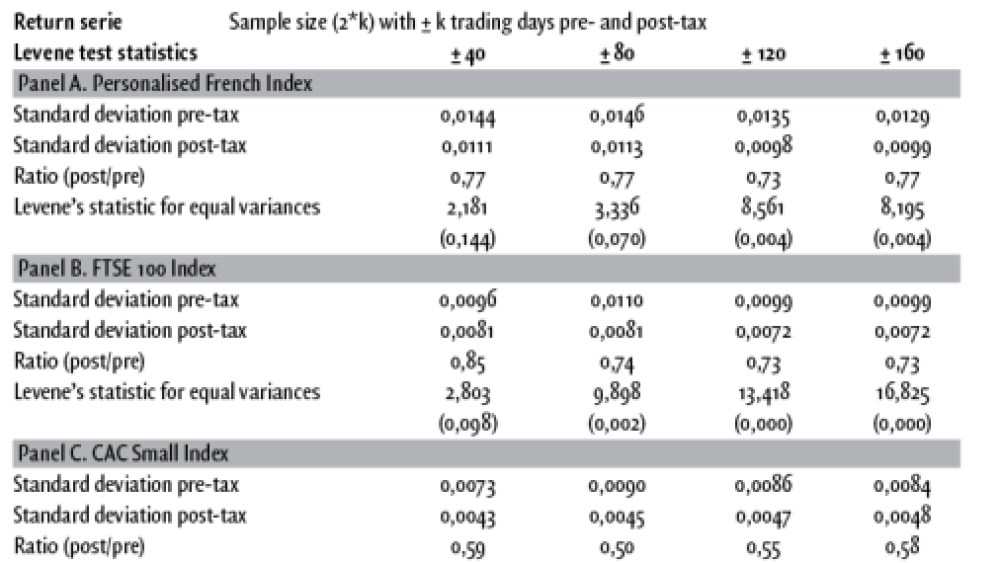
Table 1 illustrates the results of the Levene’s test for
Nevertheless, the significant decline in short- and long-term volatility also refers to the non-taxed control indices. In fact, the panel C constituents are, on average, even more meaningfully influenced by the imposition of the tax. This makes the above result for the actual taxed equities index somewhat more
Effects on liquidity
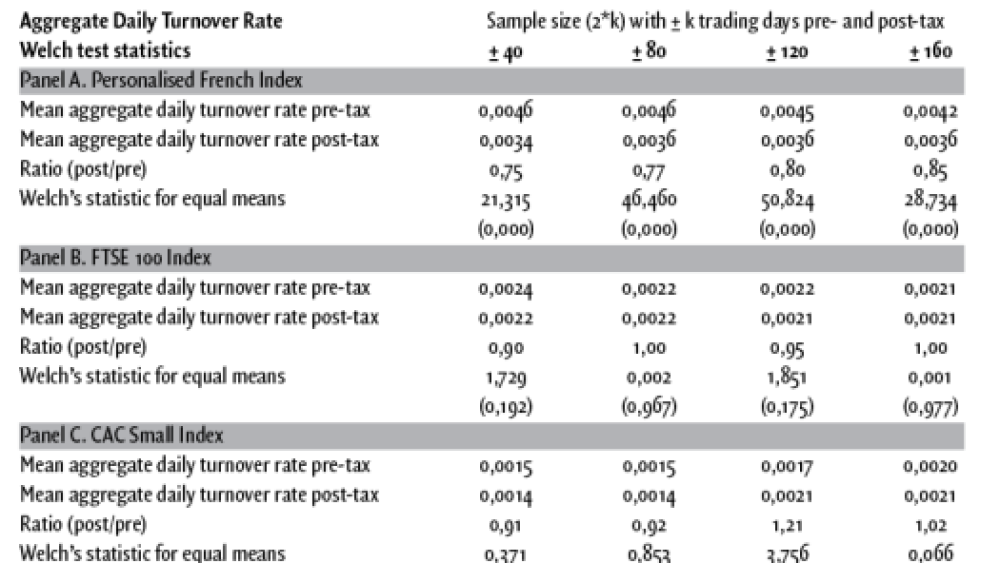
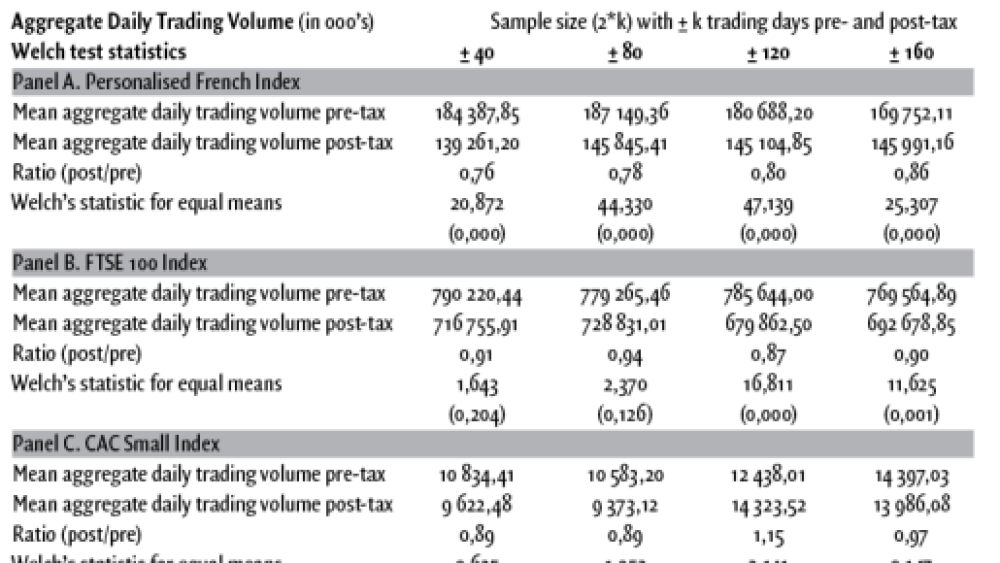
Dealing with the statistics of the aggregate daily turnover variables, we firstly notice that aggregate daily trading volume and aggregate daily bid-ask spreads are equal throughout the pre-tax and post-tax periods. Analyzing Table
The above findings are also consistent when scrutinizing results for the other liquidity variable displayed at Table 4. There are only two exceptions, in that for larger intervals (k=120, 160) trading activity also significantly decreases for the FTSE 100. The results for the third measure, the aggregate daily bid-ask spreads, partially confirm the above results. While for the studied interval of +/- 120 days of trading, liquidity has been impacted by the tax introduction, this conclusion cannot be drawn for the other intervals. Therefore, for at least two of liquidity variables, it can be concluded with very high statistical evidence that the tax has negatively influenced liquidity for panel A: the hypothesis of an equal market liquidity in both periods can thus be strongly rejected.
This finding has serious implications. Seeing that volatility decreased in the post-tax periods, which is a “success factor” for the FTT, it has to be noted that liquidity also decreased significantly, which is not as in favor of the tax because besides targeting the reduction in volatility, the French government also aims to generate tax revenues. It becomes evident that through significantly reduced trading activity the actual tax base payable is diminishing as well. Reduced market liquidity—and thereby a reduced (perhaps even suboptimally sized) tax base—is a rather undesired outcome. The empirical findings of this section are consistent with most of the literature stating that transaction taxes have negative impacts on market liquidity as quoted in previous studies. On the one hand, from the theoretical perspective, this result might imply that market participants actively seek other assets in which to invest. On the other hand, a remark regarding the optimal level of market liquidity has to be raised: the above findings suggest that market participants significantly reduced aggregate daily turnover rates and aggregate daily trading volume in the periods after 1. August 2012. This comes as a surprise, especially in view of the fact that French policymakers aimed at preventing a negative liquidity effect by excluding market-making activities from the legal tax base and by taxing only supposedly highly traded equities. The findings cannot be used to conclude whether or not post-tax levels, which differ strongly, actually depart from the optimum.
Relationship between liquidity and volatility
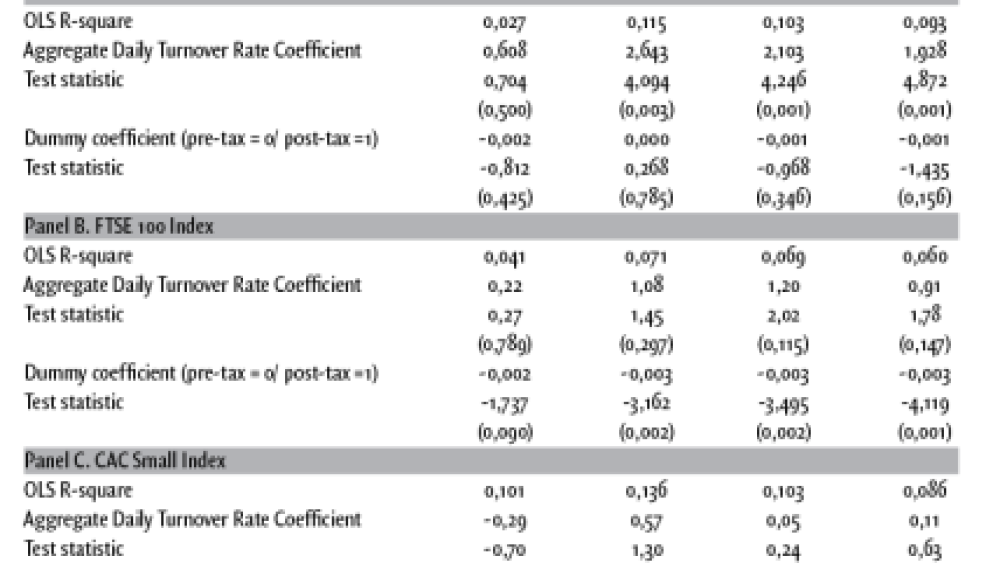
Schröder (2012) and Kupiec (1996) suggest that market liquidity should have strong impacts on market volatility. To answer the question of the link between liquidity and volatility, a linear regression model can be used. Table 5 shows the main regression outcomes of the model, especially the coefficient of market liquidity, its respective T-tests and bootstrap significance levels. In order to observe whether the influence is different in the different periods, it is necessary to check the sign and significance of the dummy variable. Regression estimations indicate that throughout most intervals (except for k = 40), the influence of aggregate daily turnover rate on return residuals is very strongly and significantly positive for the panel A. This is indicated by the almost consistently lower than 1% p-values and the positive sign of the coefficient. The large significance levels of the dummy variables indicate that throughout the periods, this strong positive relationship has not changed. For the control panels B and C, changes in the variable aggregate daily turnover rate do not explain changes in daily return residuals. However, the coefficient’s sign also indicates the fact that liquidity, generally speaking, might influence volatility in a positive manner. These findings suggest that liquidity is positively correlated with volatility and they also confirm the results above, in that higher liquidity will lead to higher volatility. The actual size of the coefficients thereby quantifies this effect. For example, in the k = 160 interval, any one-unit increase in the aggregate daily turnover rate would result in a 1.928 unit increase in the return residuals, and vice versa.
Conclusion
This paper studies the case of financial transaction taxes in the light of the recent proposal for an FTT in the EU. A large number of countries have implemented transaction taxes, albeit insignificant empirical evidence for reductions in market volatility but strong significance for its negative impact on market liquidity. Examining empirically the case of France, the tax is shown to affect market volatility in a significantly negative way. This volatility reduction, however, is accompanied by a significant decline in market liquidity and a decrease in market efficiency. The reduction in liquidity is surprising, seeing that market-making activities and thus liquidity provision activities have been intentionally excluded from the tax. The tested null hypotheses regarding no influence of the French FTT on French taxable equities can be rejected in all cases. The global research question of this paper enquires as to whether or not the tax affects stock market volatility, liquidity, and efficiency as its proponents expect. The answer is yes and no, because while speculation (in terms of reduced volatility) might decrease, diminishing market liquidity and the connected decline in the tax base pose a threat to the amount of potential tax revenue gained. As liquidity as well as efficiency “suffer” from the imposition of a tax makes any prediction of tax revenues hazardous. The results cannot be taken as a prediction of the market impact of a possible EU-wide FTT, due to essential differences in the nature of the taxes. In terms of market regulation, it remains unclear as to whether or not a mere tax is able to prevent future crises. Within the framework of several regulation policies coming into place for the financial sector, its introduction is most likely an important step towards overall increased market stability. Any significant decline or increase in volatility or liquidity must necessarily be interpreted in a negative or positive way, the real outcome clearly depending on the optimum levels of liquidity and volatility to be achieved in the markets. How are these determined? The empirical study at hand is limited in the sense that it does not distinguish between the possible effects of the different taxes imposed by the French government. Further research could attempt to find possible effects by selecting the tax base accordingly. Additionally, the results of the empirical study are dependent on the chosen sample and are certainly influenced by the statistical tests chosen herein. Alternative statistical methodologies should be used in new empirical studies, in order to make the findings potentially more robust. The conclusions drawn should be made with strong reservations. France imposed an essentially different tax regime on transactions than was proposed by the 11 member states, enhanced cooperation procedure for an EU-wide FTT was needed. If the EU FTT comes into place, the effect on derivatives should be examined, as the former particularly could have very noteworthy implications. Future studies should also take other markets into consideration (commodities), since they were probably subjects to investment and speculative movements recently. Even if such a tax were feasible, one of the most important challenges would be the determination of its optimal level to ensure a trade-off between tax revenues and market activity. A well-balanced mechanism therefore needs to be implemented.