

Initial Public Offerings are hugely mediatised financial operations in today’s business environment where the equity and ownership of a company in the form of its shares are for the first time offered to public investors, resulting in the company to be quoted on a stock exchange. Going public marks one of the most important and deliberate turning points in the life of a company: the considerably high costs and resources put towards succeeding in this financial operation mean that the motives and goals must be well established.
Firstly, an IPO provides access to public equity capital and consequently can ultimately lower the cost of financing the firm’s business operations and investments when the company decides to raise equity capital later through this channel (a primary offering where newly created shares are issued and sold to the public). An IPO of a company also delivers a trading venue for its shares, allowing its current shareholders the opportunity to exit their investments and to monetize their capital gains from having taken the equity risk by invested in the company or creating it (this is a secondary offering as the operation is non-dilutive).
Private equity (PE) is an alternative form of equity investment in companies that are not listed on a public exchange. PE is characterized by its dynamic investment model, where the financial sponsor aims to provide operational improvements in firms that they are engaged in. Financial sponsors generally invest in companies that are in late stages of development, i.e. relatively large businesses. The investment period is medium term and generally oscillates around five years. Investing in large and established businesses is associated with lower risk in comparison with investing into small companies.
IPOs have always been a fundamental exit solution for financial sponsors when they decide to sell their stakes of the companies, they have invested in. However, limited research has been performed into how these public listings from PE backed firms differ from other public listings. Most studies on underpricing have been conducted in the US, the country in which the most offerings have been placed. Having an empirical examination of the European equity capital markets is of interest to be able to see which theories stand equally in both regions.
Many of the studies conducted to analyze the origination and the sensitivity of the underpricing in IPOs has been done by evaluating either the IPO parameters (size of the deal, amount of shares, proportion of the company sold as free float…), the company parameters (revenue of the corporation, leverage of the company…) or the market parameters (industry of the company, year of the IPO, country of the IPO…). One of the parameters that is essential in understanding underpricing and often overlooked is the ownership of the company going public. Indeed, while there are many different categories of owners of shareholders, there is one that is of interest because of their way of operating and the purpose of their investment.
IPO underpricing
The most critical point as well as the main recurring debate in an IPO revolves around the pricing of the stock. Such pricing is the conclusion of a long and intricate investigation of the company, involving the contribution of a variety of company stakeholders and feedback form potential investors. Ultimately, determined by the underwriters, the proposed offer price of the securities to the public will set the amount of net proceeds that is gained by the company and/or the selling shareholders. To do so, the underwriter generally evaluates the company’s future cash flows, the current conditions of the equity markets as well as the overall condition of the sector in which the company operates. The pricing of an IPO is subject to continuous adjustments before the launch of the transaction: after the theoretical approach, the valuation range will be fine-tuned throughout the pre-marketing phase, while the final pricing results from the bookbuilding process.
The offer price will normally be set in the form of a range and at a substantial discount from the predicted aftermarket trading share price. Naturally, the seller (either the existing shareholders or the company or both) aim to attain the highest possible price for the company’s shares. However, contrarily to the issuer’s initial beliefs, an excessively high IPO price may not be in the company’s advantage. Indeed, the underwriters of the IPO might have difficulty selling the shares if the IPO price is deemed as too high by potential investors. Moreover, if the trading price of the company’s shares falls beneath the offer price, a fragile after-market could occur, consequentially adversely impacting on the company, the potential investors and the underwriter’s reputation.
It has been well researched that for these reasons IPOs are susceptible to be underpriced and that this underpricing is consistent both over time and across different regions. Whether such underpricing is an accurate compensation for investors who take on significant risk at such an early stage in the development of a company whilst providing regular and valuable feedbacks throughout the valuation process or is in fact disproportionate and mostly driven by the agency problems that occur among the issuers and the underwriters, is a central debate in the ECM and IPO literature.
The IPO discount is theoretically the difference between the IPO offer price and the fundamental, intrinsic and fully distributed value of the company. Many factors influence such “discount”, which is by no means systematic. In principle, a discount would be justified by the fact that the company is new to the market, its management often has no immediate track record of managing a publicly listed entity and is therefore offering a “sweetener” to motivate investors to look at the new investment proposition. IPO discount primarily are dependent on the uniqueness and the “must have” characteristics of the equity story, market conditions and the management roadshow impact. From a tactical standpoint and to create IPO demand momentum, bottom of the price range should offer a discount to the “true” value to raise interest.
There are several approaches to measuring the true value of the company before it becomes public and therefore assess the numeric discount to the final offer price set as the company is sold in the public market. The post IPO performance is probably the most accessible way of evaluating the IPO where the closing price on the first trading day can be taken as an initial proxy for the company’s fair value.
Two contradicting theories
The main theory supported by literature that tries to explain the differences in underpricing in PE backed IPOs and non-backed IPOs is certification hypothesis. One of the first pioneering studies was conducted by Barry et al. (1990) which provide evidence that PE firms invest in other companies to provide monitoring services, such as providing capital, help firms formulate their business plan and manage their human resources. The authors argue that PE firms exercise significant influence on PE backed companies, thereby reducing the uncertainty regarding the PE backed offerings. They suggest that capital markets appear to recognize better monitors through lower underpricing. Berry et al. (1990) show that PE backed firms experience lower first day returns (i.e. lower underpricing) than non-backed firms.
Megginson and Weiss (1991) later develop the certification hypothesis, meaning that the existence of PE can be explained as a third party certifying the true value of securities issued by firms not yet rated by the markets. They argue that outside investors are more likely to believe that information disclosed by a third party are more accurate. This means that the IPO offer price of a PE backed firm should, reflect all relevant and available information. Thus, certification reduces the information asymmetry.
Research regarding PE funding and underpricing is also discussed in relation to the grandstanding hypothesis (Gompers, 1996; Lee and Wahal, 2004). Gompers (1996) introduces grandstanding and argues that young PE firms need to establish a reputation and raise capital faster than established PE firms. Therefore, younger PE firms have enticed to grandstand, that is to signal their ability to take firms public. This means that young PE firms tend to take firms public earlier to raise capital for their next PE fund. The author suggests that grandstanding results in higher underpricing as young PE firms rush to take companies public, they tend to back younger companies. Gompers (1996) argues that the capital market appears to recognize young PE firms by including the cost of underpricing.
Hypothesis
It is generally considered that the PE sector is more established and developed in Anglo-Saxon countries (United Kingdom and Unites States), than in Continental European countries. But one should be wary to generalize Anglo-Saxon results in Continental European countries as there are numerous cross-country differences. This leads to the following hypothesis:
- Hypothesis 1: Do PE backed IPOs in Europe have lower underpricing than non-backed IPOs?
- Hypothesis 2: Is there a relation between the detention period of a company by a financial sponsor in Europe and the level of underpricing?
- Hypothesis 3: Is there a relation between the detention rate of a company by a financial sponsor in Europe and the level of underpricing?
Data collection and explanation of variables
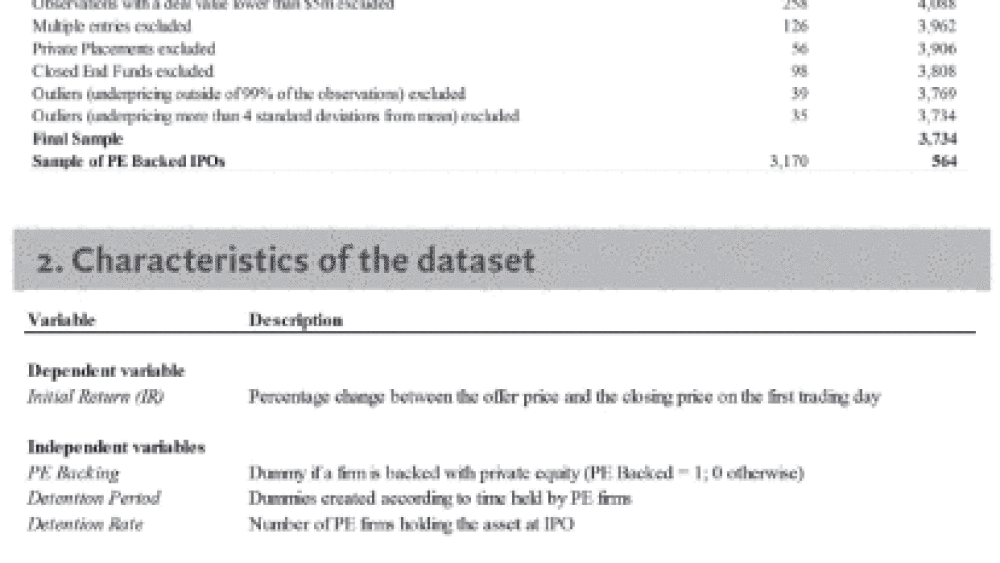
An original sample of 8,741 IPOs within EMEA was obtained. Adjustments were made as to have a dataset with the most harmonious and useable population. As such were removed, all IPOs priced before 2000, all IPOs not in Europe or the UK, all IPOs with deal value lower than $5m, multiple entries, private placements, closed-end funds, and outliers (underpricing levels outside of 99% of the observations or more than four standard deviations away from the mean). The final dataset offered 3,734 IPOs with 564 PE backed IPOs representing 15.1% of the final sample.
As the study was to understand the impact of PE ownership in pricing of IPOs, the percent amount of underpricing (also called Initial Return) was set as the dependent variable. In turn, “PE Backed” (in the form of a binary dummy variable if PE firms have a minimum holding of 5% in the IPO prospectus), “Detention Period” (in the form of a four-way dummy variable for periods of 0 to 5 years, 5 to 10 years, 10 to 15 years, and no holding) and “Detention Rate” were respectively set as the independent variables across all three-regression analysis.
Finally, the control variables can be divided into IPO characteristics and market characteristics. Offer proceeds, market capitalization and the fraction of the company sold are IPO characteristics which will be studied. The market characteristics analysed shall be the industry type, the year in which the IPO priced, and the deal country characterized by the listing exchange.
Regression analysis
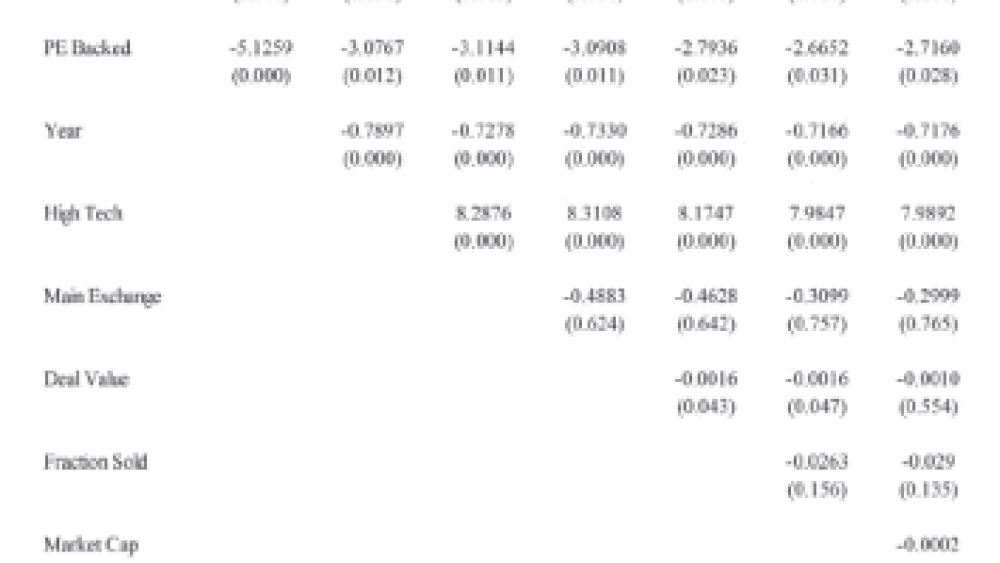
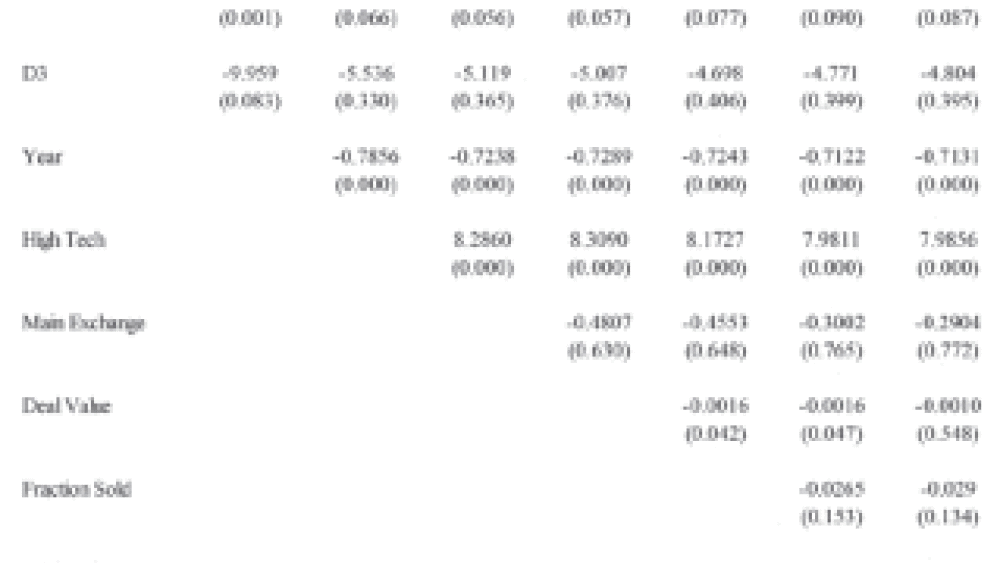
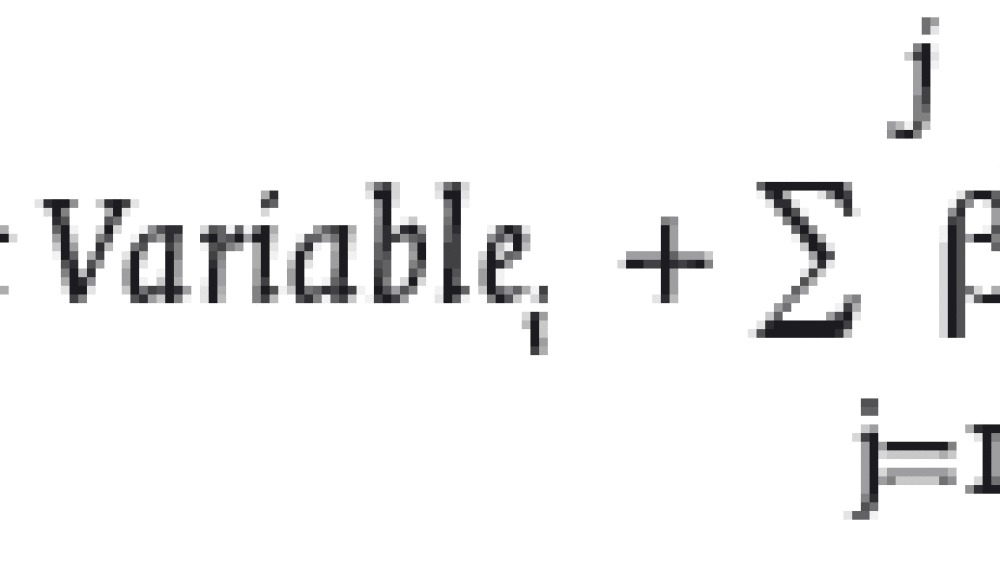
A first regression analysis was performed on the dependent variable underpricing and the independent dummy variable PE Backing. The control variables were then successively added to the initial regression analysis to establish a potential improvement in the adjusted fit of the model. Two following regressions analysis, where the independent variable was be changed, were performed according to the process above. The independent variable PE Backing was replaced by the independent variables Detention Period and Detention Rate respectively.
Results, conclusion and recommendations
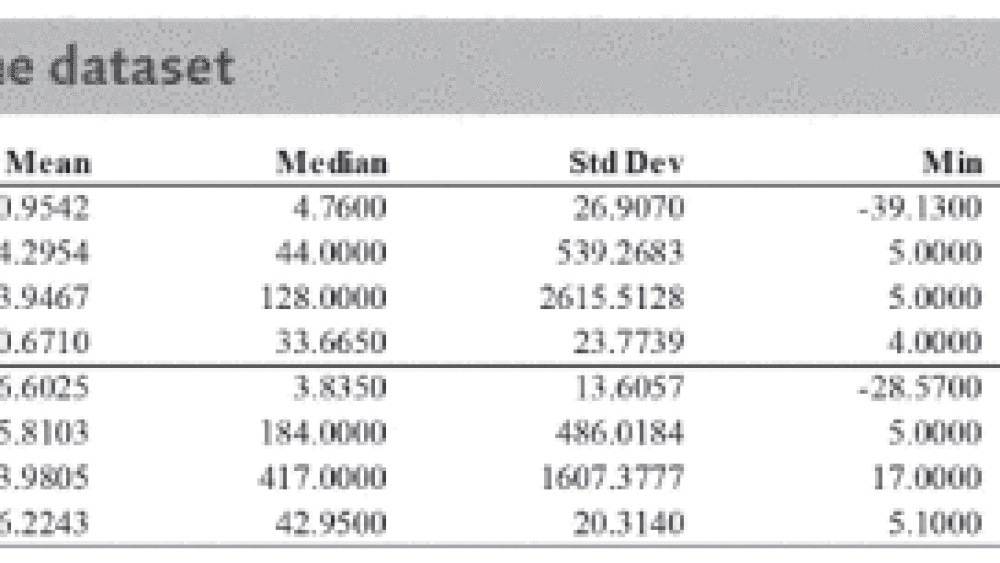
This research aimed to establish new insight into the underpricing puzzle associated with financial sponsor related IPOs. The idea was to get a better understanding of the influence of several PE characteristics on the level of underpricing. The main research question of this research is: How does PE ownership explain variation in underpricing in Europe? In a sample of 3,734 European IPOs between January 2010 and June 2018, an average initial return of 10.95% was found. This result supports the previous research that IPOs are, on average, underpriced. In the sample, the research shows that the average underpricing for financial sponsor related IPOs is also considerably smaller at 6.60% than the general underpricing in Europe.
The first OLS regression analysis made in this research reports significant relation between PE Backing and Initial Return. Initial Return decreases, when a firm going public is PE backed. This conclusion holds when the other variables are held constant. Thus, hypothesis H1 is accepted since evidences demonstrate that PE-backed IPOs experience lower underpricing than non-backed IPOs. Therefore, this analysis supports the certification hypothesis (in line with Megginson and Weiss, 1991). This means that PE funding serves as a form of certification for potential investors who are inclined to interpret it as a confirmation of a stocks’ intrinsic value. If a PE firm has an ownership in the issuing firm, the offer price should reflect the quality of the firm and of the information disclosed to the market. This is an indication that PE firms reduce information asymmetry. Furthermore, a positive and very significant relationship has been demonstrated between the underpricing of an IPO and whether the company operates in a High-Tech sector or not. Finally, negative significant association is proven between the level of underpricing and the year in which the company is listed. Consequently, it can be viewed that the amount of underpricing in an IPO decreases if the company is not in the technological sector and the closer it happens to the present day. To summarize however there is no statistical evidence that the exchange on which the deal occurs, the firm size, fraction sold, and IPO size are related to initial return.
In the second regression analysis the aim was to investigate whether the holding period of a company by a financial sponsor before the listing affected the underpricing of the IPO. Since the Detention Period dummy does not show a significant relation to initial return, there is not enough evidence to support hypothesis H2. Here there is enough indication to suggest a significant relation between the sector of the company and the year in which it goes public. Yet again, there is no statistical evidence that the exchange on which the deal occurs, the firm size, fraction sold and IPO size are related to initial return.
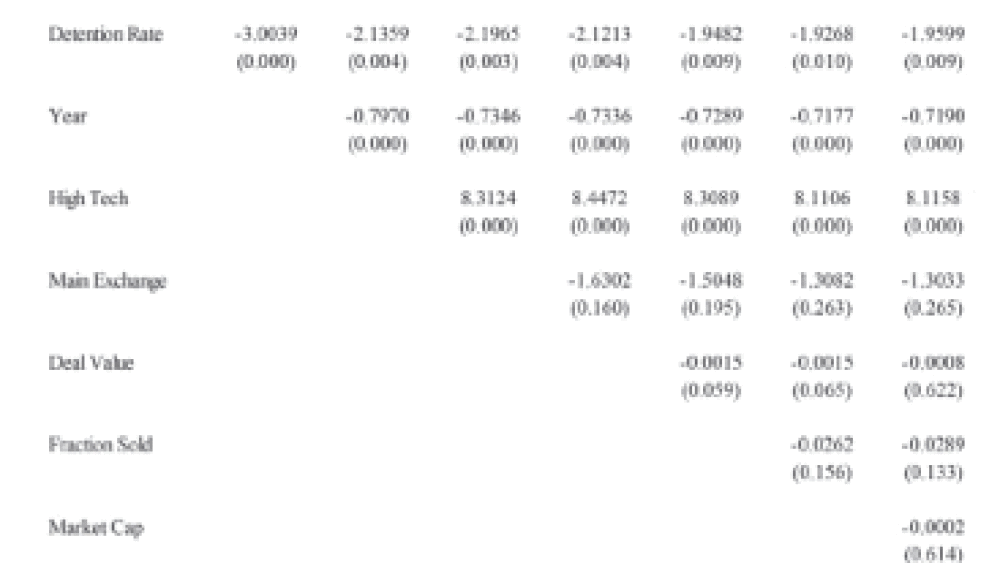
The third and final regression analysis seeks to examine whether the holding rate of a company by one or several financial sponsors at the time of listing has any effect on the level of underpricing of the IPO. Indeed, the OLS regression analysis reports significant relation between Detention Rate and Initial Returns. It is observed that underpricing decreases as the number of financial sponsors holding the asset increases. This conclusion holds when the other variables are held constant. Therefore, hypothesis H3 is accepted. This finding in some ways also supports certification hypothesis as the number of PE firms backing the company serves as a certification for investors and reveals the stocks’ intrinsic value. There a numerous third parties certifying the true value of securities issued. Similarly, to the two previous regression analysis, the relation between underpricing and both the deal year and the sector is found here again. No statistical evidence that the exchange on which the deal occurs, the Firm Size, Fraction Sold and IPO Size are related to initial return has been found as well.
These results contribute to the European research on PE-backing and its effect on underpricing. Comparing these results to previous European research, it is believed that the PE backed firms have notable recognition in the Equity Capital Market activity. This indicates that mature and developed capital markets appear to certify the value of PE backed firms through lower underpricing.