
In 2018, the Trump administration announced tariffs on approximately $283 billion of U.S imports, and these tariffs rate between 10% and 50%. As one of the U.S. trading partners, China retaliated with tariffs averaging 16% on approximately $121 billion of U.S. exports. In this context of the US-China trade war since 1st March 2018, we aim to investigate if Chinese cross-border Mergers and Acquisitions create positive value for Chinese publicly listed acquirors in the US and in Europe (France, UK and Germany) before and during the trade war. For this investigation, an event study analysis was conducted on 127 acquisitions in the US and in Europe (France, UK and Germany) by Chinese publicly listed companies from 1st January 2017 to 31st August 2019.
Overview of Chinese cross-border Mergers & Acquisitions
Among the sample of 127 cross-border M&A transactions, 68 deals occurred before the US-China trade war (between 1st January 2017 and 28th February 2018), and 59 during the trade war (between 1st March 2018 and 31st August 2019). Before the trade war, 38 deals were invested by Chinese public listed companies in the US, and 30 in Europe (precisely in France, the UK and Germany). During the trade war, 28 deals were invested by Chinese public listed acquirors in the US, and 31 in Europe (in the same 3 countries). Every deal was associated to a distinct acquiror to avoid double counting.
The acquirors in our 4 selected sub-samples are listed in 3 stock markets: China mainland, HK and the US. Among the 38 Chinese acquirors investing in the US before the trade war, 25 are listed in the stock market of China mainland, 8 listed in the stock market of HK, and 5 listed in the US. Among the 28 Chinese acquirors investing in the US during the trade war, 16 are listed in the stock market of China mainland, 3 listed in HK, and 9 in the US.
Targeted sectors
Before the trade war, the top three sectors in the US attracting the most Chinese investors were High Technology, Consumer products and services, as well as Healthcare with a total number of 22 M&A deals. During the trade war, the top three sectors in the US attracting the Chinese acquirors are Healthcare, High Technology, and Industrials with 17 deals. Before the trade war, the top three sectors in Europe attracting the Chinese investors were Industrials, Materials, and Healthcare with 20 deals. During the trade, the top three sectors in Europe attracting Chinese acquirors are Industrials, Materials, and High Technology with 20 deals.
By observing the above results, we find that before and during the trade war: in the US, High Technology and Healthcare have always been the most attractive sectors for Chinese investors; Whereas in Europe, Industrials and Materials have always been the top sectors attracting the Chinese acquirors.
Without considering the trade war’s impact, the sectors Healthcare, High Technology and Industrials attract Chinese acquirors to invest in both the US and Europe.
Confirmed by the PWC report, Chinese government supports the acquisitions of technologies and brands. This support facilitates and encourages Chinese investors’ acquisitions in High technology and Industrials sectors in foreign markets.
Based on the World Health Organization’s report on China’s ageing and health assessment, the healthcare expenditures in China are growing rapidly with aging population and health issues. This conclusion motivates Chinese investors to invest in healthcare sector.
Cumulative Abnormal Return
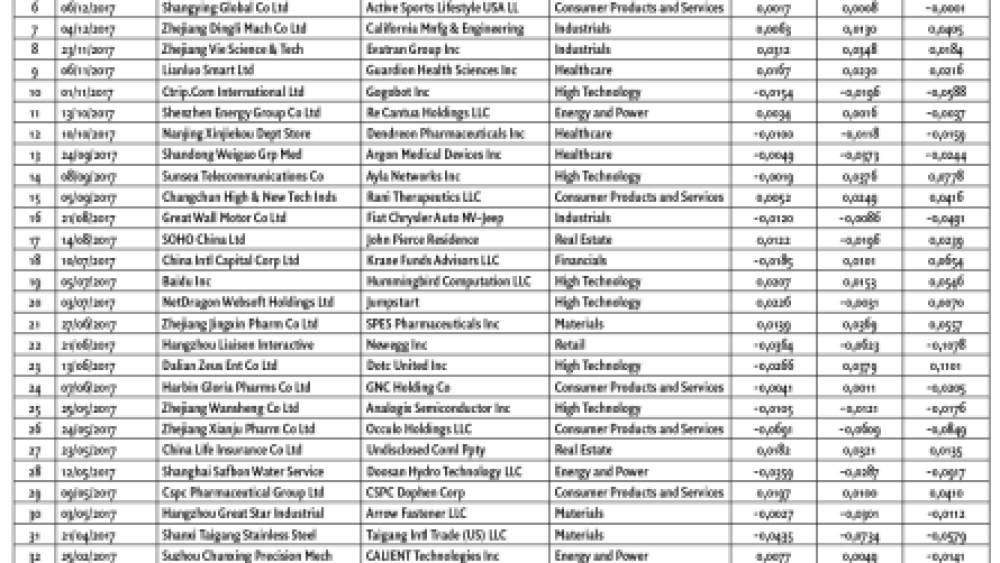
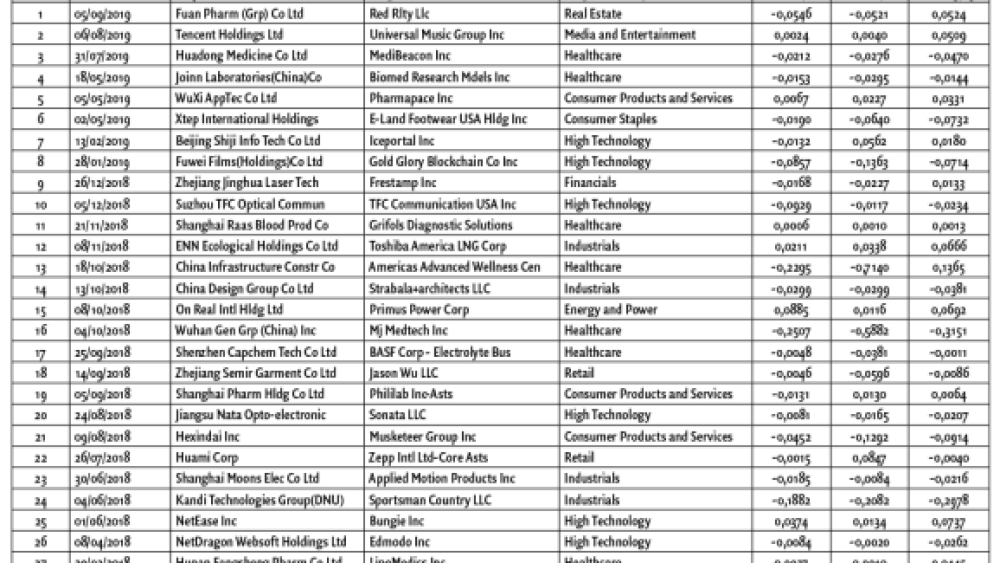
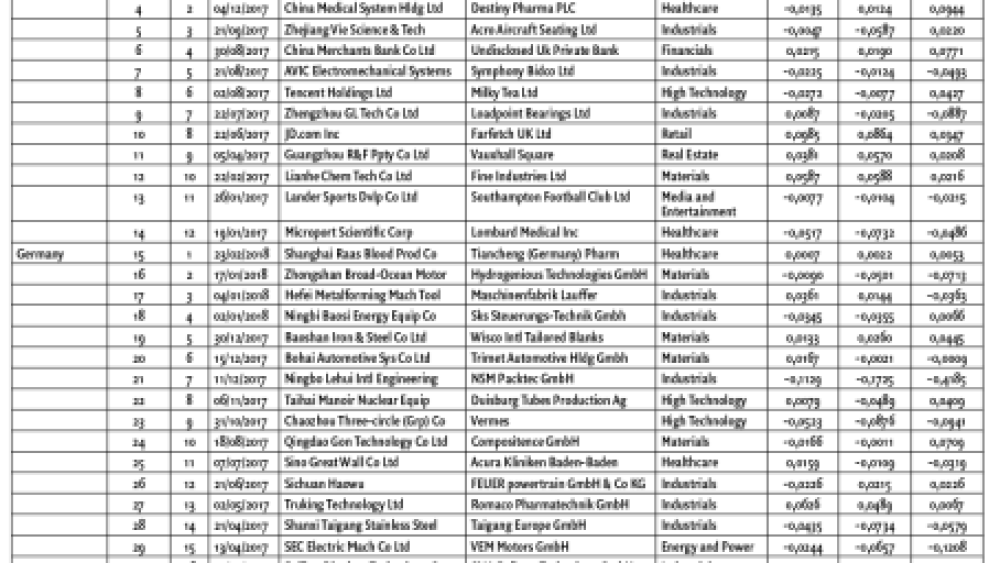
Based on Cumulative Abnormal Returns (CAR) analysis of 3 types of event windows: 1 trading day [CAR (-1, +1)], 2 trading days [CAR (-2, +2)], 5 trading days [CAR (-5, +5)], we present the detailed results in the tables as below. These results answer to 5 questions:
1. Do Chinese cross-border acquisitions in the US create value for the acquirors before the start of the trade war?
Based on the 38 deals of Chinese acquirors who invested in the US before the trade war, we observe that the means of CAR (-1, +1), CAR (-2, +2) and CAR (-5, +5) are all positive.
2. Do Chinese cross-border acquisitions in the US create value for the acquirors after the start of the trade war?
Based on the 28 deals of Chinese acquirors who invested in the US during the trade war, we observe that the means of CAR (-1, +1), CAR (-2, +2) and CAR (-5, +5) are all negative.
3. Do Chinese cross-border acquisitions in Europe (taking UK, France and Germany as examples in this thesis) create value before the start of the trade war?
Based on the 30 deals of Chinese acquirors who invested in Europe before the trade war, we observed that the means of CAR (-1, +1), CAR (-2, +2) and CAR (-5, +5) are all negative.
4. Do Chinese cross-border acquisitions in Europe create value after the start of the trade war?
Based on the 31 deals of Chinese acquirors who invested in Europe during the trade war, we observed that the means of CAR (-1, +1), CAR (-2, +2) and CAR (-5, +5) are all positive.
5. If the trade war causes a change in the value creation for the Chinese acquirers in both the US and Europe, is there any difference between the change in the US and the change in Europe?
According to the answers to the 4 first questions, our conclusion is that the value creation situation changes after the start of the US-China trade war in both US and Europe. Since the start of the trade war, the mean of CAR of acquirors investing in the US changes from positive to negative. Since the trade war, the mean of CAR of acquirors investing in Europe changes from negative to positive. These results show that the US-China trade has a negative impact for the value creation of Chinese acquirors in the US, but a positive impact for the value creation of Chinese acquirors in Europe.
Our significance tests show that for Chinese investors in the US, the cross-border acquisitions create significant positive value before the trade war, but mainly significant negative value during the trade war. For Chinese companies acquiring targets in Europe, T-test can confirm the significant positive value created by the cross-border acquisitions during the trade war but can’t confirm the significant negative value creation related to the cross-border acquisitions before the trade war.
Cumulative Abnormal Return by sector
By calculating the CAR means by sector for acquirors investing in the US, we observe that:
– before and during the trade war, Consumer Products and Services always have negative CAR means;
– during the trade war, the CAR mean of Industrials change from positive to negative;
– during the trade war, the CAR means of Media & Entertainment and of Energy & Power change from negative to positive.
By calculating the CAR means by sector for acquirors investing in Europe, we observe that:
– before and during the trade war, Consumer Staples and Materials always show positive CAR means;
– before and during the trade war, High Technology always has negative CAR means;
– during the trade war, Financials changes from positive CAR mean to negative CAR mean;
– during the trade war, Energy and Power and Industrials change from negative CAR means to positive CAR means.
If we compare between the acquirors investing in the US and the acquirors investing in Europe, the only common point is that the Energy and Power sector enjoys a positive change on CAR means since the start of the trade war.
Cumulative Abnormal Return by stock market
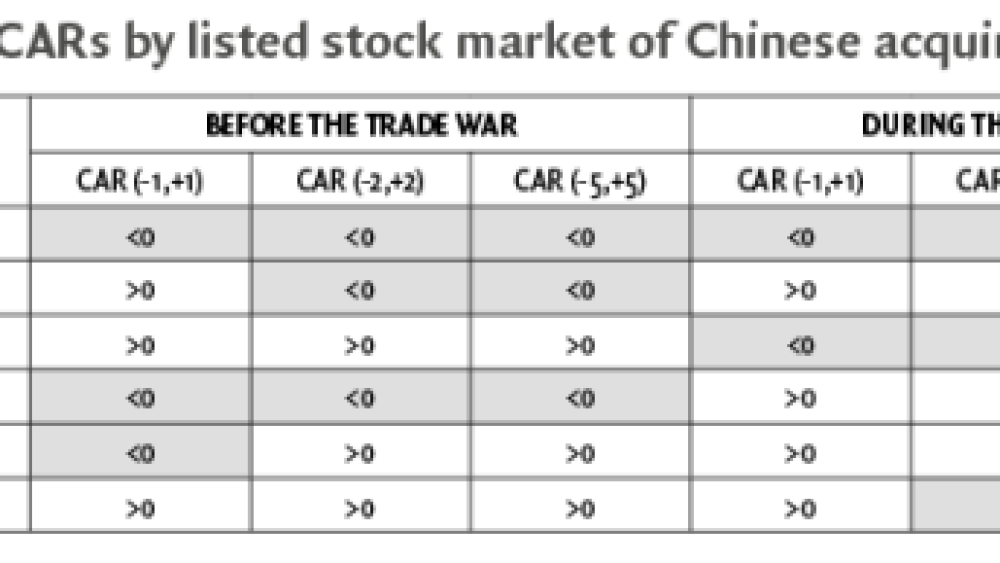
According to this summery table (5), we find that:
– Before the trade war, Chinese acquirors listed in China mainland have all negative CAR means, but during the trade war, those investing in the US show 2 negative CAR means and 1 positive CAR mean; those investing in the Europe show all positive CAR means;
– Before the trade war, Chinese acquirors listed in HK could show either positive or negative CAR means, but during the trade war, all of them show positive CAR means;
– Before the trade war, for acquirors listed in the US, both acquirors investing in the US and in Europe show positive CAR means, but during the trade war, those investing in the US all show negative CAR means.
To conclude, the trade war impacts mostly the Chinese acquirors listed in the US and at the same time investing in the US, and the Chinese acquirors listed in China mainland and at the same time investing in Europe. The first type of acquirors changes from positive CAR means to negative CAR means. The latter changes from negative CAR means to positive CAR means.
Operating performance analysis
A focus was given on 6 representative Chinese acquirors in our sample for the operating performance analysis:
– Shanghai Daimay Automotive and Renren are the 2 companies which contributed the highest CARs among acquirors investing in the US before the trade war;
– China Infrastructure Construction contributing the lowest CARs among acquirors investing in the US during the trade war;
– Ningbo Lehui International Engineering contributing the lowest CARs among acquirors investing in Europe before the trade war;
– Zhejiang Tieliu Cluth contributing the highest CARs among acquirors investing in Europe during the trade war.
Analysis was realized on these 6 companies on various ratios: Gross margin, Operating margin, Net margin, Return on Assets, Return on Equity, Return on Total Capital, Return on Invested Capital, Cash Flow Return on Invested Capital. We can’t conclude an obvious impact of the trade war on their operating performance. But all these Chinese acquirors show a lower Return on Total Capital ratio in the end of the year of the M&A announcement compared to the year before.
Conclusion
Partially confirmed by significance T-tests, empirical evidence demonstrates that before the US-China trade war, acquisitions from Chinese listed companies in the US created positive value for Chinese acquirors but created negative value for Chinese acquirors during the trade war. It is the opposite situation for the Chinese cross-border acquisitions in Europe. Before the trade war, acquisitions in Europe created negative value for Chinese acquirors; but during the trade war, they create positive value for Chinese acquirors. Energy and Power sector enjoys a positive change on value creation for Chinese acquirors since the start of the trade war in both the US and Europe.