
Economic theory defines different types of market efficiency:
- Strong: all the public and private information is taken into account in the market price;
- Half-strong: only the public information affects assets’ prices;
- Weak: only the past information is priced by the market.
Unequal access to information creates inequalities among distressed investors
One of the most common accepted hypotheses about economics is that in a fair market all participants should have the same information. Unless having insider information it’s impossible to outperform the market just on the basis of news publications. In theory, as soon as the new is available, it’s immediately incorporated in the security’s price by market makers.
Usually this idea is broadly accepted in the equity market. Everyone has already seen one airline stock price changed after the public announce of a crash or the surge for a biotech share price after a positive medical test. These market reactions (in agreement with the economic theory) are possible because there is only one kind of stock that is traded on the market. Indeed, It can be acceptable to assume that all available information is reachable with low costs and efforts and therefore is represented in the security price. The transparency of the equity market is usually accepted. That is why most of the systemic strategies (algo-trading…) are used only in this area. However, when it comes to the debt market, the situation is not similar. A single company may have dozens of different bonds. When American airlines has one stock, it has more than 5 different bonds. Each one has a different coupon, maturity and subordination... Thus, when new information is released, it’s much more complicated to reach quickly a fair price for each one.
Moreover, there are hundreds of small-mid cap HY issuers that have no in-depth analyst coverage. Finally, according to Stephen. G Moyer: “ most distressed debt trade occurred in the over-the-counter markets where prices are not disclosed to the public. In the US, the SEC demands to file period reports for equity issuers. It not rare to see HY issuers who don’t have any equity so they are exempted from the reporting requirement of the exchange act. In those cases the only possible available info is available to the current debt holders.”
To finish, when a distressed situation occurs, investors shouldn’t underestimate how hard it can be to have access to financial statements. This is true especially when it comes to having a quick access. It can require significant efforts to locate the necessary info. This preoccupation is absolutely different when it comes to a blue chip company like Apple or General Motors. In one click, anyone can have access to their whole financial statements.
Moreover, in a lot of distressed situations there will be two different levels of information access: restricted non-public info and publicly available info that is accessible to banks involved in negotiation with the issuer. Even if investors are supposed to have signed no DNA, it would be naïve to believe that the border is fully hermetic.
All in all, in a distressed situation the common assumption that investors have an easy, equal access to all available information is not true. There will always be some asymmetries between investors. And even when the information is available, having an access to it is not easy.
These inequalities of information can lead to irrational behaviors
Another key assumption of the efficient market hypothesis is to take for granted that investors are rational. To begin with the behaviorist finance school has called into question that hypothesis. Besides, there are some reasons proper to the distressed market to doubt about investor full rationality.
First, “free will” which is essential for a rational investor is not always guaranteed. In theory an investor should be able to buy and sell securities to maximize portfolio returns. He shouldn’t be forced to sell an asset if he doesn’t want to. Yet, there are various sources of “coerced sales”.
Banks sales are not always driven by profit maximization. Large banks have to comply with target ratios/benchmarks important for the management or regulators like the non performing asset ratio for instance (defaulted assets / total earning asset ). To decrease this ratio banks can be forced to sell loans (likely at a discount). Such sales are not driven by a “rational” view of the value of the loan. But much more by a necessity to reach a limit value for a key ratio.
Another reason can come from a desire to generate earnings to reach some predefined targets. Let take an example with a Bank X which holds very distressed bond Y, but it has been written down to zero because of its very low rating (metric: shared national credit). Now, let’s suppose that management wants to increase the bank earnings and let’s assume that the bond Y is selling at 30 in the market (compared to a 100 original value). Even if the management believes bond Y is worth 50, they know that by selling now they can recognize profits (it’s indeed carried at 0). Thus, the management could reach his target earnings. In this case too, the bond selling at a value lower than it’s objective “fair” / “rationale” price happens because of considerations other than portfolio return maximization.
The last source of “irrational selling” comes from another actor: high yield mutual fund. Indeed, for some liquidity management needs they can be forced to proceed to sales. The usual structure for HY mutual funds is “open ended”, it means that investors don’t have restrictions to redeem their interests on a daily basis. So, when there is a change of sentiment against HY market and investors decide to withdraw their funds, the fund manager must have cash on hand to honor such redemptions, which may require selling securities. Thus, during hard times for the HY/distressed market, funds with high percentage of withdrawals lead to liquidations of holdings at the worst period of the market.
At the end of the day, sales decisions in the distressed market can occur for other reasons than economics necessities. This investment irrationality undermines the applicability of the efficient market hypothesis to the distressed sector.
The nature itself of the distressed market makes this market “expensive” for its participants
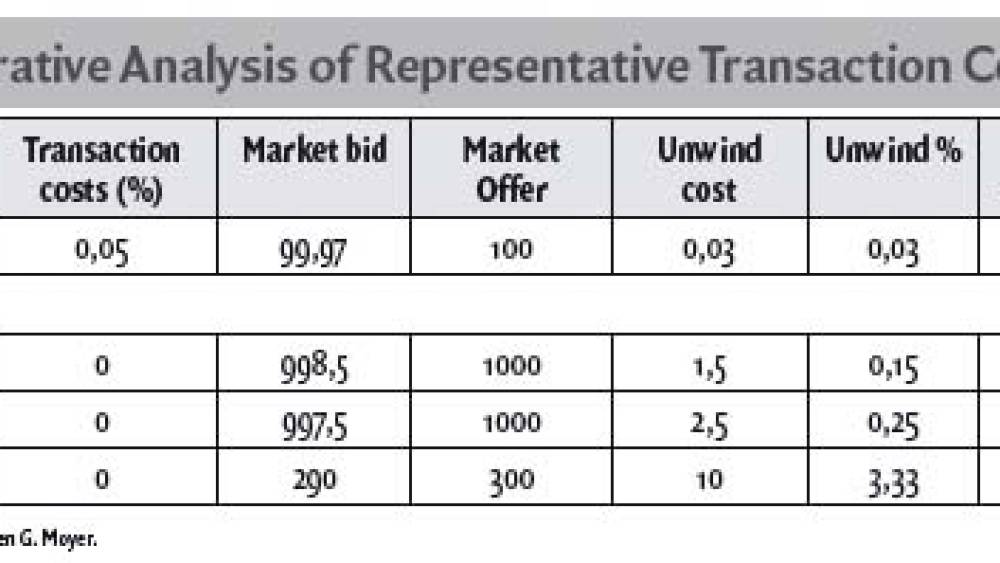
The distressed market is by definition not liquid. This mean that get in/out of a position can be difficult for investors. Contrary to a theoretical market where there are no transaction costs (or very low so negligible) distressed investors have to face huge costs. There are two main sources of transaction costs faced by an investor. The first one is relatively low and is the settlement fee, which corresponds to the direct transaction cost (commission to the broker). The other one, is the “unwind cost” which corresponds to the crossing of the bid-ask spread by investors. So, logically the minimum market movement needed to break-even is an amount greater than the two transaction fees (buy/sell) and the unwind fees.
To conclude, the vital assumptions necessary for efficient markets to exist do not appear to be present in the distressed securities market. To begin with, not all information in the market is easily and freely available to all market participants. Second, investors can be required to sell assets with knowledge that they are receiving potentially suboptimal pricing because of the existence of other non-investment criteria. Finally, transaction costs can be much higher for distressed securities, making it impossible for the market to fluidly grind to the “true price”. Nevertheless, these elements are not the only ones to make the case for an “imperfect” distressed market. The trading perspective adds some arguments too.
A market maker has to deal with the positions that no one wants
In theory, market participants would like to have in their portfolios only great companies with bright future and very low current prices. Unfortunately, this dreamed situation rarely exists. Especially for market makers who are not free to organize their portfolio as they want. According to David J. Breazzano, the ideal candidate is “a good company with a bad balance sheet“. Indeed, it’s the dream for all distressed debt investors to have such a company because the reorganization process through the distressed situation would solve the leverage problem. Thus, it would give an easy return for the investor without taking too much risk. However, this situation is rarely the case, and very often bad balance sheet leads to operation problems. To try to save the company and meet the next debt payment, the management is often keen to cut capex or other essential elements for the growth of the company. All the work of a good distressed investor is to identify these good candidates among the distressed companies.
However, because market makers cannot be sure that they hold only good assets they have to balance / hedge their book.
A Pm/market maker should always monitor the overall portfolio and balance both looser and winners regularly. Indeed, he should try to have a large industry exposure to avoid being affected by unexpected events in a particular sector (like the drop of oil price). Nevertheless, the risk of being focused on one industry is higher with distressed investing than in others strategies. Indeed, it’ not unlikely that a distressed opportunity exists in one sector in particular (example: the energy one) and leads to an overweighting in the portfolio. This focus can lead to big losses in case of unexpected events. Moreover, even for a passive investor, it’s important to stay current with new regulations and trends in the market. The legal aspect in distressed investing is essential. Balancing a portfolio is the most elementary hedge that can be done, but each market maker will have a real hedging of his book. Let’s put an important remark here: rebalancing is much easier for buy side than for sell side. Market makers are the counterparts of each transaction so they basically end with the positions that market participants don’t want. That is why, when the market leaves a sector, market makers are the people that take the other side of the trade and bear the risk. So, rebalancing can be a little bit challenging for them.
At the end of the day, all the imperfections of the distressed market combined with the nature itself of the market making function are enough to say that the distressed market is not a perfect market in the sense of the economic theory. Therefore in the distressed world more than in any other markets, market makers have to be careful and precautious in their pricing and risk taking. Knowing that the prices they see are not the “fair value” of the assets is already a start…Now, one can wonder how these market imperfection can be corrected?
Bibliography
Stephen G. Moyer, CFA (2005), Distressed Debt Analysis: Strategies for Speculative Investors.
William F. Maxwell and Mark R. Shenkman (Eds) (2010), Leverage Financial Markets.
Ben Branch and Hugh Ray (2007), Bankruptcy Investing - How to Profit From Distressed Companies.
Stephen J. Antczak, Douglas J. Lucas and Frank J. Fabozzi (2009), Leveraged Finance: Concepts, Methods, and Trading of High-Yield Bonds, Loans, and Derivatives, The Frank J. Fabozzi Series.
Edward I. Atman and Edith Hotchkiss (2006), Corporate Financial Distress and Bankruptcy: Predict and Avoid Bankruptcy, Analyze and Invest in Distressed Debt, Wiley Finance.
Gregory Zuckerman (2010), The Greatest Trade Ever – The Behind-the-Scenes Story of How John Paulson Defied Wall Street and Made Financial History.